
The 12th Schedule of Indian Constitution discusses the powers, authority, and responsibilities of Municipalities. It was added through the 74th Constitutional Amendment Act of 1992, which marked a major step toward decentralising governance in urban areas. The amendment aimed to strengthen Urban Local Bodies (ULBs) by empowering them with the 3Fs, Functions, Funds, and Functionaries.
Schedule of Indian Constitution
The Constitution of India was adopted on January 26, 1950 which consists of 8 Schedules initially which expanded to 12 Schedule of Indian Constitution through amendment.
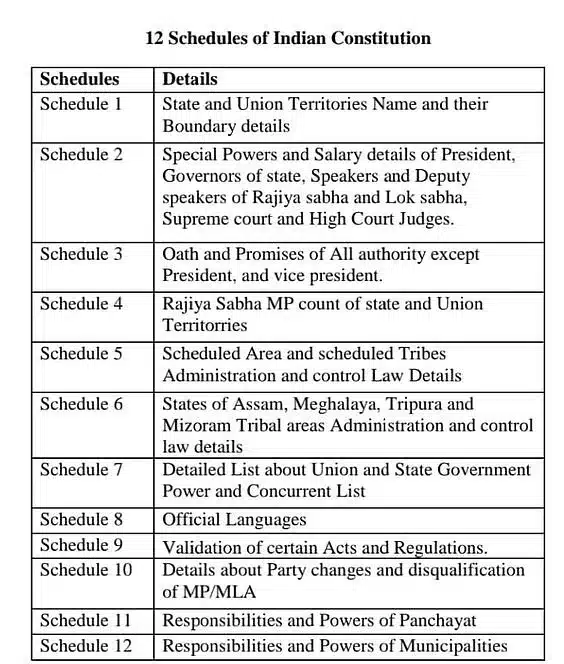
12th Schedule of the Indian Constitution Provisions
Article 243W of the Indian Constitution empowers municipalities to function as effective institutions of self-government. It allows the State Legislature to assign powers, authority, and responsibilities to municipalities through legislation. These powers include:
- Preparing plans for economic development and social justice
- Implementing schemes related to subjects entrusted to them, such as those listed in the 12th Schedule
This provision is the constitutional foundation for decentralised urban governance in India.
Types of Municipal Bodies under Article 243W:
- Nagar Panchayat - for transitional areas (moving from rural to urban)
- Municipal Council - for smaller urban areas
- Municipal Corporation - for larger urban areas
12th Schedule of Indian Constitution Subjects
The 12th Schedule of the Indian Constitution includes 18 functional items under the domain of municipalities:
- Urban planning including town planning;
- Regulation of land use and construction of buildings;
- Planning for economic and social development;
- Roads and bridges;
- Water supply for domestic, industrial, and commercial purposes;
- Public health, sanitation, conservancy, and solid waste management;
- Fire services;
- Urban forestry, protection of the environment, and promotion of ecological aspects;
- Safeguarding the interests of weaker sections of society, including the handicapped and mentally retarded;
- Slum improvement and up-gradation;
- Urban poverty alleviation;
- Provision of urban amenities and facilities such as parks, gardens, and playgrounds;
- Promotion of cultural, educational, and aesthetic aspects;
- Burials and burial grounds, cremations and cremation grounds, and electric crematoriums;
- Cattle ponds, prevention of cruelty to animals;
- Vital statistics including registration of births and deaths;
- Public amenities including street lighting, parking lots, bus stops, and public conveniences; and
- Regulation of slaughterhouses and tanneries.
| Also Check | |
| 2nd Schedule of Indian Constitution | 3rd Schedule of Indian Constitution |
| 4th Schedule of Indian Constitution | 10th Schedule of Indian Constitution |
| 11th Schedule of Indian Constitution | |
12th Schedule of Indian Constitution FAQs
Q1: What is the 12th Schedule of the Indian Constitution?
Ans: It lists the functions of municipalities under Article 243W, added by the 74th Constitutional Amendment Act of 1992.
Q2: How many subjects are included in the 12th Schedule?
Ans: The 12th Schedule contains 18 functional items that municipalities are responsible for managing.
Q3: Which amendment introduced the 12th Schedule?
Ans: The 74th Constitutional Amendment Act, 1992 introduced the 12th Schedule to strengthen urban local governance.
Q4: What is the main purpose of the 12th Schedule?
Ans: It defines the scope of work for municipalities, ensuring effective urban planning and administration.
Q5: Which article relates to the 12th Schedule?
Ans: Article 243W relates to the 12th Schedule, empowering municipalities to perform functions listed in it.
