UPSC Daily Quiz 4 August 2025

UPSC Daily Quiz

The Daily UPSC Quiz by Vajiram & Ravi is a thoughtfully curated initiative designed to support UPSC aspirants in strengthening their current affairs knowledge and core conceptual understanding. Aligned with the UPSC Syllabus 2025, this daily quiz serves as a revision resource, helping candidates assess their preparation, revise key topics, and stay updated with relevant issues. Whether you are preparing for Prelims or sharpening your revision for Mains, consistent practice with these Daily UPSC Quiz can significantly enhance accuracy, speed, and confidence in solving exam-level questions.

[WpProQuiz 35]  


UPSC Daily Quiz FAQs

Q1: What is the Daily UPSC Quiz?

Ans: The Daily UPSC Quiz is a set of practice questions based on current affairs, static subjects, and PYQs that help aspirants enhance retention and test conceptual clarity regularly.

Q2: How is the Daily Quiz useful for UPSC preparation?

Ans: Daily quizzes support learning, help in revision, improve time management, and boost accuracy for both UPSC Prelims and Mains through consistent practice.

Q3: Are the quiz questions based on the UPSC syllabus?

Ans: Yes, all questions are aligned with the UPSC Syllabus 2025, covering key areas like Polity, Economy, Environment, History, Geography, and Current Affairs.

Q4: Are solutions and explanations provided with the quiz?

Ans: Yes, each quiz includes detailed explanations and source references to enhance conceptual understanding and enable self-assessment.

Q5: Is the Daily UPSC Quiz suitable for both Prelims and Mains?

Ans: Primarily focused on Prelims (MCQ format), but it also indirectly helps in Mains by strengthening subject knowledge and factual clarity.

Article 4 of Indian Constitution, Interpretation, Significance

Article 4 of Indian Constitution

Article 4 of the Constitution of India empowers Parliament to enact laws for the formation of new states or alteration of existing ones. Historic developments like the linguistic reorganization of states in the 1950s or the creation of Telangana in 2014 were carried out using the framework laid down under Article 4. It ensures that such changes are not only legally valid but also uphold democratic processes, thereby reinforcing India’s flexible yet stable federal structure. In this article, we are going to cover Article 4 of the Constitution of India, its interpretation and its significance. 

Article 4 of Indian Constitution History

On November 18, 1948, Article 4 was discussed for the first time in the Assembly. The article states that the laws passed by the Parliament under Article 2 and Article 3 will not be counted as constitutional amendments. These two articles can be implemented by just a majority vote instead of opting for a special procedure. Shibban Lal Saksena, a member of the Indian National Congress from the United Provinces, voiced serious concerns during the Constituent Assembly debates about the implications of altering state boundaries. He emphasized that such decisions carried substantial national importance and should not be left to the discretion of a simple majority in Parliament. Saksena cautioned against the instability that could arise if successive governments frequently altered state boundaries. While other members, including Pattabhi Sitaramayya from Madras, shared similar reservations, no formal amendments were introduced. As a result, Article 4 was adopted into the Constitution in its original form, without any changes.

Article 4 of Indian Constitution Interpretation

The constitution of India states the following about Article 4: 

  • "Any law referred to in article 2 or article 3 shall contain such provisions for the amendment of the First Schedule and the Fourth Schedule as may be necessary to give effect to the provisions of the law and may also contain such supplemental, incidental and consequential provisions (including provisions as to representation in Parliament and in the Legislature or Legislatures of the State or States affected by such law) as Parliament may deem necessary."
  • No such law as aforesaid shall be deemed to be an amendment of this Constitution for the purposes of article 368. 

Article 4 of the Indian Constitution can be interpreted in the following manner: 

The phrase “Any law referred to in Article 2 or Article 3” signifies that Article 4 of the Indian Constitution governs laws related to the admission of new states (Article 2) and the creation or alteration of states (Article 3).

  • The clause “shall contain such provisions for the amendment of the First Schedule and the Fourth Schedule” makes it mandatory for such laws to appropriately update the First Schedule (which lists states and union territories) and the Fourth Schedule (which details Rajya Sabha seat allocation), ensuring constitutional alignment with the territorial changes.
  • The expression “as may be necessary to give effect to the provisions of the law” underlines the need for all essential amendments that make the proposed changes legally and functionally effective.
  • The provision that the law “may also contain such supplemental, incidental and consequential provisions” grants the authority to include additional provisions required for implementation such as adjustments in legislative representation, administrative arrangements, or jurisdictional boundaries—thus enabling smooth execution of the reorganisation.

Article 4 of Indian Constitution Significance 

Article 4 of the Indian Constitution reflects the dynamic and adaptable nature of the Constitution by empowering Parliament to create new states or alter the boundaries of existing ones through a simple majority and ordinary legislative procedure, rather than a constitutional amendment.

  • Parliament’s Legislative Competence: It grants Parliament the exclusive authority to reorganize states like changing their names, boundaries, or status and ensuring administrative efficiency and responsiveness to evolving regional demands.
  • Not a Constitutional Amendment: Laws enacted under Article 4 are not treated as constitutional amendments under Article 368, which simplifies the process and avoids procedural rigidity in matters of state reorganization.
  • Uphold Legal and Constitutional Coherence: Article 4 ensures that necessary adjustments such as to the First and Fourth Schedules are made seamlessly to maintain constitutional consistency, enabling smooth and effective implementation of reorganization laws.

Article 4 of Indian Constitution Impact

Article 4 of the Constitution of India has been used by the Parliament to enact important acts. In this table below, we show the states that are involved in the corresponding legislative acts: 

States Involved Acts

Assam

Assam (Alteration of Boundaries) Act, 1951: Altered boundaries by ceding a strip of area from India to Bhutan.

Andhra Pradesh

Andhra State Act, 1953: Formed a new state by taking territory from Madras.

Himachal Pradesh

Himachal Pradesh and Bilaspur (New State) Act, 1954: Merged Part C states of Himachal Pradesh and Bilaspur into one state.

West Bengal

Bihar and West Bengal (Transfer of Territories) Act, 1956: Transferred certain territories from Bihar to West Bengal.

Kerala

States Reorganisation Act, 1956: Formed new state of Kerala; merged states like Madhya Bharat, Pepsi, Saurashtra, Travancore Cochin, etc.

Madhya Pradesh

Rajasthan and Madhya Pradesh (Transfer of Territories) Act, 1959: Transferred certain territories from Rajasthan to Madhya Pradesh.

Andhra Pradesh

Andhra Pradesh and Madras (Alteration of Boundaries) Act, 1959: Altered boundaries of Andhra Pradesh and Madras.

Gujarat and Maharashtra

Bombay Reorganisation Act, 1960: Partitioned Bombay into Gujarat and Maharashtra.

Assam, Punjab, and West Bengal

Acquired Territories (Merger) Act, 1960: Merged territories acquired from Pakistan into Assam, West Bengal, and Punjab.

Nagaland

State of Nagaland Act, 1962: Formed a new state of Nagaland from the Naga Hills-Tuensang Area.

Punjab and Haryana

Punjab Reorganisation Act, 1966: Split Punjab into Punjab, Haryana, and union territory of Chandigarh.

Andhra Pradesh and Mysore

Andhra Pradesh and Mysore (Transfer of Territory) Act, 1968: Transferred territory from Mysore to Andhra Pradesh.

Bihar and Uttar Pradesh

Bihar and Uttar Pradesh (Alteration of Boundaries) Act, 1968: Altered boundaries between Bihar and Uttar Pradesh.

Meghalaya

Assam Reorganisation (Meghalaya) Act, 1969: Created autonomous sub-state Meghalaya within Assam.

Himachal Pradesh

State of Himachal Pradesh Act, 1970: Upgraded Himachal Pradesh from Union Territory to state status.

Mizoram, Arunachal Pradesh

North Eastern Areas (Reorganisation) Act, 1971: Upgraded Manipur, Tripura, Meghalaya to states; Mizoram and Arunachal Pradesh to Union Territories.

Sikkim

35th Amendment Act, 1974: Admitted Sikkim as a state; 36th Amendment Act, 1975: Introduced Article 371F for special protections.

Haryana and Uttar Pradesh

Haryana and Uttar Pradesh (Alteration of Boundaries) Act, 1979: Altered boundaries between Haryana and Uttar Pradesh.

Mizoram

State of Mizoram Act, 1986: Elevated Mizoram from Union Territory to state status.

Arunachal Pradesh

State of Arunachal Pradesh Act, 1986: Upgraded Arunachal Pradesh from Union Territory to state status.

Goa

Goa, Daman, and Diu Reorganisation Act, 1987: Formed the state of Goa, separating it from Daman and Diu.

Chhattisgarh

Madhya Pradesh Reorganisation Act, 2000: Created new state of Chhattisgarh from Madhya Pradesh.

Uttaranchal

Uttar Pradesh Reorganisation Act, 2000: Separated Uttaranchal from Uttar Pradesh.

Jharkhand

Bihar Reorganisation Act, 2000: Created a new state of Jharkhand from Bihar.

Telangana

Andhra Pradesh Reorganisation Act, 2014: Separated Telangana from Andhra Pradesh.

Also Check Related Post
Article 295 of Indian Constitution Article 194 of Indian Constitution
Article 39 of Indian Constitution Article 191 of Indian Constitution
Article 20 of Indian Constitution Article 16 of Indian Constitution
Article 67 of Indian Constitution Article 40 of Indian Constitution
Article 78 of Indian Constitution

Article 4 of Indian Constitution FAQs

Q1: What is Article 4 of the Indian Constitution?

Ans: Article 4 empowers Parliament to make laws for admission or alteration of states and amend the First and Fourth Schedules accordingly, without a constitutional amendment.

Q2: What is Article Part 4 of the Indian Constitution?

Ans: Part IV of the Constitution (Articles 36 to 51) deals with the Directive Principles of State Policy, aimed at guiding the governance of the country.

Q3: What is the difference between Article 3 and Article 4?

Ans: Article 3 outlines the procedure for creating or altering states, while Article 4 allows necessary changes to the First and Fourth Schedules without treating them as constitutional amendments.

Q4: What is Article 2 of the Indian Constitution?

Ans: Article 2 gives Parliament the power to admit new states into the Union of India on terms it deems fit.

Q5: How to amend the Constitution of India?

Ans: The Constitution can be amended under Article 368 through either a simple majority, special majority, or special majority with state ratification, depending on the nature of the amendment.

Article 15 of Indian Constitution, Interpretation, Significance

Article 15 of Indian Constitution

Article 15 comes under Part III of the Constitution of India. The article talks about prohibiting discrimination on the grounds of religion, race, caste, sex and the place of birth and guarantees all citizens equal access to public places like shops, hotels, restaurants, entertainment venues, roads and water facilities. In this article, we are going to cover all about Article 15 of the Indian constitution along with its interpretation and its significance. 

Article 15 of the Constitution of India

The Constitution of India states the following about Article 15: 

Prohibition of discrimination on grounds of religion, race, caste, sex or place of birth

(1)The State shall not discriminate against any citizen on grounds only of religion, race, caste, sex, place of birth or any of them.

(2)No citizen shall, on grounds only of religion, race, caste, sex, place of birth or any of them, be subject to any disability, liability, restriction or condition with regard to-

(a)access to shops, public restaurants, hotels and places of public entertainment; or

(b)the use of wells, tanks, bathing ghats, roads and places of public resort maintained wholly or partly out of State funds or dedicated to the use of the general public.

(3)Nothing in this article shall prevent the State from making any special provision for women and children.

(4)Nothing in this article or in clause (2) of article 29 shall prevent the State from making any special provision for the advancement of any socially and educationally backward classes of citizens or for the Scheduled Castes and the Scheduled Tribes.

(5)Nothing in this article or in sub-clause (g) of clause (1) of article 19 shall prevent the State from making any special provision, by law, for the advancement of any socially and educationally backward classes of citizens or for the Scheduled Castes or the Scheduled Tribes in so far as such special provisions relate to their admission to educational institutions including private educational institutions, whether aided or unaided by the State, other than the minority educational institutions referred to in clause (1) of article 30.

(6)Nothing in this article or sub-clause (g) of clause (1) of article 19 or clause (2) of article 29 shall prevent the State from making,—

(a) any special provision for the advancement of any economically weaker sections of citizens other than the classes mentioned in clauses (4) and (5); and

(b) any special provision for the advancement of any economically weaker sections of citizens other than the classes mentioned in clauses (4) and (5) in so far as such special provisions relate to their admission to educational institutions including private educational institutions, whether aided or unaided by the State, other than the minority educational institutions referred to in clause (1) of article 30, which in the case of reservation would be in addition to the existing reservations and subject to a maximum of ten per cent. of the total seats in each category.

Explanation.—For the purposes of this article and article 16, "economically weaker sections" shall be such as may be notified by the State from time to time on the basis of family income and other indicators of economic disadvantage.

Note: "The information provided above has been sourced from the official website, i.e., Indian Code. While the content has been presented here for reference, no modifications have been made to the original laws and orders" 

Article 15 of Indian Constitution Interpretation

Article 15 of the Constitution of India frames an important part of fundamental rights. It provides protection against discrimination and promotes inclusivity in public life. The article restrains the state from exercising any power to discriminate. It provides protection in access to public spaces and services, ensuring commitment to equality and social justice. 

  • Article 15(1) of the Constitution of India does not allow the state to discriminate against any citizen on the basis of religion, race, caste, sex and place of birth. 
  • Article 15(2) of the Indian Constitution covers public spaces, making sure that no citizens are denied access to shops, restaurants, public roads, wells, tanks and other places funded and maintained by the state. 
  • Article 15(3): Gives Power to the State to make special provisions for women and children, in order to support their welfare.
  • Article 15(4) (First Amendment, 1951): Allows the State to make special provisions for the socially and educationally backward classes, including Scheduled Castes (SCs) and Scheduled Tribes (STs).
  • Article 15(5) (93rd Amendment): Provides reservations for SCs, STs, and OBCs in educational institutions, including private (non-minority) institutions.
  • Article 15(6) (103rd Amendment): Introduces 10% reservation for EWS in education and public employment, broadening affirmative action beyond caste to economic disadvantage.

Article 15 of the Indian Constitution Significance

Article 15 of the Constitution of India is important due to the following reasons: 

  • Maintains Equality: Guarantees that no individual is subjected to discrimination in public life based on identity factors.
  • Emphasises on Social Justice: Enables the State to take affirmative measures to uplift historically marginalized and disadvantaged communities.
  • Safeguards Fundamental Rights: Provides the right of every citizen to access opportunities and resources without systemic or institutional bias.

Article 15 of the Constitution of India Landmark Cases

Article 15 of the Constitution of India has been a part of important judiciary cases: 

  1. State of Madras v. Champakam Dorairajan (1951)
    • Caste-based reservations in educational institutions were invalidated under Article 15(1), leading to the First Constitutional Amendment introducing Article 15(4).
  2. Indra Sawhney v. Union of India (1992)
    • Upheld 27% OBC reservation; introduced the concept of the ‘creamy layer’ to exclude affluent OBCs from reservation benefits.

  3. Ashoka Kumar Thakur v. Union of India (2008)
    • Validated OBC reservations in private educational institutions under Article 15(5).

  4. Janhit Abhiyan v. Union of India (2022)
    • Upheld the 103rd Constitutional Amendment allowing EWS reservations, stating it does not violate the basic structure of the Constitution.
Also Check Related Post
Article 295 of Indian Constitution Article 194 of Indian Constitution
Article 39 of Indian Constitution Article 191 of Indian Constitution
Article 20 of Indian Constitution Article 16 of Indian Constitution
Article 67 of Indian Constitution Article 40 of Indian Constitution
Article 78 of Indian Constitution

Article 15 of Indian Constitution FAQs

Q1: What is Article 15 of the Constitution of India?

Ans: Article 15 prohibits discrimination by the State against any citizen on grounds of religion, race, caste, sex, or place of birth.

Q2: What is Article 15 16 of the UPSC?

Ans: Articles 15 and 16 collectively ensure non-discrimination and provide for equality of opportunity in public employment.

Q3: What is Article 14 15 16 17 and 18?

Ans: These Articles form the Right to Equality, guaranteeing equality before law, non-discrimination, equal opportunity, abolition of untouchability, and ending titles.

Q4: Which article represents the right to equality in the Indian Constitution?

Ans: Article 14 represents the Right to Equality, ensuring equality before the law and equal protection of laws.

Q5: What article prevents discrimination in the Indian Constitution?

Ans: Article 15 prevents discrimination on the basis of religion, race, caste, sex, or place of birth.

Doctrine of Severability, Characteristics, Rules, Cases, Criticism

Doctrine of Severability

The Doctrine of Severability called the Separability Doctrine is a legal principle that comes into play when only part of a law or contract is found to be invalid or unconstitutional. Instead of tossing out the whole thing, the idea is simple: if one section doesn’t hold up, you can cut that part out, and the rest can still stand. It lets courts preserve the valid parts of a law while removing only what conflicts with the Constitution.

Doctrine of Severability

The application of Doctrine of Severability depends on the jurisdiction and the legal context in which it's being used. Courts look at the original intent behind the law or contract before applying this doctrine. They assess how the invalid part is connected to the rest of the provisions. If there’s a severability clause, it makes it easier for courts to remove the flawed part. The potential effects of removing or retaining the invalid section are carefully evaluated.

The Doctrine of Severability helps maintain the balance between legal enforcement and constitutional compliance. Courts also use it to uphold legislative or contractual intent without discarding the entire document. It serves as a tool to fix legal defects without disrupting the entire framework.

In India, the Doctrine of Severability is mentioned in Article 13 of the Constitution.

  • Article 13 states that any law inconsistent with fundamental rights is void to the extent of that inconsistency. 
  • This means that only the portion violating fundamental rights is struck down, not the whole law.

Courts apply Doctrine of Severability to decide whether the remaining provisions can still stand on their own. If the rest of the law is meaningful and functional, only the problematic section is removed. The Supreme Court has made it clear, if a part of a law violates the Constitution but can be separated, it can be struck out without affecting the rest.

The court looks at the objective behind the law and whether that purpose can still be achieved. The intent of the legislature plays a key role in deciding what stays and what goes. In civil law countries like France and Germany, severability is codified in statutes. These legal systems offer specific rules on when and how invalid provisions can be separated. Courts refer to these statutes to determine how much of a law or contract can be saved.

This ensures that only the flawed portion is removed, while the valid parts continue to operate.

Doctrine of Severability Characteristics

The Doctrine of Severability applies when only specific provisions of a law violate fundamental rights.

  • Article 13 of the Indian Constitution supports this doctrine.
  • According to it, any law inconsistent with fundamental rights is void only to the extent of that inconsistency.
  • This means that only the offending portion is struck down, not the entire statute.
  • For the court to declare a clause unconstitutional, it must be clearly separable from the rest of the law.
  • If the remaining parts can function independently, they remain valid and enforceable.
  • The basic idea is to preserve as much of the law as possible without violating constitutional rights.
  • This allows courts to uphold legislative intent while ensuring that fundamental rights are protected.

Doctrine of Severability Rules

  • In India, the Doctrine of Severability is shaped by constitutional, legislative, and judicial interpretations.
  • Several key rules guide the courts when applying this theory.
  • First is Constitutional Validity. If a particular section of a law violates the Constitution, courts check if the rest of the law can stand on its own.
  • The Intent of the Legislature also plays a major role. Judges assess why the law was enacted to see whether its valid parts can be preserved.
  • The Pith and Substance Doctrine helps courts focus on the law’s core objective. If the unconstitutional part is not central to the law’s main purpose, it can be removed without affecting the rest.
  • Interpretation of Statutes is another tool. Courts study the language, structure, and legislative background to determine if different provisions are interlinked or can be separated.
  • When a law includes a Severability Clause, courts refer to it for guidance. This clause often outlines how to handle situations where one part is struck down.
  • Protection of Fundamental Rights is always the priority. If a provision is violated on core constitutional rights, its impact is carefully weighed to decide whether it must be removed entirely or in part.

Doctrine of Severability Cases

The table below highlights key court cases that have helped define and shape the Doctrine of Severability in India. Each case sets a precedent in how courts interpret and apply this principle.

Doctrine of Severability Cases
Case Year Summary

Association of Unified Telecom Service Providers of India v. Union of India

2012


  • The Supreme Court of India applied the doctrine of severability in this case related to telecom licenses. 
  • Certain provisions of the telecom license agreements were held unconstitutional and arbitrary by the court. 
  • The provisions not affected by the invalidity could be severed. 
  • These provisions remained enforceable. 
  • The case emphasized the principle of preserving valid contractual obligations.
  • The case also emphasized striking down invalid provisions.

Navtej Singh Johar v. Union of India

2018

  • The Supreme Court decriminalized consensual same-sex relations in this case. It declared certain provisions of Section 377 of the Indian Penal Code unconstitutional. 
  • The court held that the remaining provisions of Section 377 could be upheld. 
  • These provisions did not violate fundamental rights.
  • The case applied the doctrine of severability. 
  • The context was decriminalization and protection of individual rights.

Shayara Bano v. Union of India

2017

  • Supreme Court declared instant triple talaq (divorce) among Muslims unconstitutional and void. 
  • The court held that the provision allowing instant triple talaq was arbitrary.
  • The provision violated the fundamental rights of Muslim women.
  • The court held that some provisions of Muslim personal law were invalid. 
  • The remaining provisions of Muslim personal law were not affected by the invalidity. 
  • The court allowed the remaining provisions to be severed. 
  • The remaining provisions of Muslim personal law remained enforceable. This case showcased the application of severability in family and personal laws.

Doctrine of Severability Criticism

Doctrine of Severability also faced some criticisms which are discussed below:

  • The Doctrine of Severability requires courts to determine whether the legislature would have enacted a law even if the unconstitutional parts were removed. This is problematic, as legislatures rarely anticipate constitutional objections during enactment.
  • Courts are often left to rely on hypothetical interpretations of legislative intent, as no actual guidance exists when parts of a statute are struck down.
  • By severing certain provisions and retaining others, courts effectively modify the law, stepping into the domain of the legislature and raising concerns over separation of powers.
  • A petitioner challenging a specific provision may inadvertently expose the entire statute to judicial scrutiny if one part is found unconstitutional.
  • The Doctrine of Severability sometimes allows courts to review and potentially invalidate parts of the law that the petitioner is not directly contesting, thereby stretching the requirement of locus standi.

Doctrine of Severability FAQs

Q1: What is the Doctrine of Severability?

Ans: It allows unconstitutional parts of a law to be struck down while retaining the valid portions that can operate independently.

Q2: Where is the doctrine applied?

Ans: It is applied in constitutional law by Indian courts when evaluating the validity of a statute with partially unconstitutional provisions.

Q3: Which Article of the Constitution relates to this doctrine?

Ans: It is linked to Article 13, which states laws violating Fundamental Rights are void to the extent of contravention.

Q4: What is the purpose of the Doctrine of Severability?

Ans: To protect the valid parts of legislation while removing only those sections that are unconstitutional.

Q5: How do courts decide what can be severed?

Ans: Courts examine if the valid portion can stand alone and was intended to operate independently of the unconstitutional part.

Battle of Kannauj, Background, Winner, Battle Leader

Battle of Kannauj

The Battle of Kannauj of 1540 is also known as the Battle of Bilgram which was fought between the Mughal Emperor Humayun and Afghan Warlord Sher Shah Suri, the mughals were defeated which led to the establishment of the Sur Empire in India and shift in power dynamics of the region.

Battle of Kannauj Background

The Battle of Kannauj Background was initiated during the disintegration of the Gupta Empire which led to power shift in North India. Other regional powers such as Pratiharas, Rashtrakutas, and Palas each of these dynasties sought to control Kannauj. Kannauj was strategically important due to its location and economic significance.

Battle of Kannauj Course

The Battle of Kannauj stretched over several decades. It saw the rise and fall of multiple dynasties. The conflict involved fierce clashes between the Pratiharas, Rashtrakutas, Palas, and other regional powers. Each group aimed to assert dominance over the strategic region.

The Battle of Kannauj was defined by shifting alliances and frequent military campaigns. Political navigation played a key role throughout the battle. Together, these events helped shape the political map of medieval India. In a separate historical event, two armies stood face to face for nearly a month without engaging.

Eventually, heavy rains flooded Humayun’s camp. The downpour destroyed their weapons and ammunition. Sher Shah had been waiting for such an opportunity. On May 17, 1540, when he saw the Mughal forces trying to relocate, he attacked. The sudden strike threw the Mughal army into chaos. Many were killed in the confusion. Humayun fought bravely but ultimately lost. He was forced to flee the battlefield.

Battle of Kannauj Aftermath

After losing at Bilgram, Humayun was basically on the run. He reached Agra, but Sher Shah was right behind him with a large army. Before he could make any real plans, news came that both Delhi and Agra had already fallen. He barely made it to Lahore.

In Lahore, he met his brothers but instead of coming together, they each had their own plans. Hindal wanted control over Sindh. Kamran was more interested in protecting his hold over Punjab and Afghanistan. Neither was willing to back Humayun.

When Humayun tried heading toward Kashmir, Kamran blocked the route. With no support and nowhere else to go, he moved through Lahore into Sindh. Eventually, he had to leave India and seek help from the Shah of Persia.

Battle of Kannauj Cause of Failure

  • For ten years (1530–1540), Humayun was caught up in battles and barely paid attention to administration. With no meaningful reforms or welfare measures, his treasury was drained, and public support eroded. 
  • Humayun misread both the strength of the Afghan tribes and Sher Shah’s strategy. He didn’t realize that Sher Shah wasn’t just a military commander, he was a smart tactician with deep knowledge of local politics and warfare.
  • Afghan chieftains across northern India, long hostile to Mughal rule, rallied under Sher Shah’s leadership. Their unity, something Humayun lacked within his own camp, gave Sher Shah a major edge.
  • Humayun had no backing from local zamindars or nobles. Internal feuds, especially with his own brothers, further weakened his hold. Political instability within the Mughal court made things worse.
  • Humayun’s ill-timed and poorly thought-out Bengal campaign drained resources and delayed his response to Sher Shah’s rise. He failed to grasp how serious the threat really was.
  • After losing the Battle of Chausa in 1539, Humayun didn’t act aggressively to retake lost territory. Instead, he stayed on the defensive, which only helped Sher Shah consolidate power and reputation.
Also Check
Battle of Haldighati Battle of Bhima Koregaon
Battle of Kannauj Battle of Pollilur

Battle of Kannauj FAQs

Q1: What was the Battle of Kannauj?

Ans: A decisive battle was fought in 1540 between Mughal emperor Humayun and Afghan ruler Sher Shah Suri.

Q2: When was the Battle of Kannauj fought?

Ans: It took place on 17 May 1540.

Q3: Where is Kannauj located?

Ans: Kannauj is in present-day Uttar Pradesh, India, historically a significant political and cultural center.

Q4: Who won the Battle of Kannauj?

Ans: Sher Shah Suri defeated Humayun, leading to the Mughal emperor’s temporary exile.

Q5: Why is the Battle of Kannauj important?

Ans: It marked the end of Humayun’s rule in India and the beginning of the Sur Empire.

Battle of Porto Novo, Year, Battle Leaders, Key Details

Battle of Porto Novo

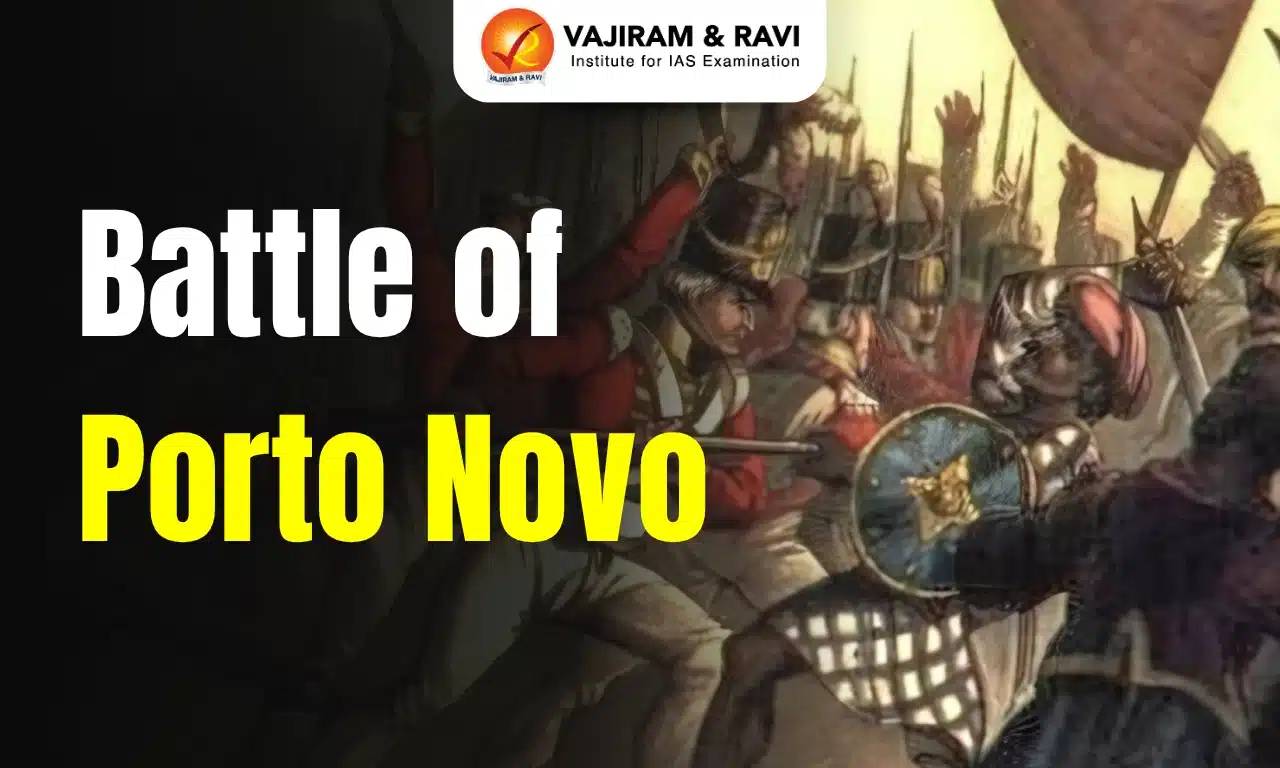
The Battle of Porto Novo took place on 1 July 1781 during the Second Anglo-Mysore War. It was fought between the British East India Company and the Kingdom of Mysore at Porto Novo (present-day Parangipettai). Despite being heavily outnumbered, with just over 8,000 troops, the British forces under Sir Eyre Coote defeated Hyder Ali’s much larger army of around 40,000 soldiers. This victory marked a turning point for the British in southern India.

Battle of Porto Novo Chronology

  • The Second Anglo-Mysore War began in 1780 when Hyder Ali declared war against the British. This move was a response to the British attack on Mahe, a French possession under Hyder Ali's control.
  • In July 1780, Hyder Ali invaded the Carnatic region, where the British faced a severe defeat. Following this, Hyder Ali renewed the siege of Arcot.
  • The British, alarmed by his success, strengthened their defences in South India and sent reinforcements under Sir Eyre Coote to Madras.
  • Initially, Coote was pushed back by Hyder Ali, but he later secured key victories.
  • The turning point came at the Battle of Porto Novo (now Parangipettai in Tamil Nadu) in July 1781. In this battle, Coote led a British force of just over 8,000 men against Hyder Ali’s 40,000-strong army.
  • Despite being outnumbered, Coote defeated Hyder Ali. This victory is considered significant in Hyder Ali’s expansionist ambitions.
  • The war ended with the Treaty of Mangalore, signed on 11 March 1784 between Tipu Sultan and the British East India Company.
  • According to the treaty, both sides agreed to restore captured territories and release prisoners.
  • By that time, Hyder Ali had died in 1782 and his son Tipu Sultan had taken over.
  • Two more Anglo-Mysore wars followed, ending with the Siege of Seringapatam in 1799.
  • Tipu Sultan was killed in that final battle, marking the end of Mysore’s resistance against British rule.

Also Check:

Battle of Porto Novo FAQs

Q1: What was the Battle of Porto Novo?

Ans: A major battle fought on 1 July 1781 between British East India Company forces and Hyder Ali’s Mysore army.

Q2: Where did the Battle of Porto Novo take place?

Ans: It occurred near Porto Novo (now Parangipettai) in present-day Tamil Nadu, India.

Q3: Who led the British forces in the battle?

Ans: Sir Eyre Coote led the British East India Company troops during the battle.

Q4: Who commanded Mysore’s army in the battle?

Ans: Hyder Ali, the Sultan of Mysore, led the Mysorean forces.

Q5: What was the result of the Battle of Porto Novo?

Ans: The British defeated Hyder Ali's much larger army despite being heavily outnumbered.

Battle of Pollilur, History, Winner, About Tipu Sultan

Battle of Pollilur

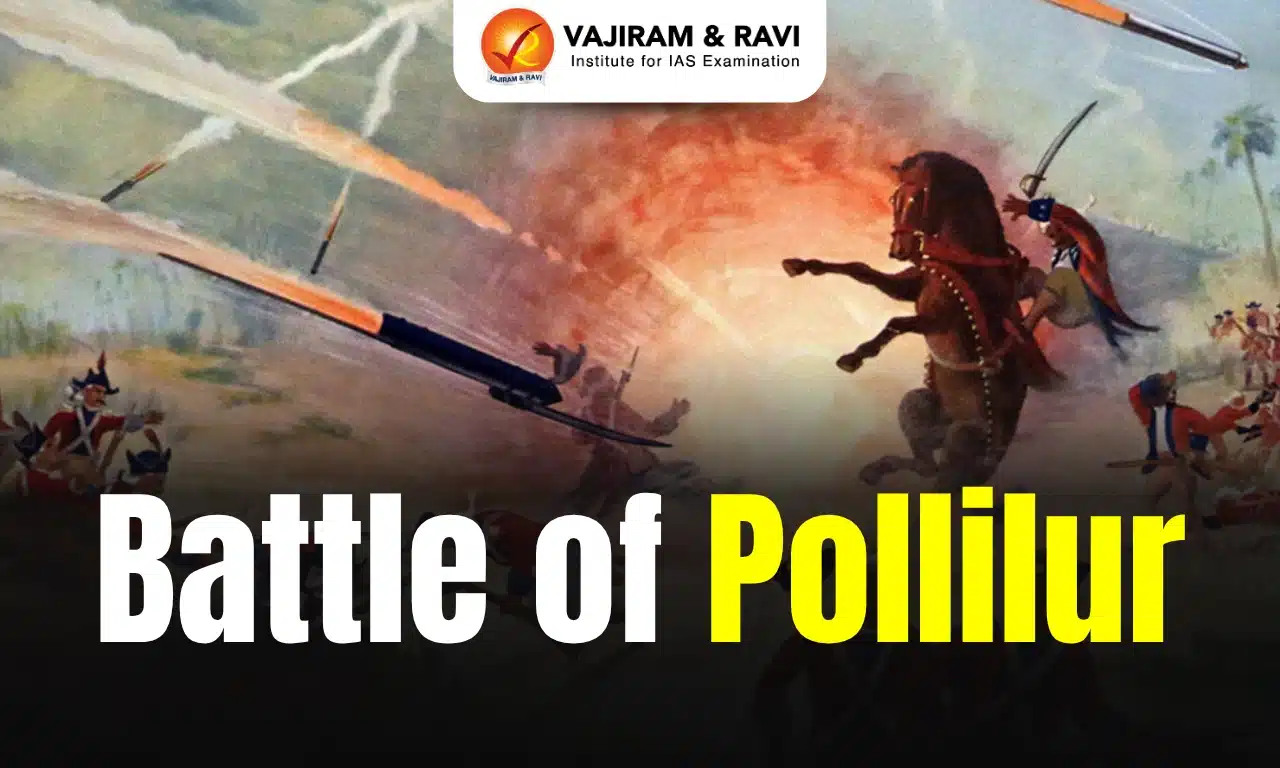
The Battle of Pollilur, part of the Second Anglo-Mysore War, was fought between the British East India Company and the Kingdom of Mysore, led by Hyder Ali and his son Tipu Sultan. The clash occurred near Kanchipuram in present-day Tamil Nadu. General Sir Eyre Coote commanded the British forces, known for his earlier success at the Battle of Wandiwash. The 

Battle of Pollilur was not the first conflict at Pollilur, Hyder Ali had previously defeated the British there in September 1780. However, in the encounter of 1781, Coote’s forces managed to push back Mysorean troops, though the British themselves called it a “dubious victory.” The British lines were split, fighting both Hyder and Tipu separately. 

Battle of Pollilur

On 10th September 1780, Battle of Pollilur which was a part of Second Anglo-Mysore War took place near Kanchipuram which is now a part of Tamil Nadu, India. The Battle was between the Kingdom of Mysore which was led by Tipu Sultan and the forces of British East India Company which was led by William Baillie. The Mysore army won the Battle of Pollilur over the British East India Company.

Also Check:

Battle of Pollilur History

Tipu Sultan aimed to prevent the British forces from joining together. William Baillie's detachment was moving to link up with another British force under Hector Munro at Conjeevaram. Meanwhile, Hyder Ali, Tipu’s father, was engaged in attacking Arcot. Tipu’s strategy was to isolate Baillie’s troops and make them easier to defeat.

Tipu Sultan About

The Kingdom of Mysore was ruled by Tipu Sultan, the son of Haidar Ali and a formidable warrior famously known as the Tiger of Mysore. Born in November 1750, Tipu was a diplomat and a strong admirer of democratic ideals. He supported French soldiers in setting up a Jacobin Club at Seringapatam in 1797 and even planted the Tree of Liberty there.

He modernised his army on the European model, using Persian commands and recognising the importance of naval power. Tipu was eventually defeated and killed in the Fourth Anglo-Mysore War on May 4, 1799, at Srirangapatna in present-day Mandya district, Karnataka.

Battle of Pollilur FAQs

Q1: What was the Battle of Pollilur?

Ans: The Battle of Pollilur (1780) was a major conflict between the Kingdom of Mysore and the British East India Company.

Q2: Who fought in the Battle of Pollilur?

Ans: It was fought between Tipu Sultan and his father Hyder Ali against British forces led by Colonel William Baillie.

Q3: When did the Battle of Pollilur take place?

Ans: The battle occurred on 10 September 1780 during the Second Anglo-Mysore War.

Q4: Where was the Battle of Pollilur fought?

Ans: It took place near the town of Pollilur (modern-day Kanchipuram district) in Tamil Nadu, India.

Q5: What was the outcome of the Battle of Pollilur?

Ans: Tipu Sultan decisively defeated the British, capturing almost the entire detachment led by Colonel Baillie.

Article 29 and 30 of Indian Constitution, Provisions, Key Details

Article 29 and 30 of Indian Constitution

Article 29 and Article 30 of the Constitution of India covers Cultural and Educational Rights of the Indian Constitution. Article 29 and Article 30 are fundamental rights that are available to all the citizens of India and provide them a privilege and accessibility to maintain their own respective culture and language. When designing the Constitution of India, the makers of the Constitution emphasised on the fact that diversity provides strength to the society and helps protect and preserve the diversity. In this article, we are going to cover Article 29 & 30 of the Indian Constitution, its interpretation and significance. 

Cultural and Educational Rights in India

The concept of cultural and educational rights in India supports the vision of India to establish a cultural and composite Indian Society. Hence, cultural and Educational Rights in India are given the status of fundamental rights under Article 29 and 30. The status of fundamental rights provides these rights the protection, including rights to preserve a language script and culture. The Constitution of India does not allow states to discriminate against citizens in fulfilling these rights. 

Article 29 and Article 30 Constitutional Provisions

Article 29 and Article 30 of the Constitution of India can be interpreted in the following manner: 

Article 29- Protection of Interests of Minorities

  • Article 29(1): Provides any section of Indian citizens with a distinct language, script, or culture the right to conserve it. This applies to both minorities and majorities, as the term used is "section of citizens."

  • Judicial Interpretation: The Supreme Court has explained that this right is not confined to minorities. Advocacy for language preservation is considered part of this constitutional right and does not amount to corrupt practice under the Representation of the People Act, 1951.

  • Article 29(2): Prohibits denial of admission to state-run or state-aided educational institutions solely on grounds of religion, race, caste, language, or any of them.

Article 30- Right of Minorities to Establish and Administer Educational Institutions 

Minorities in India have the right to establish and administer educational institutions of their choice. The state doesn't have any rights to abolish and restrict this right. The rule remains even if the state owns a minority educational institution or provides any financial help.

  • Article 30(1): All religious and linguistic minorities have the right to establish and administer educational institutions of their choice. This right is protected even if the state acquires their property.

  • Article 30(2): The state is not allowed to discriminate in granting aid to minority-managed institutions on grounds of religion or language.

Types of Minority Educational Institutions:

  1. Institutions seeking both recognition and aid
  2. Institutions seeking neither
  3. Institutions seeking only recognition or aid

Minorities as Part of Indian Constitution 

The term “Minorities” is explicitly not mentioned in the Constitution of India. A minority refers to a group of people who are different from the majority of people in terms of religion, language, ethnicity and other characteristics. It consists of a group of people who are marginalized and discriminated against in the society and often face challenges in accessing employment, education and other areas.

Also Check Related Post
Article 295 of Indian Constitution Article 194 of Indian Constitution
Article 39 of Indian Constitution Article 191 of Indian Constitution
Article 20 of Indian Constitution Article 16 of Indian Constitution
Article 67 of Indian Constitution Article 40 of Indian Constitution
Article 78 of Indian Constitution

Article 29 and 30 of Indian Constitution FAQs

Q1: What is the Article 29 of the Constitution of India?

Ans: Article 29 protects the rights of any section of Indian citizens to conserve their distinct language, script, or culture and prohibits discrimination in educational institutions.

Q2: What is the Article 30 of the Constitution of India?

Ans: Article 30 grants minorities the right to establish and administer educational institutions of their choice without state discrimination.

Q3: What is status of Minorities in the India Constitution?

Ans: The Constitution provides minorities with fundamental cultural and educational rights under Articles 29 and 30.

Q4: Is the term Minorities defined in the Indian Constitution?

Ans: No, the term "minorities" is not explicitly mentioned in the Constitution of India.

Q5: What does one mean by cultural and educational rights?

Ans: Cultural and educational rights ensure communities can preserve their culture and establish institutions to promote it.

Environment Protection Act 1986, Scope, History, Objectives

Environment Protection Act

The Environment Protection Act of 1986 is one of the most important environmental laws in India. It came at a time when the country needed a stronger framework to deal with pollution, especially after the Bhopal Gas Tragedy. The Act gave the central government broad powers to tackle environmental issues head-on. 

Environment Protection Act

The Environment Protection Act, 1986, was enacted under Article 253 of the Indian Constitution, which empowers Parliament to make laws for implementing international agreements. Its foundation can be traced back to India’s participation in the United Nations Conference on the Human Environment held in Stockholm in June 1972. At that conference, global leaders recognized the urgent need to address environmental degradation, and India pledged to take legislative steps toward environmental protection. 

Environment Protection Act Scope

The Environment Protection Act, 1986 applies across the entire territory of India. Section 2 of the Act lays out key definitions that form the foundation for interpreting the law. 

  • Environment: This includes water, air, land, and the interactions between them. It also covers human beings, all forms of life like plants and animals, microorganisms, and even property.
  • Environmental Pollutants: These are substances whether solid, liquid, or gas that are considered harmful to the health of living organisms.
  • Environmental Pollution: Refers to the presence of these harmful substances in the environment.
  • Hazardous Substance: Any substance or preparation that, due to its chemical or physical properties, can cause harm to humans, other living beings, or property.
  • Handling: Involves the processes related to manufacturing, processing, using, selling, collecting, or storing any substance, especially hazardous ones.
  • Occupier: Refers to a person who has control over the operations of a factory or premises essentially the individual responsible for day-to-day management.

Also Read: Fiscal Responsibility & Budget Management Act

Environment Protection Act History

  • Fragmented Environmental Laws Before 1986: Prior to EPA 1986, environmental issues in India were governed by scattered laws like the IPC, CrPC, Factories Act, Indian Forest Act, and Merchant Shipping Act, which lacked a unified and focused approach.
  • Stockholm Conference, 1972 as Catalyst: The 1972 UN Conference on the Human Environment held in Stockholm highlighted the need for uniform environmental legislation to tackle issues threatening public health and biodiversity.
  • India’s Constitutional Commitment: India became the first country to constitutionally mandate environmental protection through the 42nd Constitutional Amendment Act, 1976.
  • Directive Principle – Article 48-A: This provision directs the State to protect and improve the environment and safeguard forests and wildlife.
  • Fundamental Duty – Article 51-A(g): It obligates every citizen to protect and enhance the natural environment, including forests, lakes, rivers, and wildlife, and to show compassion towards living beings.
  • Limitations of Water and Air Acts: The Water Act (1974) and Air Act (1981), enacted before EPA 1986, dealt only with specific types of pollution and lacked a holistic framework.
  • Need for Comprehensive Legislation: Realizing the limitations of sectoral laws, Parliament passed the Environment (Protection) Act, 1986 as an umbrella legislation to comprehensively cover environmental issues.

Environment Protection Act Objectives

  • It led to the creation of central and state-level authorities with the power to take necessary measures for environmental protection and enforcement.
  • It aimed to ensure better coordination among existing regulatory bodies dealing with different aspects of environmental law.
  • The Act empowered the government to regulate the discharge of environmental pollutants and to control the handling, storage, and use of hazardous substances.
  • It provided for a prompt and effective response mechanism in case of environmental accidents, especially those involving toxic or hazardous materials.
  • The law introduced strong penalties and punishments to act as a deterrent against violations, including imprisonment and hefty fines.

Also Read: Vernacular Press Act

Environment Protection Act Features

  • The Environment (Protection) Act, 1986 gives the central government full authority to take any action necessary for protecting and improving environmental quality and controlling pollution.
  • This includes setting national standards for environmental quality, as well as emission and effluent discharge limits.
  • The government can regulate where industries can be located to avoid environmental harm.
  • It can lay down procedures for the safe handling and management of hazardous substances.
  • The Act also ensures safety by establishing safeguards to prevent environmental accidents and mandates the collection of pollution-related data.
  • Regulatory duties under this Act are largely assigned to agencies already operating under the Water Act of 1974.
  • Central and state governments, along with other relevant bodies, are responsible for enforcing specific rules depending on their jurisdiction and function.
  • The Act grants government officials the power to inspect, test equipment, and collect samples of air, water, soil, or any substance from any location.
  • It strictly prohibits handling hazardous substances unless done in compliance with prescribed safety standards.
  • Violators of the Act face up to five years in prison, a fine up to ₹1 lakh, or both. For continuous violations, the imprisonment term may extend to seven years.
  • A unique feature of this Act is that any person, not just government authorities, can approach a court and file a complaint against environmental offences.
  • Every rule framed under this Act must be placed before both Houses of Parliament after it is made.

Environment Protection Act Effectiveness

  • The Environment Protection Act gives the central government wide-ranging powers to safeguard the environment.
  • Despite this, many rivers have turned into open drains and the air in several cities remains dangerously polluted.
  • This reflects serious gaps between the law and its actual enforcement.
  • The Act mandates the collection and public sharing of pollution data, but the government has largely failed to do so.
  • Without this information, communities are often unaware of hazardous industries operating nearby.
  • While the Act allows the public to seek legal action, only government officials are permitted to collect samples needed as legal evidence.
  • This restriction weakens public participation in holding polluters accountable.
  • River pollution continues unchecked due to ineffective policies and mismanaged cleanup efforts.
  • These failures show that simply having a law is not enough without strong implementation and accountability.

Environment Protection Act Amendments

  • The Ministry of Environment, Forest and Climate Change has proposed amendments to the Environment Protection Act, 1986 to decriminalise certain provisions.
  • Currently, the Act prescribes imprisonment of up to five years or a fine of up to ₹1 lakh or both for environmental violations.
  • If the violation continues, an additional fine of ₹5,000 per day is imposed, and in some cases, jail terms can extend up to seven years.
  • The proposed amendment seeks to replace imprisonment with significantly higher monetary penalties.
  • These fines could now range between ₹5 lakh and ₹5 crore, depending on the nature and extent of the violation.
  • Violations that result in serious injury or death will be dealt with under the Indian Penal Code, read with Section 24 of the EPA.
  • The decriminalisation move will also apply to offences under the Air and Water Acts.
  • An adjudication officer will be appointed to assess and impose penalties for non-compliance, such as failure to submit information or reports.
  • All collected penalties will go into a designated “Environmental Protection Fund” for future use.

Environment Protection Act FAQs

Q1: What is the Environment Protection Act, 1986?

Ans: A comprehensive law enacted to protect and improve India’s environment after the Bhopal Gas Tragedy.

Q2: When was the Act enacted?

Ans: It was enacted on May 23, 1986, and came into force on November 19, 1986.

Q3: Why was the Environment Protection Act passed?

Ans: To provide a legal framework for environmental protection and implement decisions from the 1972 UN Conference on the Human Environment.

Q4: What is the scope of the Act?

Ans: It covers air, water, land, and biodiversity protection, including waste management and regulation of hazardous substances.

Q5: Who enforces the Environment Protection Act?

Ans: The Ministry of Environment, Forest and Climate Change and pollution control boards at central and state levels.

Bio-Fortified Potatoes

Bio-fortified Potatoes

Bio-Fortified Potatoes Latest News

India is taking a significant step in tackling micronutrient deficiencies and improving agricultural sustainability by introducing bio-fortified potatoes with enhanced iron content, developed by the International Potato Center (CIP) based in Peru.

What are Bio-Fortified Potatoes?

  • Bio-fortified potatoes are a new variety enriched with higher iron content aimed at addressing iron deficiency and hidden hunger. These are developed using conventional breeding and biotechnology without altering taste or yield.
  • The initiative is led by the International Potato Centre (CIP), based in The CIP is a global research leader in tuber crops and is working actively to promote nutritionally improved potatoes in India.

About Bio-Fortified Sweet Potatoes

  • Bio-fortified sweet potatoes enriched with Vitamin A are already available in Karnataka, Assam, West Bengal, and Odisha. Plans are underway to expand their access to more farmers across India.
  • The current focus is on iron-fortified potato varieties, for which germplasm has been shared with ICAR-Central Potato Research Institute (CPRI), Shimla.
  • A variety has already been released in Peru and is currently under evaluation and adaptation for Indian agro-climatic conditions.
  • CIP is establishing a South Asia regional centre in Agra, Uttar Pradesh, acknowledging the Indo-Gangetic plains as the world’s largest potato-producing region. This centre will boost regional R&D and seed access.
  • ICAR has released biofortified seed varieties across 61 crops, including 34 field crops (cereals, pulses, millets, oilseeds) and 27 horticultural crops (tubers, vegetables, medicinal plants).
  • Examples of Biofortified Crops
    • CR Dhan 416: Salinity-resistant rice variety with multiple pest resistances.
    • Durum Wheat: Adapted to irrigated areas, rich in zinc (41.1 ppm) and iron (38.5 ppm), and contains 12% protein.

About Biofortification

  • Biofortification is the process of enhancing the nutrient content of crops using conventional breeding, agronomic techniques, or modern biotechnology.
  • It helps increase vitamin and mineral levels in staple crops.

Source: TH

Bio-Fortified Potatoes FAQs

Q1: What are bio-fortified potatoes?

Ans: Bio-fortified potatoes are specially bred varieties enriched with iron to combat micronutrient deficiencies like anaemia. They are developed through conventional breeding and biotechnology.

Q2: Who developed the bio-fortified potato variety introduced in India?

Ans: The International Potato Center (CIP), based in Peru, developed the iron-rich variety and has shared its germplasm with ICAR’s Central Potato Research Institute in Shimla.

Q3: Why is bio-fortification of potatoes important for India?

Ans: Bio-fortified potatoes help address iron-deficiency anaemia, which affects over 50% of Indian women and children, according to NFHS-5.

Collusive Litigation

Collusive Litigation

Collusive Litigation Latest News

The Supreme Court has taken a suo motu cognisance of "collusive litigations" by officials of the Bengaluru Development Authority (BDA) recently.

About Collusive Litigation

  • It is defined as a lawsuit where the parties involved are not genuinely adversarial, but rather cooperate to achieve a desired outcome or to challenge the constitutionality of a law.
  • These suits often involve a degree of cooperation between the parties, who may share a common goal or interest in the outcome.
  • Some of the key issues surrounding these suits include:
    • The potential for abuse, where parties may collude to manipulate the judicial process or achieve an outcome that might not be possible through other means.
    • The risk of undermining the adversarial system, where the court's decision is based on a genuine dispute between parties.
    • The potential for collusive suits to be used as a means of circumventing the normal legislative process.
  • In India, collusive decrees can be set aside if the party challenging the decree is not a party to it and can prove collusion or fraud.
  • The High Court has the authority to intervene in cases where a decree is found to be collusive, particularly under Article 227.
  • A party to a collusive decree cannot seek to have it set aside. This principle is established in various cases where the courts have ruled that only parties not involved in the collusion may challenge the decree.
  • The burden of proving that a decree was obtained collusively lies with the party seeking to set it aside.
  • Courts have held that under a general prayer for relief, they can set aside a decree if it is found to be collusive, even if a specific prayer for setting aside was not made.

Source: DH

Collusive Litigation FAQs

Q1: What best describes a collusive litigation?

Ans: A lawsuit where the parties cooperate to achieve a predetermined outcome.

Q2: What is one major risk posed by collusive suits?

Ans: They can manipulate the judicial process.

Q3: Can a party involved in a collusive decree seek to set it aside?

Ans: No, they cannot challenge their own collusion.

Samagra Shiksha Scheme, Launch Date, Background, Objectives

Samagra Shiksha Scheme

The Samagra Shiksha Scheme is a comprehensive initiative that brings together all aspects of school education from preschool to Class 12 under one umbrella. It was created by merging three earlier schemes: Sarva Shiksha Abhiyan (SSA), Rashtriya Madhyamik Shiksha Abhiyan (RMSA), and Teacher Education. The aim is to ensure a more coordinated and efficient delivery of quality education across all levels.

Recently, the Cabinet Committee on Economic Affairs expanded the scope of Samagra Shiksha to better align it with the Sustainable Development Goals (SDGs) on education. It has also been realigned to reflect the reforms and priorities outlined in the National Education Policy (NEP) 2020.

Samagra Shiksha Scheme

The Samagra Shiksha Scheme, launched in 2018 by the Ministry of Education, is a flagship initiative aimed at delivering equitable, inclusive, and cost-effective school education across India. It covers over 1.16 million schools, the scheme benefits around 15.6 crore students and 57 lakh teachers in both government and government-aided institutions. It spans the entire school spectrum, from pre-primary to senior secondary levels, ensuring a seamless learning experience. Implemented as a centrally sponsored scheme, the funding is shared between the central and state governments in a 60:40 ratio, reinforcing cooperative federalism in the education sector.

Also Read: PM Yasasvi Yojana

Samagra Shiksha Scheme Background

The Samagra Shiksha Scheme is a key initiative of the Government of India designed to improve the overall quality of school education. Launched in 2018, it brings together three previously separate schemes Sarva Shiksha Abhiyan (SSA), Rashtriya Madhyamik Shiksha Abhiyan (RMSA), and Teacher Education (TE) into a single, integrated framework. The primary goal of this unified approach is to provide holistic education from preschool to Class 12, enhance learning outcomes, and make quality education accessible to every child, regardless of their background or location.

Samagra Shiksha Scheme Vision

The Samagra Shiksha Scheme Vision is rooted in the idea of inclusive and equitable education for every child in India, from pre-primary through secondary school. It seeks to close the gaps in access and opportunity, ensuring that no child is left behind due to socio-economic, regional, or gender-based disparities.

At the same time, the scheme emphasizes raising the bar for educational excellence by improving infrastructure, teacher training, and learning outcomes across all levels of schooling.

Samagra Shiksha Scheme Objectives

  • The Samagra Shiksha Scheme aims to transform the entire school education system in India from pre-primary to senior secondary level.
  • It is implemented by the Ministry of Education (formerly the Ministry of Human Resource Development).
  • The scheme is administered through the Department of School Education and Literacy.
  • Its primary objective is to improve the quality and effectiveness of school education.
  • It follows a comprehensive, integrated approach by addressing all stages of education in a single framework.
  • The focus is on inclusive, equitable access to education and improved learning outcomes.
  • In June 2021, the Ministry launched the NIPUN Bharat Programme under this scheme.
  • NIPUN Bharat targets children aged 3 to 9 years and focuses on strengthening foundational literacy and numeracy skills.

Samagra Shiksha Scheme Features

  • Samagra Shiksha Scheme 2.0 adopts a holistic approach by covering the entire school education system from pre-primary to Class 12 under a single umbrella.
  • It replaces the earlier fragmented schemes by integrating SSA, RMSA, and TE to ensure smooth coordination and implementation.
  • The scheme allows states the flexibility to plan and prioritize interventions based on local needs and conditions.
  • A significant increase in funding supports infrastructure development, quality education initiatives, and learning outcomes.
  • Improving learning outcomes is central to the scheme, with enhanced teacher training through SCERTs and DIETs, annual library grants, and tech-integrated pedagogy.
  • Digital education is a major component, with smart classrooms, ICT labs, and platforms like DIKSHA making learning more interactive and accessible.
  • Schools are being consolidated for better resource management, while funds are allocated for transport and improved infrastructure, including hygiene and sanitation.
  • The scheme gives special attention to girls’ education by upgrading Kasturba Gandhi Balika Vidyalayas (KGBVs) to cover Classes 6 to 12 and offering stipends and self-defence training.
  • Inclusive education is promoted through increased support for Children with Special Needs (CwSN), including scholarships and accessible learning materials.
  • Vocational training has been introduced from Class 6 onwards to help students develop practical skills and early exposure to career options.
  • Physical education and sports are integrated into the school curriculum, with financial support provided for sports equipment under the “Khelo India” initiative.
  • The scheme ensures regional equity by focusing on Educationally Backward Blocks (EBBs), Left Wing Extremism (LWE) areas, and border and aspirational districts, aligning with the principle of "Sabka Saath, Sabka Vikas."

Samagra Shiksha Scheme Funding Pattern

  • The Samagra Shiksha Scheme operates as a Centrally Sponsored Scheme, meaning both the Centre and States share the financial responsibility.
  • In Union Territories without a Legislature, the Central Government bears 100% of the cost of implementation.
  • For States and UTs with a Legislature, the fund-sharing ratio is 60:40, with the Centre contributing 60% and the State covering the remaining 40%.
  • The North-Eastern and Himalayan States receive greater central assistance, with a 90:10 funding split, where the Centre provides 90% and the State contributes just 10%.

Also Read: PM Vikas Scheme

Samagra Shiksha Scheme 2.0

  • Samagra Shiksha Scheme 2.0 is an expanded version of the original scheme, designed to reform and strengthen school education across India.
  • It covers education from pre-primary to higher secondary levels, with a focus on inclusive and equitable quality education.
  • The scheme supports infrastructure development including classrooms, libraries, labs, and toilets to create better learning environments.
  • It includes teacher training and professional development programs to build capacity and improve teaching quality.
  • A key feature is the integration of technology in classrooms, promoting digital learning tools to increase educational outcomes.
  • The scheme gives priority to marginalized groups including girls, children with disabilities, and socio-economically disadvantaged students.
  • There’s a strong focus on accountability and data-driven governance, with systems to track student progress and monitor outcomes.

Samagra Shiksha Scheme FAQs

Q1: What is the Samagra Shiksha Scheme?

Ans: A government initiative to improve school education from pre-primary to Class 12 through integrated funding and support for learning, infrastructure, and teacher development.

Q2: When was the Samagra Shiksha Scheme launched?

Ans: It was launched in 2018 by the Ministry of Education by subsuming Sarva Shiksha Abhiyan (SSA), Rashtriya Madhyamik Shiksha Abhiyan (RMSA), and TE.

Q3: What are the major objectives of Samagra Shiksha?

Ans: To ensure inclusive, equitable, and quality education for all children and to promote holistic learning and development.

Q4: Which levels of education are covered under the scheme?

Ans: It covers pre-primary, primary, upper primary, secondary, and senior secondary school education across all government and government-aided schools.

Q5: Who implements the Samagra Shiksha Scheme?

Ans: The scheme is implemented by State Project Directors in coordination with the Ministry of Education at the central level.

Functions of Parliament, Legislative, Financial and Other Functions

Functions of Parliament

The Parliament is the primary law-making body of the Government of India, responsible for framing laws and overseeing governance. India has a bicameral legislature consisting of The President of India, Rajya Sabha (Council of States - the Upper House) and Lok Sabha (House of the People - the Lower House). It discusses, debates, and decides on key matters such as policies, laws, budget allocations, and governance issues affecting the country. While the Rajya Sabha represents the states and union territories, the Lok Sabha represents the citizens of India directly through elected members.

Parliament of India

The Parliament of India serves as the nation’s supreme legislative authority, holding the central role in law-making and governance. It follows the British Westminster model and functions as a bicameral legislature, meaning it consists of two separate houses, the Rajya Sabha (Council of States) and the Lok Sabha (House of the People).

In addition to these two houses, the President of India is considered an essential part of the Parliament, with the power to summon sessions, give assent to bills, and dissolve the Lok Sabha. Together, these three components work to draft, debate, and pass legislation, approve the national budget, and ensure accountability of the executive to the legislature. This structure allows for a representative and balanced system of governance across different regions and population groups in the country.

Functions of Parliament

The Parliament of India, as the apex legislative body, holds a pivotal role in the country’s political and administrative framework. The Constitution outlines a wide range of powers, responsibilities, and functions assigned to Parliament, shaping the way governance operates in India. Broadly, these Functions of Parliament can be grouped under several key categories.

  • Legislative Functions: Makes, amends, and repeals laws for the country.
  • Executive Functions: Holds the executive (Council of Ministers) accountable through questions, debates, motions, and discussions.
  • Financial Functions: Approves the Union Budget, authorizes taxation and public expenditure, and scrutinizes government spending.
  • Constituent Functions: Has the power to amend the Constitution under Article 368.
  • Judicial Functions: Can impeach the President, remove judges of the Supreme Court and High Courts, and punish members for breach of privilege.
  • Electoral Functions: Participates in the election of the President and Vice-President of India.
  • Other Functions: Discusses and debates national issues, raises matters of public concern, and shapes public policy.

Legislative Functions of Parliament

  • The Parliament legislates on all matters listed in the Union List and the Concurrent List.
  • In case of a conflict on matters in the Concurrent List, the union law prevails unless the state law had received prior Presidential assent. However, Parliament can amend or repeal such state law at any time.
  • Parliament can also legislate on matters in the State List under certain conditions:
    • During Emergency or President’s Rule (Article 356): Parliament can make laws on State List subjects if an emergency is in force or a state is under President’s Rule.
    • Under Article 249: If the Rajya Sabha passes a resolution with a two-thirds majority of members present and voting, stating it is necessary in the national interest, Parliament can legislate on State List items.
    • Under Article 253: Parliament can make laws on State subjects to implement international treaties, agreements, or conventions.
    • Under Article 252: If two or more state legislatures pass a resolution requesting a law on a State List subject, Parliament can make that law applicable only to those states. Other states can adopt it later.

Executive Functions (Control over the Executive) of Parliament

  • In the parliamentary system, the executive is accountable to the legislature, meaning the Parliament has multiple tools to control and supervise the government.
  • No-Confidence Motion: If the Parliament passes this motion, the Cabinet must resign. It’s a direct way to remove a government from power.
  • Question Hour: MPs can question ministers about government actions or failures. This keeps the executive transparent and accountable.
  • Adjournment Motion: Used only in the Lok Sabha, this motion halts normal proceedings to discuss a recent issue of urgent national importance.
  • Committee on Ministerial Assurances: This committee monitors whether ministers fulfill promises made on the floor of the House.
  • Censure Motion: Moved by the opposition in the Lok Sabha to criticize and disapprove of specific government policies. While it doesn’t force resignation, the government must prove it still has the House’s confidence.
  • Cut Motion: This allows MPs to oppose any demand for grants in the budget. It can lead to debates or reductions in government expenditure proposals.

Financial Function of Parliament

  • Financial Control: Parliament holds the power of the purse. The Executive cannot spend any money without its approval.
  • Union Budget: The annual budget, prepared by the Cabinet, must be passed by Parliament before any funds can be allocated or spent.
  • Taxation Authority: No new tax can be levied or collected without Parliament’s consent.
  • Parliamentary Committees: Two key standing committees, the Public Accounts Committee and the Estimates Committee monitor government spending and ensure accountability.

Amending Powers of Parliament

  • Power to Amend: Parliament holds the authority to amend the Constitution of India under Article 368.
  • Equal Role of Both Houses: Both the Lok Sabha and Rajya Sabha play an equal role in the amendment process.
  • Procedure: A constitutional amendment must be passed by a special majority in both Houses to become effective.

Electoral Functions of Parliament

  • Election of President and Vice President: Parliament participates in the election process for both posts.
  • Electoral College: The elected members of both Lok Sabha and Rajya Sabha are part of the electoral college that elects the President.
  • Removal of President: The President can be removed through impeachment, a resolution must be passed by the Rajya Sabha and agreed to by the Lok Sabha.

Also Read: Difference between Lok Sabha and Rajya Sabha

Judicial Functions of Parliament

  • Breach of Privilege: Parliament can take punitive action if any member breaches the privileges enjoyed by the House or its members.
  • Privilege Motion: A member may move a privilege motion if they believe another member or minister has misrepresented or withheld key facts.
  • Judicial Immunity: Legislative privileges are generally beyond the scope of judicial review in India.
  • Punitive Powers: Parliament has the authority to punish its own members for misconduct or breach of privilege.
  • Impeachment Powers: Parliament can initiate impeachment proceedings against the President, Vice President, judges of the Supreme Court and High Courts, and the Comptroller and Auditor-General.

Other Functions of Parliament

  • Deliberation on Key Issues: Parliament discusses matters of national and international importance, often bringing in multiple perspectives.
  • Role of Opposition: The opposition ensures alternate viewpoints are heard, keeping the ruling government accountable.
  • ‘Nation in Miniature’: Parliament reflects the diversity of the country, representing different regions, communities, and political opinions.
  • Debate Before Decisions: Before passing laws or resolutions, Parliament debates their implications, a key democratic function.
  • Alteration of State Boundaries: Parliament has the power to change the boundaries or status of states and Union Territories.

Organ of Information: Ministers are obligated to answer questions and provide information in the House when asked by members.

Functions of Parliament FAQs

Q1: What are the main functions of the Indian Parliament?

Ans: The Parliament makes laws, approves budgets, controls the executive, amends the Constitution, and represents the public’s interests.

Q2: What is the legislative function of Parliament?

Ans: Parliament formulates, debates, and passes laws for the country on subjects in the Union and Concurrent Lists.

Q3: How does Parliament control the executive?

Ans: Through questions, debates, motions, and committees, Parliament holds the government accountable for its actions and decisions.

Q4: What is the financial function of Parliament?

Ans: Parliament approves the Union Budget, authorizes expenditure, and ensures government spending aligns with national interests.

Q5: How does Parliament amend the Constitution?

Ans: Parliament can amend the Constitution by passing a bill with a special majority in both Houses, sometimes requiring state ratification.

HQ-16 Missile

HQ-16 Missile

HQ-16 Missile Latest News

The United States military publicly unveiled a mockup of a Chinese HQ-16 surface-to-air missile system, drawing attention at this year’s Experimental Aircraft Association ‘AirVenture Show’ in Oshkosh, Wisconsin.

About HQ-16 Missile

  • The HQ-16, known by its NATO designation CH-SA 16, is a medium-range surface-to-air missile (SAM) system developed by China and based heavily on Russia’s Buk missile family.
  • It is designed to engage enemy aircraft, cruise missiles, helicopters, and unmanned aerial vehicles.

HQ-16 Missile Features

  • HQ-16 features a vertical launch system, giving it 360-degree coverage and the capability to fire in a complicated geographical environment.
  • The missile system is mounted on a Chinese-designed 6x6 high mobility chassis instead of tracked platforms, providing ease of maintenance and better road mobility. 
  • Each launch vehicle carries up to 6 missiles.
  • The missile weighs 650 kg, has a length of 5.2 m and a diameter of 0.34 m. 
  • It can intercept flying aerial targets at altitudes of 15 km to 18 km. 
  • The maximum interception range for aircraft is 40 km, between 3.5 km and 12 km for cruise missiles flying at 300 m/s.
  • The missile guidance system comprises inertial guidance and semi-active radar homing at the terminal phase.

Source: EURT

HQ-16 Missile FAQs

Q1: The HQ-16 surface-to-air missile system was developed by which country?

Ans: China

Q2: What is the maximum interception range of the HQ-16 missile against enemy aircraft?

Ans: 40 km

Q3: What kind of mobility platform does the HQ-16 system use?

Ans: 6x6 high mobility wheeled chassis

Q4: What type of guidance does the HQ-16 use?

Ans: The missile guidance system comprises inertial guidance and semi-active radar homing at the terminal phase.

El Salvador

El Salvador

El Salvador Latest News

Recently, El Salvador's ruling party passed a bill that will allow indefinite presidential reelection and extend presidential terms to six years.

About El Salvador

  • It is a small mountainous Central American nation.
  • Bordered by: It is bordered by Honduras to the northeast; Guatemala to the northwest and by the Pacific Ocean to the south.
  • It is the only Central American nation without a coast on the Caribbean.
  • Topography: The Central Region of El Salvador is characterized by a mix of mountains, valleys, and a volcanic plateau.
  • The region is dominated by the volcanic chain, part of the larger Sierra Madre mountains, which includes several volcanoes such as San Salvador, Ilopango, and San Vicente.
  • Highest Point: The highest point in the country, Cerro El Pital, stands at 2,730 meters (8,957 feet) and is located on the border with Honduras in the northern part of this region.
  • River:  Lempa River plays a significant role in the geography of the country.
  • Major Lakes: Lake Ilopango, Lake Coatepeque , Lake Güija 
  • Climate: The climate of El Salvador is tropical but is moderated by elevation in the interior; in general it is warm rather than hot
  • Capital City: San Salvador

Source: TH

El Salvador FAQs

Q1: Why is El Salvador so famous?

Ans: El Salvador earns its nickname as the “Land of Volcanoes” with around 20 volcanoes. Two of the most famous are San Miguel Volcano and Santa Ana Volcano.

Q2: Is San Salvador volcano active?

Ans: San Salvador volcano has not erupted for more than 80 years but it has a long history of repeated, and sometimes violent, eruptions.

ICRISAT’s AI-based Agromet Advisory Service

ICRISAT’s AI-based Agromet Advisory Service

ICRISAT’s AI-based Agromet Advisory Service Latest News

Recently, International Crops Research Institute for the Semi-Arid Tropics (ICRISAT) and ICAR have launched an AI-based context-specific Agromet Advisory Service to boost farming.

About ICRISAT’s AI-based Agromet Advisory Service

  • ICRISAT’s AI-based Agromet Advisory Service is a new initiative which harness artificial intelligence (AI) and machine learning (ML) to provide real-time, personalised climate advisory services to farmers.
  • It aims to equip smallholder farmers with hyper-local, actionable weather and climate insights, enabling them to make informed decisions amid increasing climate variability.
  • The initiative will provide farmers with timely, actionable recommendations for critical decisions such as sowing, irrigation, and pest management.
  • These advisories will be delivered through user-friendly digital channels, including an AI-powered WhatsApp bot, ensuring easy access even in remote farming communities. ​
  • The project is supported under the Government of India’s Monsoon Mission III.
  • The project will first be implemented in Maharashtra, through ICAR’s Agro-Meteorological Field Units (AMFUs) to reach smallholder farmers. Insights from this phase will inform a national rollout and serve as a model for South-South expansion.
  • Organisations involved: The Central Research Institute for Dryland Agriculture (CRIDA-ICAR), the International Livestock Research Institute (ILRI), the Indian Institute of Tropical Meteorology (IITM), and Indian Meteorological Department (IMD) joined the initiative.
  • The Intelligent Systems Advisory Tool (iSAT), a digital platform developed and piloted by ICRISAT and partners during Monsoon Mission II is now being upgraded into a fully functional AI-powered tool under this new initiative.
    • iSAT was initially designed to transform complex climate and agronomic data into personalised, science-based advisories.

Source: BL

ICRISAT’s AI-based Agromet Advisory Service FAQs

Q1: Where is the International Crops Research Institute for the Semi-Arid Tropics situated?

Ans: Hyderabad, India.

Q2: What is ICRISAT and its functions?

Ans: ICRISAT stands as the premier drylands agricultural research institute, dedicated to uplifting smallholder farmers and ensuring food security in semi-arid tropics.

Central Industrial Security Force (CISF)

Central Industrial Security Force

Central Industrial Security Force Latest News

The Union Ministry of Home Affairs (MHA) recently approved the recruitment of 58,000 additional personnel for the Central Industrial Security Force (CISF), anticipating future industrial hubs in areas now affected by Left Wing Extremism (LWE).

About Central Industrial Security Force

  • It is a Central Armed Police Force (CAPF) in India.
  • It is directly under the Union Ministry of Home Affairs, and its headquarters are in New Delhi.
  • Motto: "Protection and Security"

CISF Establishment

  • The CISF came into existence in 1969 through the CISF Act 1968 with a sanctioned strength of only three battalions. 
  • The original charter of CISF was to provide integrated security cover to certain sensitive public sector undertakings.
  • The Act was amended in 1983 declaring the CISF as an Armed Force of the Union. 
  • The force has since grown into a premier multi-skilled organization with a present strength of more than 188,000 personnel.
  • The CISF at present provides security cover to 359 establishments across the country.

CISF Organisation Structure

  • CISF is headed by an Indian Police Service officer with the rank of Director-General, assisted by an IPS officer in the rank of Addl. Director-General.
  • The force is divided into seven sectors (Airport, North, North-East, East, West, South, and Training), and also has a Fire Service Wing.

CISF Functions

  • The CISF security umbrella includes India’s most critical infrastructure facilities, like nuclear installations, space establishments, airports, seaports, power plants, etc.
  • The specialized task of airport security was assigned to CISF in the year 2000 in the wake of the hijacking of Indian Airlines Flight IC-814 to Kandahar.
  • In addition, the CISF also protects important government buildings, iconic heritage monuments, Delhi Metro, Parliament House Complex, and Central Jails of Jammu and Kashmir.
  • The CISF also has a specialized VIP Security vertical, providing round-the-clock security to important protectees.
  • CISF personnel are trained in disaster management techniques, enabling them to actively respond to natural disasters like earthquakes, floods, and cyclones. 
  • CISF is one of the largest Fire Protection Service providers in the country. CISF is the only force with a customized and dedicated fire wing.
  • Post the Mumbai terror attack in November 2008, the mandate of CISF was broadened to provide security cover to private corporate establishments also.
  • It is a compensatory cost force, which means that it bills its clients for the services it provides.
  • The CISF is the only CAPF with a daily public interface – in the airports, in the Delhi Metro, and in the iconic monuments.

Source: TH

Central Industrial Security Force FAQs

Q1: Under which Union Ministry does the CISF function?

Ans: Ministry of Home Affairs

Q2: What is the motto of the CISF?

Ans: Protection and Security

Q3: Where is the headquarter of CISF?

Ans: New Delhi

Sea of Japan

Sea of Japan

Sea of Japan Latest News

China and Russia began joint naval drills in the Sea of Japan recently.

About Sea of Japan

  • The Sea of Japan, or East Sea, is a marginal sea of the western Pacific Ocean.
  • It is bound by Japan and Sakhalin (Sakhalin Oblast, Russia) to the east and by mainland Russia, North Korea, and South Korea to the west.
  • It covers an area of 978,000 sq.km.
  • The sea is almost elliptical, having its major axis from southwest to northeast.
  • It is connected with the East China Sea in the south via the Tsushima and Korea straits and with the Okhotsk Sea in the north by the La Perouse and Tatar straits.
  • In the east, it is connected with the Inland Sea of Japan via the Kanmon Strait and the Pacific Ocean by the Tsugaru Strait.
  • The average depth is 1,667 meters. Dohoku Seamount, an underwater volcano, is its deepest point.
  • Its relatively warm waters contribute greatly to the mild climate of Japan.
  • Few rivers discharge into the sea, and their total contribution to the water exchange is within 1%. 
  • Its water balance is mostly determined by the inflow and outflow through the straits connecting it to the neighboring seas and the Pacific Ocean.
  • Like the Mediterranean Sea, it has almost no tides due to its nearly complete enclosure from the Pacific Ocean. 
  • The sea has no large islands, bays, or capes. Except for the South Korean island of Ulleungdo, all the other small islands are situated near the eastern coast of the sea.
  • The sea is known for its high concentration of oxygen (dissolved in the seawater), which results in high biological productivity. 
  • Mining for mineral deposits like magnetite, natural gas, and petroleum are some of the major economic activities that are carried out in the Sea of Japan.
  • Ports:
    • Russia: Vladivostok, Sovetskaya Gavan, Nakhodka, Alexandrovsk-Sakhalinsky, and Kholmsk. 
    • North Korea: Hamhung, Chongjin, and Wonsan.
    • Japan: Niigata, Tsuruta, and Maizuru.

Source: TH


Sea of Japan FAQs

Q1: The Sea of Japan is also known by which other name?

Ans: East Sea

Q2: Where is the Sea of Japan located?

Ans: The Sea of Japan, or East Sea, is a marginal sea of the western Pacific Ocean.

Q3: Which strait connects the Sea of Japan with the Pacific Ocean?

Ans: Tsugaru Strait

Q4: Which sea lies to the south of the Sea of Japan?

Ans: East China Sea

Bishnoi Movement, History, Origin, Objective, Cause, Success

Bishnoi Movement

Around 290 years ago, in the early 1700s, the Bishnoi community in Rajasthan sparked one of the earliest recorded environmental movements. When the King of Jodhpur ordered trees to be cut down for wood, the Bishnois resisted and started the Bishnoi Movement which was led by a woman named Amrita Devi; people from 84 nearby villages stood in defense of the forest. In a remarkable act of courage, many of them sacrificed their lives to protect the trees.

Bishnoi Movement

Bishnoi Movement took place in the 1730s in Khejarli village, Rajasthan was initiated for wildlife protection and eco-conversation, Bishnois are the First Environmentalists of India. King Abhay Singh of Jodhpur ordered trees to be cut for palace construction. Amrita Devi Bishnoi opposed the tree felling by hugging the trees. Her daughters, Asu, Ratni, and Bhagu joined her in protest. Hundreds of Bishnoi villagers joined the Bishnoi Movement. The Bishnoi sect promotes conservation of trees and wildlife. Forests provided fuelwood and fodder for the community. 363 Bishnois were killed while trying to protect the Khejri trees.

Also Check:

Bishnoi Movement History

  • The Bishnoi Movement originated in the 15th century in Marwar, Rajasthan.
  • Founded by Guru Jambheshwar (Jambhoji), a spiritual leader and environmentalist.
  • The name "Bishnoi" means twenty-nine in Marwari, referring to the 29 principles laid down by Guru Jambheshwar.
  • These principles promote environmental conservation, non-violence, and sustainable living.
  • Bishnois prohibit cutting green trees, killing animals, and polluting water sources.
  • Known for sacrificing lives to protect trees and wildlife (e.g., the 1730 Khejarli Massacre).
  • The community continues to play a key role in wildlife protection and eco-activism today.
  • Their practices have influenced modern environmental movements in India.

Amrita Devi Bishnoi Wildlife Protection Award

To honour the legacy of Amrita Devi Bishnoi and sacrifice for wildlife conservation, the Government of India instituted the Amrita Devi Bishnoi Wildlife Protection Award, a prestigious national recognition for individuals or institutions working to protect wildlife.

The first award was conferred in 2001, posthumously awarded to Ganga Ram Bishnoi of Chirai village, Jodhpur. He was recognized for his commitment to protecting wildlife, and the award was presented by the Union Minister of Environment and Forests.

Bishnoi Movement Objectives

  • Protection of Biodiversity: The Bishnoi Movement strongly advocates for the conservation of flora and fauna. The community is deeply committed to preserving native species and maintaining ecological balance in their region.
  • Promotion of Health and Hygiene: Guru Jambheshwar emphasized cleanliness, personal hygiene, and community health. The Bishnoi Movement encourages habits that lead to physical well-being and social responsibility.
  • Prevention of Deforestation: A cornerstone of the Bishnoi philosophy is the absolute prohibition against cutting green trees. The movement actively resists deforestation and promotes sustainable use of natural resources.
  • Compassionate Animal Care: The Bishnois are known for their care toward animals. They oppose hunting and poaching and have long practiced co-existing peacefully with wildlife, often nursing injured animals back to health.

Bishnoi in Rajasthan

  • Location & Population: The Bishnoi community is mainly found in the western Thar Desert and parts of northern India, with around 600,000 followers across the country.
  • Founder: Established by Jambhoji, a 15th-century villager near Jodhpur, who became Swami Jambeshwar Maharaj after experiencing a spiritual awakening during a severe drought.
  • Origin Belief: Jambhoji believed that the drought and hardships were caused by human disruption of nature’s balance.
  • Formation of the Sect: The Bishnoi sect was founded in 1485 AD to promote environmental and ethical living.
  • 29 Principles: Swami Jambeshwar laid down 29 commandments to guide the community’s lifestyle, focusing on environmental conservation, compassion, and non-violence.
  • Key Teachings: 
    • “Jeev Daya Palani” - Show compassion to all living beings. 
    • “Runkh Lila Nahi Ghave” - Do not cut green trees.
  • Ecological Awareness: Jambaji observed that cutting trees during droughts to feed animals led to further ecological damage. His teachings emphasized the need to protect both trees and wildlife.
  • Legacy: These principles laid the foundation for one of the earliest and most consistent grassroots environmental movements in India.

Bishnoi Community

  • Geographical Presence: The Bishnoi community has lived for generations in western Rajasthan, especially around the Thar Desert region.
  • Environmental Ethos: They hold a deep respect for all life forms and strictly avoid harming animals or cutting green trees.
  • Pioneers of Conservation: Known for their eco-conscious lifestyle, they practice sustainable living and actively protect local biodiversity.
  • Economic Activity: The community is skilled in dairy farming and is also known for producing high-quality dairy products and handmade soap.
  • Natural Habitat: Their homeland near Jodhpur is lush with trees and supports a diverse range of wildlife, thanks to their conservation efforts.
  • Funeral Practices: Though they follow Hinduism, Bishnois bury their dead instead of cremating them conserving wood and aligning with their environmental values.

Bishnoi Movement Success

    • Royal Intervention: After the turning point of the Bishnoi movement, the Maharaja of Marwar issued a royal decree banning the cutting of trees in all Bishnoi-inhabited villages.
    • Historical Significance: The origins of Bishnoism around 1730 AD laid the foundation for the concepts of tree-embracing and environmental activism in India.
    • Influence on Chipko Movement: The Bishnoi movement directly inspired the later Chipko Movement, led by Sunder Lal Bahuguna in the 20th century, which popularized tree-hugging as a form of protest.
  • Awards in Honor:
  • The Amrita Devi Bishnoi Smrithi Paryavaran Award was established by the Rajasthan Government.
  • The Amrita Devi Bishnoi Wildlife Protection Award was instituted by the Government of India, both to recognize individuals or groups committed to protecting wildlife and forests.

Bishnoi Movement FAQs

Q1: What is the Bishnoi Movement?

Ans: A 1730 environmental protest in Rajasthan where 363 Bishnois sacrificed their lives to protect Khejri trees from being cut.

Q2: Who started the Bishnoi Movement?

Ans: Amrita Devi Bishnoi led the movement, sacrificing her life to save trees from royal deforestation orders.

Q3: Where did the Bishnoi Movement take place?

Ans: The movement began in Khejarli village, near Jodhpur in Rajasthan, India.

Q4: Why is the Bishnoi Movement important?

Ans: It is one of India’s earliest environmental movements, showcasing community-led ecological conservation and non-violent resistance.

Q5: What are the beliefs of the Bishnoi community?

Ans: Bishnois follow 29 principles emphasizing non-violence, environmental protection, and compassion toward all living beings.

Daily Editorial Analysis 4 August 2025

Daily Editorial Analysis

The ‘Right to Repair’ Must Include the ‘Right to Remember’

Context

  • In May 2025, the Indian government took a bold step by accepting a proposal for a Repairability Index for mobile phones and appliances.
  • This initiative, along with new e-waste policies incentivising formal recycling, marks a timely push for sustainable electronics.
  • While these developments signal progress, the path to a truly sustainable and inclusive digital future demands more than regulatory reform.
  • It requires deep appreciation and support for the tacit, cultural knowledge that underpins India’s vibrant but often overlooked repair economy.

The Invisible Backbone of India’s Technology Ecosystem

  • India’s evolving digital and AI policies, exemplified by initiatives like Digital Public Infrastructure (DPI) and the National Strategy on Artificial Intelligence (NSAI), prioritise innovation and data-driven efficiency.
  • Yet, the informal repair sector, composed of mobile and appliance fixers working in bustling places like Delhi’s Karol Bagh and Chennai’s Ritchie Street, remains largely invisible to digital and policy frameworks.
  • This sector’s knowledge is not written in manuals or stored in software; rather, it is embodied in experience, intuition, and adaptability.
  • The work of these repairers extends the life of electronics far beyond planned obsolescence.
  • They diagnose faults through sensory cues, reuse components, and improvise solutions with modest tools.
  • Their significance goes far beyond mere economic contribution, they sustain India’s material resilience, often in the face of increasing consumer disposability and devices designed to be unrepairable.

The Value of Tacit Knowledge

  • Tacit knowledge, passed through mentorship, observation, and hands-on practice, is central to India’s repair culture.
  • Unlike formal training, it thrives on learning by doing, adapting to context, and improvising.
  • As AI systems continue to evolve, drawing upon patterns shaped by this real-world problem-solving, the contributions of informal workers become ever more crucial.
  • Yet, these communities typically receive little formal recognition or policy support, exacerbating imbalances even as technology advances due to insights sourced from their labour.
  • Globally, the Right to Repair movement is gaining ground. The European Union now mandates manufacturers to offer spare parts and repair documentation.
  • India, too, has made strides, launching a Right to Repair framework and a national portal.
  • Yet, to lead effectively, India must recognise repair not merely as a service, but as essential knowledge work.

Gaps and Blind Spots in Policy

  • In 2021–22, India was the world’s third-largest generator of e-waste. Rules emphasising Extended Producer Responsibility (EPR) rightly pressure manufacturers to manage products at end-of-life, but rarely position repair as the frontline defence against waste.
  • National skilling schemes and educational policies, such as the Pradhan Mantri Kaushal Vikas Yojana (PMKVY) and the National Education Policy (NEP) 2020, praise experiential learning and traditional knowledge, yet seldom provide concrete pathways for passing on repair skills.
  • This oversight illustrates a broader blind spot: while policies tout repair and reuse principles, they risk marginalising the very workforce at the heart of these practices.
  • Sustainability initiatives like Mission LiFE champion environmental consciousness but must extend to supporting the informal economy that makes such goals possible.

Unmaking and the Circular Economy

  • A pivotal idea emerging from research is unmaking, deliberately designing products with the expectation that they will be disassembled, repaired, or repurposed.
  • This approach recognises every breakdown and repair as a source of learning and innovation: a recovered circuit board becomes a learning device, and a rescued phone part restores connectivity for someone in need.
  • Repairers are thus not simply menders of material goods, but stewards of the circular economy, embodying the principles of reuse and longevity that sustainability demands.

The Way Forward: Reimagining Policy and AI for Repair Justice

  • India’s tradition of frugality and innovation, seen in the everyday practices of jugaad, predates digital reforms.
  • However, new technology often prioritises compact design and proprietary control over repairability.
  • A recent iFixit report showed that just 23% of smartphones sold in Asia are easily repairable, largely due to design choices.
  • To address this, repairability must be embedded in design norms and procurement standards from the outset.
  • Ministry of Electronics and IT: Incorporate repairability into AI and procurement criteria.
  • Department of Consumer Affairs: Expand the Right to Repair to include classification and community participation.
  • Ministry of Labour and Employment: Formally recognize informal repairers through platforms like e-Shram, extending social protections and training.
  • Ministry of Skill Development: Develop skilling programs tailored to the adaptive, non-standardised nature of repair work.

Conclusion

  • Supporting repair is not just about intellectual property or technological efficiency, it is about valuing the quiet, essential labour that keeps society’s electronics running.
  • As philosopher Michael Polanyi once said, We know more than we can tell.
  • By preserving the tacit knowledge at the core of repair culture, India can build a just, repair-ready technological future, one where sustainability, innovation, and human wisdom go hand in hand.

The ‘Right to Repair’ Must Include the ‘Right to Remember’ FAQs

Q1. What significant step did the Indian government take in May 2025 to promote sustainable electronics?
Ans. It accepted a report proposing a Repairability Index for mobile phones and appliances, ranking products based on ease of repair, spare part access, and software support.

Q2. Why is tacit knowledge important in India’s repair economy?
Ans. Tacit knowledge, passed down through observation and hands-on experience, enables repairers to creatively diagnose and fix devices, sustaining India’s material resilience beyond planned obsolescence.

Q3. What are some gaps in India’s current policies regarding repair work?
Ans. While policies emphasize recycling and formal skilling, they often overlook informal repairers, the tacit nature of repair skills, and the need to integrate repairability into design and procurement.

Q4. What does the concept of ‘unmaking’ refer to in sustainable product design?
Ans. Unmaking involves designing products to be easily disassembled, repaired, or repurposed, making breakdowns opportunities for learning and reuse rather than failures.

Q5. How can AI and government ministries support India’s informal repair sector?
Ans. AI can help codify tacit repair knowledge into shareable formats, while ministries can incorporate repairability criteria into policies, recognize informal repairers formally, and create tailored training programs.

Source: The Hind


Another Slip Up by India in the Trade Pact with the U.K.

Context

  • The India-United Kingdom Comprehensive Economic and Trade Agreement (CETA) introduces notable changes to India’s approach toward intellectual property (IP), particularly in the field of access to medicines and technology transfer.
  • Chapter 13, especially Article 13.6, signals a significant shift in India’s policy stance, raising deep concerns about its impact on public health, affordable medicine access, and broader developmental goals.
  • Therefore, it is important to delve into the shift in India’s policy stance and it broader implications.

Shift in India’s Policy Stance and Concerns About Its Impact

  • Dilution of India’s Position on Compulsory Licensing

    • Historically, India has been a staunch defender of compulsory licensing, a mechanism that allows governments to authorise the production of patented products without the patent owner’s consent, especially to address high medicine prices.
    • The new CETA provision, however, elevates voluntary licensing as the preferable and optimal route for access to medicines.
    • This represents a move away from compulsory licensing, which India had previously championed at both domestic and multilateral levels.
    • The case of Natco Pharma’s compulsory license in 2012 for the anticancer drug sorafenib tosylate is illustrative: the price for one month’s treatment fell from ₹2,80,428 to under ₹8,800, making the drug vastly more affordable for Indian patients.
    • Such cases highlight how compulsory licensing can play a critical role in counteracting the excessive rent-seeking behaviours enabled by strong patents.
  • Legal and Policy Safeguards under Threat

    • India’s alignment with the WTO’s TRIPS Agreement had originally retained regulatory mechanisms for compulsory licensing within the Patents Act.
    • It tailored to public interest grounds, such as lack of availability or high prices of patented products.
    • Periodic reporting on the ‘working’ (commercialisation) of patents was also a key safeguard, ensuring patents actually benefit Indian consumers.
    • This safeguard has been eroded.
    • Changes brought about by India’s prior free trade agreements and now reinforced by CETA have extended the reporting period reducing transparency and making enforcement of the working requirement more challenging.
    • This, in turn, weakens another pillar for compulsory license issuance.

Problems with Voluntary Licensing

  • Voluntary licensing relies on the consent and negotiating strength of patent holders, which tend to favour powerful multinational pharmaceutical firms over domestic generic producers in developing countries.
  • Organisations like Médecins Sans Frontières (MSF) have shown that voluntary licenses come with restrictive terms, such as supply controls and geographic limitations, limiting their ability to guarantee widespread, affordable access.
  • For example, when Cipla produced remdesivir under a voluntary license from Gilead Sciences during the COVID-19 pandemic, the resulting price in India, after currency adjustments, was actually higher than what Gilead charged in the U.S.
  • This example underscores the inability of voluntary licenses to serve as a reliable mechanism for affordable access to essential medicines.

Broader Implications: Weakening Demand for Technology Transfer

  • Beyond public health, CETA may also undercut India’s long-standing demand for technology transfer on favourable terms from advanced countries.
  • This demand, rooted in the 1974 United Nations General Assembly’s New International Economic Order (NIEO), was designed to spur industrialization and environmental progress in developing countries.
  • Yet, despite decades of advocacy, significant barriers such as slow technology transfer and restrictive IP regimes persist.
  • India’s 2024 update to the United Nations Framework Convention on Climate Change explicitly noted that IP and inadequate technology transfer remain obstacles to scaling up climate-friendly technologies.
  • By moving away from demanding favourable terms for technology transfer, as signalled in the new CETA commitments, India compromises its leverage in global negotiations related to climate change and sustainable development.

Conclusion

  • India’s commitments under the CETA intellectual property chapter represent more than mere legal adjustments, they reflect a shift in policy priorities with profound implications for public health, affordable medicine access, and the right to technology transfer.
  • The prioritisation of voluntary over compulsory licensing dilutes critical safeguards that helped India protect public interest, while the weakening of demands for favourable technology transfer terms risks undermining India’s role as a leader among developing nations in international negotiations.
  • The broader consequence is a potential reduction in affordable access to medicines and slower progress toward industrialization and environmental sustainability.

Another Slip Up by India in the Trade Pact with the U.K. FAQs

 Q1. What key shift does Article 13.6 of the India-UK CETA introduce regarding access to medicines?
Ans. Article 13.6 promotes voluntary licensing as the preferred method for ensuring access to medicines, moving away from India’s previous support for compulsory licensing.

Q2. How did compulsory licensing benefit Indian patients in the case of Natco Pharma and sorafenib tosylate?
Ans. Compulsory licensing allowed Natco Pharma to offer the anticancer drug at under ₹8,800 per month, compared to the original price of ₹2,80,428 charged by the patent holder.

Q3. What risk is posed by favouring voluntary licensing over compulsory licensing?
Ans. Voluntary licenses can come with restrictive terms set by patent holders, limiting affordability and access, especially for generic manufacturers in developing countries.

Q4. How has the patent “working” requirement changed under recent trade agreements?
Ans. The reporting period for patent “working” status has been extended to at least every three years, reducing transparency and making enforcement of compulsory licensing grounds more difficult.

Q5. How does the CETA affect India’s position on technology transfer in multilateral forums?
Ans. By shifting away from demanding technology transfer on “favourable terms,” India weakens its ability to negotiate for climate-friendly technologies and support industrialization.

Source: The Hindu

Daily Editorial Analysis 4 August 2025 FAQs

Q1: What is editorial analysis?

Ans: Editorial analysis is the critical examination and interpretation of newspaper editorials to extract key insights, arguments, and perspectives relevant to UPSC preparation.

Q2: What is an editorial analyst?

Ans: An editorial analyst is someone who studies and breaks down editorials to highlight their relevance, structure, and usefulness for competitive exams like the UPSC.

Q3: What is an editorial for UPSC?

Ans: For UPSC, an editorial refers to opinion-based articles in reputed newspapers that provide analysis on current affairs, governance, policy, and socio-economic issues.

Q4: What are the sources of UPSC Editorial Analysis?

Ans: Key sources include editorials from The Hindu and Indian Express.

Q5: Can Editorial Analysis help in Mains Answer Writing?

Ans: Yes, editorial analysis enhances content quality, analytical depth, and structure in Mains answer writing.

Indian Army’s Drone Integration Post-Operation Sindoor: Bhairav Battalions, Rudra Brigades, and Modernisation Plan

Indian Army Drone Integration

Indian Army Drone Integration Latest News

  • The Indian Army is planning a major organisational overhaul that will integrate UAVs and counter-UAV systems as standard battalion-level assets across most units
  • The restructuring will also include the formation of light commando battalions, integrated brigades, and specialised artillery regiments and batteries, aimed at enhancing operational capabilities for future warfare scenarios.

Drones at the Centre of India’s Modern Warfare Strategy

  • India’s military doctrine is increasingly centred around drone warfare, powered by domestic R&D advancements and proactive policy reforms. 
  • Since 2021, the ban on imported drones and the launch of the Production Linked Incentive (PLI) Scheme have accelerated indigenous drone innovation, laying the groundwork for AI-driven autonomous drones.
    • The PLI Scheme for drones and drone components, notified in September 2021, allocated ₹120 crores over three financial years (2021-22 to 2023-24).
    • It incentivised domestic production and fostering technological advancements in the drone sector.
  • The future lies in autonomous drones with AI-driven decision-making, and India is already laying the groundwork.

Dedicated Drone Units at Battalion Level

  • In the wake of Operation Sindoor following the Pahalgam terror attack, the Indian Army is undertaking a significant organisational overhaul to enhance combat readiness for future warfare. 
  • A key focus is the integration of Unmanned Aerial Vehicles (UAVs) and counter-UAV systems as standard weapon systems at the battalion level across infantry, armoured, and artillery units.
    • Currently, drones are used as secondary assets, operated by personnel diverted from primary roles. 
  • The new structure will create dedicated UAV operating teams within each unit, ensuring focused training and deployment
  • Infantry battalions will incorporate surveillance drones at platoon and company levels, requiring the reassignment of approximately 70 personnel per unit for drone operations.

Institutionalising Drone Procurement and Supply Chains

  • A key objective is to incorporate drones and next-generation equipment as standard issue items for combat arms. 
  • This move will streamline procurement processes, establish dedicated supply chains, and reduce reliance on ad hoc or emergency purchases, ensuring sustained capability development.

Formation of Bhairav Light Commando Battalions

  • The Army plans to raise 30 light commando battalions, called Bhairav, each comprising 250 specially trained soldiers. 
  • These units will have mission-specific roles and will be deployed under various commands to enhance rapid strike capabilities. 
  • The first battalions are expected to be operational within a month.

Creation of Integrated Rudra Brigades

  • To enhance battlefield autonomy, the Army will restructure existing brigades into Rudra Brigades — integrated formations combining infantry, armour, artillery, UAVs, and logistics elements. 
  • These brigades will be capable of independent operations across diverse terrains and tailored for both conventional and hybrid warfare scenarios.

Artillery Modernisation: Drone Batteries and Divyastra Units

  • Artillery regiments will see the establishment of two expanded gun batteries and a third drone battery equipped with surveillance and combat drones
  • New Divyastra artillery batteries will be formed, integrating long-range guns, loitering munitions, and anti-drone systems for deep-strike capabilities and area defence.

Enhancements in Armoured, Mechanised Infantry and Engineers

  • The reorganisation will include upgrading reconnaissance platoons in armoured and mechanised infantry units with surveillance and strike drones. 
  • Discussions are ongoing to convert one company per battalion into a drone-centric unit. 
  • Engineer regiments will integrate drone sections for mine detection, area mapping, and reconnaissance.

Boosting UAV Capabilities in Army Aviation & EME

  • The Army Aviation Corps will be strengthened with additional UAVs to reduce dependence on helicopters for reconnaissance and surveillance missions. 
  • Simultaneously, the Corps of Electronics and Mechanical Engineers (EME) will enhance its drone repair infrastructure at corps zone workshops.

Source: IE | PIB

Indian Army Drone Integration FAQs

Q1: Why is the Indian Army integrating drones at battalion level?

Ans: To enhance surveillance, combat readiness, and operational efficiency after lessons from Operation Sindoor.

Q2: What are Bhairav Light Commando Battalions?

Ans: Specialised rapid-strike units of 250 soldiers, trained for specific missions under various commands.

Q3: What are Rudra Brigades in the Army's restructuring?

Ans: Integrated brigades combining infantry, armour, artillery, UAVs, and logistics for independent multi-terrain operations.

Q4: How will the artillery units be modernised?

Ans: By adding drone batteries, Divyastra units with loitering munitions, and anti-drone systems for deep-strike capabilities.

Q5: What is the long-term aim of Army’s drone initiative?

Ans: To institutionalise drone procurement, build supply chains, and reduce ad-hoc purchases for sustained combat capabilities.

Rhisotope Project: Using Radioactive Isotope Injections to Combat Rhino Poaching in South Africa

Radioactive Isotope Rhino Poaching

Radioactive Isotope Rhino Poaching Latest News

  • A South African university has launched the Rhisotope Project, an anti-poaching initiative that injects radioactive isotopes into rhino horns to deter illegal trafficking. 
  • The method, developed over six years by the University of the Witwatersrand with support from the IAEA, is safe for rhinos and enables customs officials to detect trafficked horns.
  • The project began with five rhinos treated in the Waterberg Biosphere Reserve and aims to scale up for mass treatment to protect South Africa's declining rhino population.

Waterberg Biosphere Reserve

  • The Waterberg Biosphere Reserve is located in the Bushveld district of Limpopo Province, South Africa.
  • It functions as a water reservoir for this arid region.
  • It comprises low mountain ranges, escarpments, and sparse soils with limited economic activity.

Ecological Characteristics

  • The Waterberg Mountain Range is one of three major mountain ranges in the Limpopo Province. 
  • There are four main drainage rivers within the area: the Lephalala, Mokolo, Matlabas and the Mogalakwena.
  • It represents a significant portion of Southern Africa’s savannah biome.
  • It features seven distinct vegetation types, including Central Sandy Bushveld and Waterberg Mountain Bushveld.
  • The reserve is home to numerous threatened species, including the critically endangered black rhinoceros.
  • It also includes the Nylsvley Nature Reserve, a registered Ramsar wetland site.
  • It contains some of South Africa’s most significant San rock art sites.

Radioactive Isotopes: Overview and Uses

  • Radioactive isotopes, or radioisotopes, are unstable forms of elements that emit radiation as they decay into more stable forms.
  • They can occur naturally (e.g., Uranium-238, Carbon-14) or be artificially produced in reactors or accelerators (e.g., Cobalt-60, Iodine-131).

Examples of Radioactive Isotopes

  • Carbon-14: Used in radiocarbon dating of ancient organic materials.
  • Iodine-131: Used in diagnosing and treating thyroid disorders.
  • Cobalt-60: Applied in sterilising medical equipment and cancer radiotherapy.
  • Technetium-99m: Widely used in medical imaging (nuclear scans).
  • Uranium-235 & Plutonium-239: Fuel for nuclear reactors and weapons.

Uses of Radioactive Isotopes

  • Medical Applications: Cancer treatment (radiotherapy); Diagnostic imaging (PET, SPECT scans)
  • Industrial Applications: Non-destructive testing (X-ray of welds, pipelines); Sterilisation of medical equipment.
  • Agriculture: Tracing nutrient uptake in plants; Pest control through irradiation.
  • Scientific Research: Radiocarbon dating for archaeology; Tracer studies in biological and chemical research.
  • Anti-Poaching & Security: Tagging wildlife parts (e.g., rhino horns in the Rhisotope Project) for tracking and detection at borders.

Radioactive Isotope Tagging Aims to Deter Rhino Poaching

  • The Rhisotope Project uses low-dose radioactive isotopes to tag rhino horns, making them detectable by radiation portal monitors (RPMs) at global border points, thereby deterring illegal trafficking. 
  • Developed by the University of the Witwatersrand with IAEA support, the method is non-invasive and harmless to rhinos, while rendering the horns “useless” and “poisonous” to humans
  • Tests using 3D-printed rhino horns confirmed that tagged horns could be detected even inside 40-foot shipping containers. 
  • A pilot phase in June injected isotopes into 20 rhinos, with cytological examinations by Ghent University finding no cellular damage. 
  • This innovation is considered as a potential game-changer in combating the rhino poaching crisis.

The Poaching Crisis

  • The global rhino population has plummeted from 500,000 in the early 20th century to just 27,000 today, largely due to rampant poaching driven by demand for rhino horns in Asian traditional medicine and status symbols
  • South Africa, home to the largest rhino population, has lost over 10,000 rhinos in the past decade, with 103 poaching cases reported in early 2025 alone. 
  • While the Rhisotope Project is not a definitive solution, researchers believe it could serve as a strong deterrent without disrupting rhino behaviour, unlike dehorning, which, though effective in reducing poaching, negatively affects rhino socialisation and territory ranges. 
  • The project’s success could pave the way for similar strategies to protect other endangered species like elephants and pangolins.

Source: IE | UNESCO

Radioactive Isotope Rhino Poaching FAQs

Q1: What is the Rhisotope Project?

Ans: An anti-poaching initiative tagging rhino horns with radioactive isotopes to deter illegal trafficking and enhance detection.

Q2: How do radioactive isotopes deter rhino poaching?

Ans: Tagged horns are traceable via radiation monitors, making them useless and risky for traffickers.

Q3: Is isotope tagging harmful to rhinos?

Ans: No, scientific tests confirmed it’s a non-invasive, safe procedure without harming rhino health.

Q4: How severe is the rhino poaching crisis?

Ans: Global rhino population fell from 500,000 to 27,000 due to poaching driven by demand for horn in Asia.

Q5: Could this method be used for other species?

Ans: Yes, researchers aim to replicate it for endangered species like elephants and pangolins.

Elephant Deaths on Railway Tracks Spur Nationwide Mitigation Strategy

Elephant Deaths

Elephant Deaths Latest News

  • The Centre has identified 77 railway stretches across 14 states for urgent mitigation after 186 elephants were killed on railway tracks since 2009.

Introduction

  • India’s expanding railway network has come under scrutiny for its increasing threat to wildlife, particularly elephants. 
  • A recent government survey revealed that 186 elephants were killed in train collisions between 2009-10 and 2024, prompting the Centre to map 77 railway stretches across 14 states for urgent mitigation. 
  • This move reflects a growing recognition of the ecological consequences of infrastructure development in biodiversity-rich regions.

Scope and Findings of the Joint Survey

  • Conducted collaboratively by the Union Ministry of Environment, the Ministry of Railways, and state forest departments, the survey covered 127 railway stretches spanning 3,452 km
  • From this, 77 stretches were identified for immediate intervention based on historical data on elephant movements and fatalities.
  • The survey marked a first-of-its-kind systematic assessment of railway-wildlife conflict zones. 
  • Using on-foot and trolley-based inspections, experts evaluated risk levels based on track elevation, vegetation cover, existing infrastructure, and drainage systems.

Proposed Mitigation Measures

  • A total of 705 structures have been proposed to reduce wildlife mortality, with a major focus on elephants. These include:
    • 503 ramps and level crossings
    • 72 bridge extensions and modifications
    • 65 underpasses
    • 22 overpasses
    • 39 fencing, barricading, or trenching structures
    • 4 exit ramps
  • These mitigation structures are designed to either allow elephants to cross safely or to divert them away from high-risk tracks.
  • States with high elephant populations, such as Assam, Maharashtra, and Uttar Pradesh, have been prioritised. Assam alone will get 131 level crossings with ramps, followed by 125 in Maharashtra and 92 in Uttar Pradesh.

Regional Focus Based on Elephant Populations

  • The 2017 elephant census revealed that Karnataka hosts the highest number of wild elephants (6,049), followed closely by Assam (5,719), Kerala (5,706), and Tamil Nadu (2,761)
  • These states are crucial for targeted interventions as they combine dense forest habitats with active rail lines.

Evolution of Wildlife-Railway Safety Collaboration

  • Discussions between the Environment and Railway Ministries began in August 2022, initially identifying 110 stretches across critical elephant and tiger landscapes. Although some mitigation structures already existed, this exercise aims to institutionalize and scale-up these efforts into a nationally coordinated framework.
  • A notable innovation has been the training of railway personnel in elephant ecology at the Wildlife Institute of India. 
  • These master trainers now educate loco pilots and railway staff on best practices to avoid wildlife collisions.

Integration of Technology: Intrusion Detection Systems (IDS)

  • To supplement physical infrastructure, the Indian Railways has started installing Artificial Intelligence-based Intrusion Detection Systems (IDS), especially in the Northeast Frontier Railway (NFR) zone. 
  • IDS technology alerts control rooms and train operators when elephants are detected near tracks. As of 2025:
    • IDS has been commissioned over 141 km, with plans to expand to 1,158 km.
    • The most significant stretch includes 207.8 km in Odisha across 20 stations in the Sambalpur division.
  • The project spans nine railway zones, including NFR, East Coast Railway, Southern Railway, and Northern Railway.
  • The total investment for IDS implementation is estimated at Rs. 208 crore.

Way Forward and Policy Implications

  • This comprehensive mitigation plan signals a shift in infrastructure policy, recognizing the need to embed ecological sensitivity into transportation planning
  • With greenfield rail projects on the rise, these frameworks will also guide retrofitting and future-proofing of railways in wildlife corridors.
  • The government’s move aligns with conservation goals and India’s obligations under international conventions like the Convention on Migratory Species (CMS) and the Convention on Biological Diversity (CBD).

Source : IE

Elephant Deaths FAQs

Q1: How many elephants have died due to train collisions in India since 2009?

Ans: At least 186 elephants have died in train collisions between 2009–10 and 2024.

Q2: What are the key interventions proposed to prevent elephant deaths on tracks?

Ans: The plan includes over 700 mitigation structures like underpasses, ramps, fences, and AI-based detection systems.

Q3: Which states have been prioritized for mitigation structures?

Ans: Assam, Maharashtra, and Uttar Pradesh are among the top states due to high elephant populations and track density.

Q4: What technology is being used to detect elephant movement near tracks?

Ans: Intrusion Detection Systems (IDS) using AI are being installed across railway zones to alert pilots and control rooms.

Q5: What is the cost of implementing the IDS across Indian Railways?

Ans: IDS projects covering 1,158 km have been sanctioned at an estimated cost of ₹208 crore.

Lyme Disease

Lyme Disease

Lyme Disease Latest News

American singer Justin Timberlake has announced that he was battling Lyme disease during his recently wrapped up world tour.

About Lyme Disease

  • It is a bacterial infection that can be spread to humans by infected ticks. 
  • It is caused by the bacteria Borrelia burgdorferi. 
  • It primarily affects the skin, nervous system, heart, and joints.
  • It was named after the town of Lyme, Connecticut,  United States, where it was first identified in children in 1976.
  • It is most commonly reported in North America, Europe, and some parts of Asia.
  • It’s also known as Lyme borreliosis.

Lyme Disease Transmission

  • It’s transmitted (spread) to humans through a tick bite. 
  • Not all tick bites cause Lyme disease. Only deer ticks (also called black-legged ticks) can spread the bacteria that cause Lyme disease.
  • These ticks are commonly found in wooded or grassy areas worldwide, particularly during warmer months. 
  • It cannot spread between humans, from pets to humans, through air, food, water, or lice, mosquitoes, fleas, and flies also do not transmit it.

Lyme Disease Symptoms

  • Lyme disease occurs in stages. The signs and symptoms of each stage can overlap.
  • Typical symptoms include fever, headache, fatigue, and a characteristic skin rash called erythema migrans. 
  • Untreated Lyme disease can cause severe arthritis and damage the heart and nervous system.

Lyme Disease Treatment

  • Most cases are treatable with antibiotics although recovery can take time, especially for those who are left undiagnosed in the early stages.
  • Even after treatment, some symptoms may linger.

Source: NDTV

Lyme Disease FAQs

Q1: Which bacterium is responsible for causing Lyme disease?

Ans: Borrelia burgdorferi

Q2: How is Lyme disease is transmitted to humans?

Ans: It’s transmitted (spread) to humans through a tick bite.

Q3: What can happen if Lyme disease is left untreated?

Ans: It can cause severe arthritis, heart, and nervous system problems.

Q4: What is the standard treatment for Lyme disease?

Ans: Antibiotics

National Green Hydrogen Mission

National Green Hydrogen Mission

About National Green Hydrogen Mission: 

  • It was approved by the Union Cabinet on January 4, 2023.
  • Aim: To make India a Global Hub for the production, utilization, and export of Green Hydrogen and its derivatives.

What are the components of the scheme?

  • The Strategic Interventions for Green Hydrogen Transition Programme (SIGHT): Under this two distinct financial incentive mechanisms will be provided
    • Targeting domestic manufacturing of electrolysers and
    • Production of Green Hydrogen
  • The Mission will also support pilot projects in emerging end-use sectors and production pathways. 
  • Regions capable of supporting large-scale production and/or utilization of Hydrogen will be identified and developed as Green Hydrogen Hubs.
  • A public-private partnership framework for R&D (Strategic Hydrogen Innovation Partnership – SHIP) will be facilitated under the Mission.
  • A coordinated skill development programme will also be undertaken under the Mission.

Norms issued for funding testing facilities

  • The Scheme will be implemented with a total budgetary outlay of Rs. 200 Crores till the financial year 2025-26.
  • The National Institute of Solar Energy (NISE) will be the Scheme Implementation agency (SIA).
  • The scheme encompasses the development of robust quality and performance testing facilities to ensure quality, sustainability, and safety in GH2 production and trade.

Source: ET

National Green Hydrogen Mission FAQs

Q1: What is Green hydrogen?

Ans: It is also referred to as ‘clean hydrogen’ that is produced by using electricity from renewable energy sources, such as solar or wind power, to split water into two hydrogen atoms and one oxygen atom through a process called electrolysis.

Enquire Now