
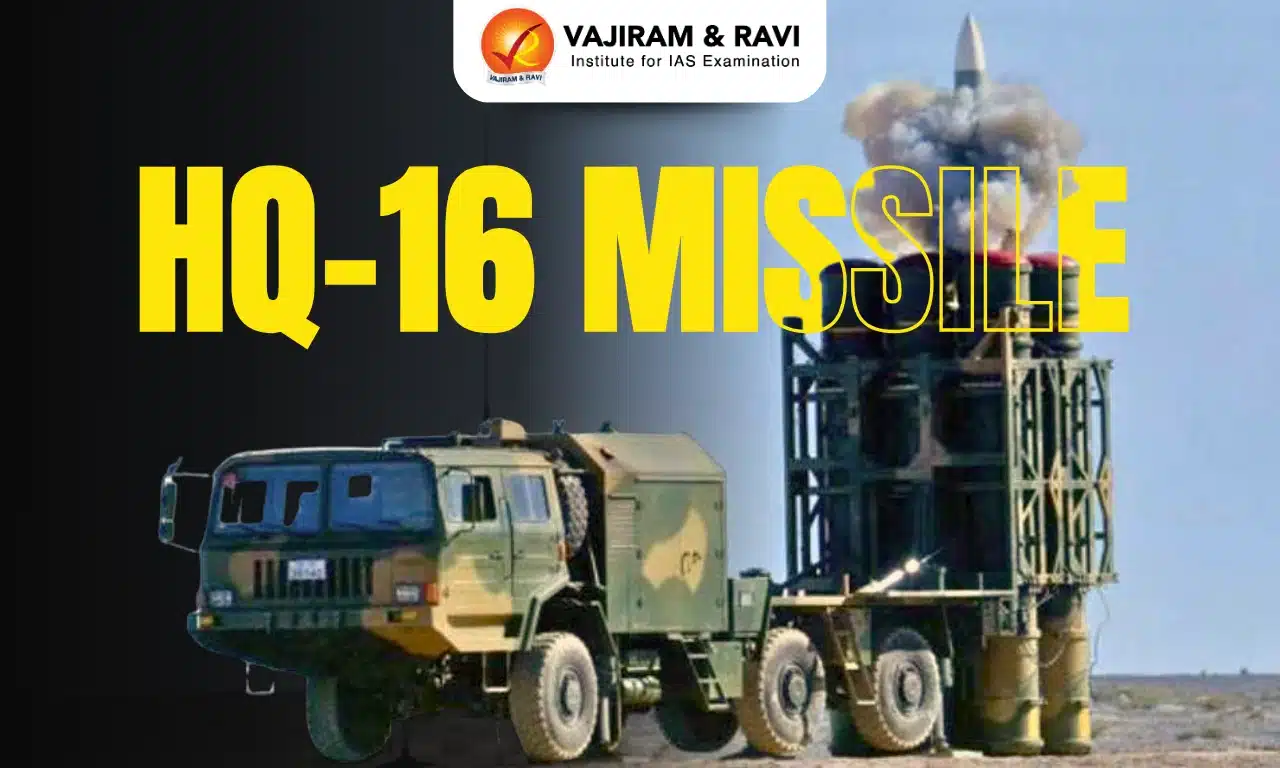
HQ-16 Missile Latest News
The United States military publicly unveiled a mockup of a Chinese HQ-16 surface-to-air missile system, drawing attention at this year’s Experimental Aircraft Association ‘AirVenture Show’ in Oshkosh, Wisconsin.
About HQ-16 Missile
- The HQ-16, known by its NATO designation CH-SA 16, is a medium-range surface-to-air missile (SAM) system developed by China and based heavily on Russia’s Buk missile family.
- It is designed to engage enemy aircraft, cruise missiles, helicopters, and unmanned aerial vehicles.
HQ-16 Missile Features
- HQ-16 features a vertical launch system, giving it 360-degree coverage and the capability to fire in a complicated geographical environment.
- The missile system is mounted on a Chinese-designed 6x6 high mobility chassis instead of tracked platforms, providing ease of maintenance and better road mobility.
- Each launch vehicle carries up to 6 missiles.
- The missile weighs 650 kg, has a length of 5.2 m and a diameter of 0.34 m.
- It can intercept flying aerial targets at altitudes of 15 km to 18 km.
- The maximum interception range for aircraft is 40 km, between 3.5 km and 12 km for cruise missiles flying at 300 m/s.
- The missile guidance system comprises inertial guidance and semi-active radar homing at the terminal phase.
Source: EURT
HQ-16 Missile FAQs
Q1: The HQ-16 surface-to-air missile system was developed by which country?
Ans: China
Q2: What is the maximum interception range of the HQ-16 missile against enemy aircraft?
Ans: 40 km
Q3: What kind of mobility platform does the HQ-16 system use?
Ans: 6x6 high mobility wheeled chassis
Q4: What type of guidance does the HQ-16 use?
Ans: The missile guidance system comprises inertial guidance and semi-active radar homing at the terminal phase.
