
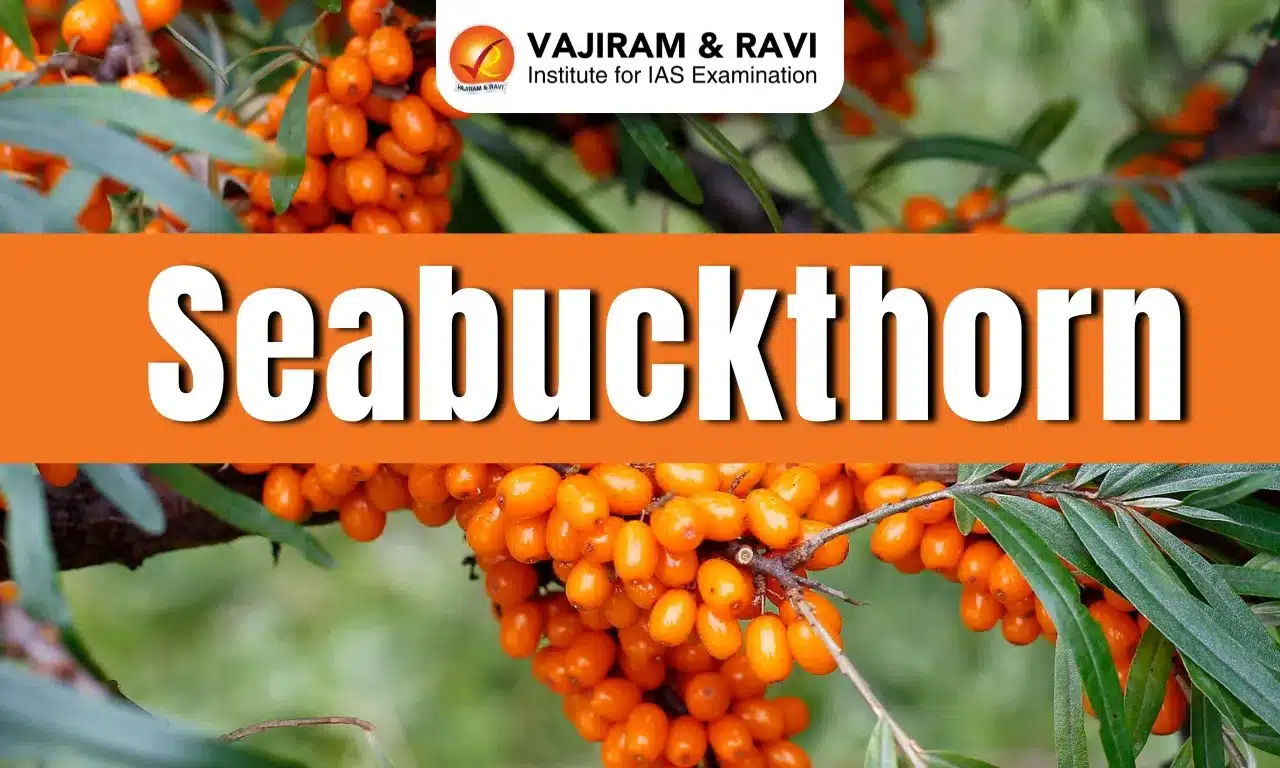
Seabuckthorn Latest News
Seeds of seabuckthorn and buckwheat grown in the cold desert of Ladakh are part of the experiments on board the International Space Station flown by NASA's Crew-11 mission.
About Seabuckthorn
- It is popularly known as the ‘Wonder Plant’, ‘Ladakh Gold’, ‘Golden Bush’, or ‘Gold Mine’ of cold deserts.
- Distribution: Sea buckthorn (Hippophae rhamnoides) is a plant found throughout Europe and Asia.
- In India, it is found above the tree line in the Himalayan region, generally in dry areas such as the cold deserts of Ladakh and Spiti.
- It produces small orange or yellow-coloured berries that are sour in taste but rich in vitamins, especially vitamin C.
- The shrub can withstand extreme temperatures ranging from minus 43 degrees Celsius to 40 degrees Celsius and is considered drought-resistant.
- These two characteristics make the shrub an ideal plant species to establish in cold deserts.
- Sea Buckthorn berries have a unique characteristic of remaining intact on the shrub throughout the winter months despite the subzero temperature.
Uses of Seabuckthorn
- It has been used traditionally for a variety of purposes.
- Every part of the plant–fruit, leaf, twig, root, and thorns has been traditionally used as medicine, nutritional supplement, fuel, and fence.
- Many bird species feed on the berries when other sources of food are limited in the region.
- The leaves serve as protein-rich fodder for cold desert animals like sheep, goats, donkeys, cattle, and double-humped camels.
Source: TH
Seabuckthorn FAQs
Q1: Why is seabuckthorn important?
Ans: Seabuckthorn is a soil-binding plant which prevents soil-erosion, checks siltation in rivers and helps preserve floral biodiversity.
Q2: What is sea buckthorn called in India?
Ans: In India, sea buckthorn berry is commonly called “Chharma” or “Leh berry”.

