
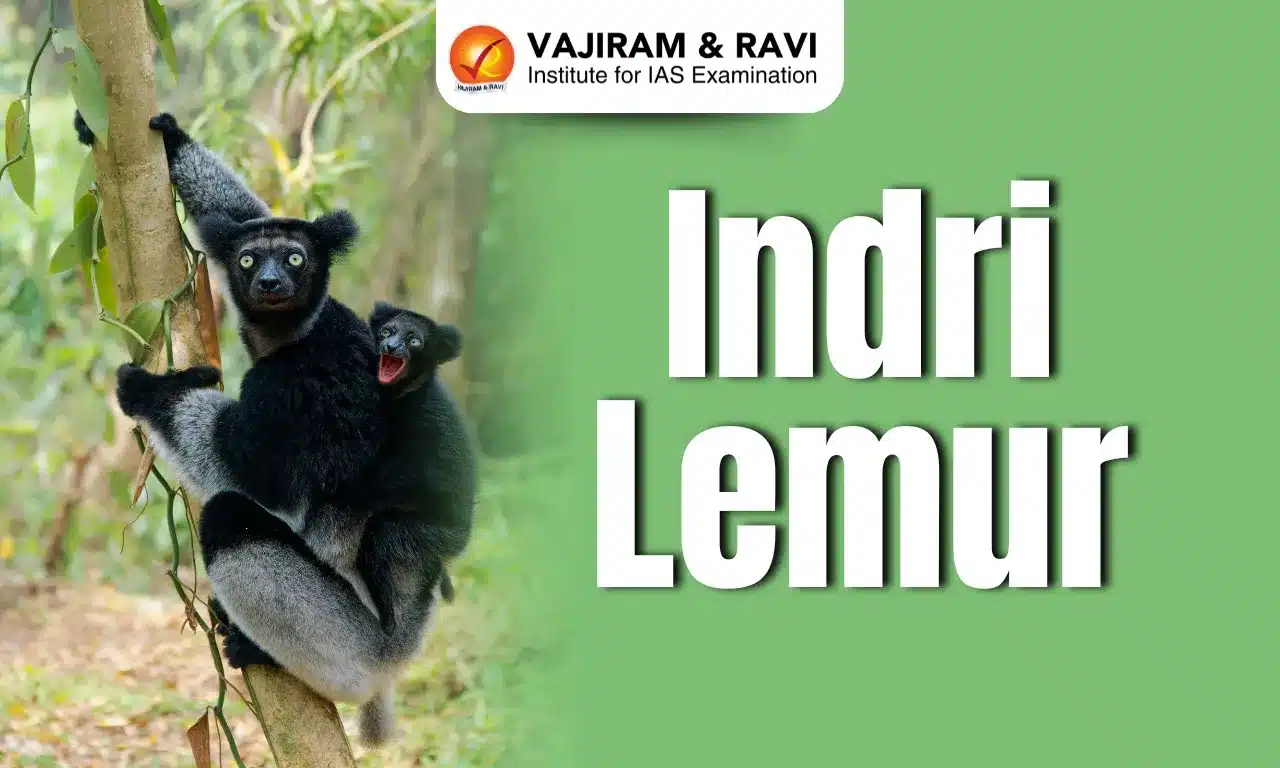
Indri Lemur Latest News
Joint research has, for the first time, ascertained the composition of the intestinal microbiome of the indri, a critically endangered lemur only found in the north-east of Madagascar.
About Indri Lemur
- Indri, or babakoto in the local language, is the largest of the surviving lemur species.
- Scientific Name: Indri indri
Indri Lemur Distribution
- Found only in remote parts of northeastern Madagascar.
- Resides in coastal and montane rainforest from sea level to 1,800 m.
Indri Lemur Features
- It is 60–70 cm (24–28 inches) long, with a rudimentary tail and large hands and feet.
- The round head has a pointed face and round, furry ears.
- Indris have smooth, silky fur covering their whole bodies.
- Its fur is black, with white on the head, throat, forearms, and buttocks; the relative proportions of white and black vary geographically.
- In the wild, indris live between 15 and 18 years.
- Active during the day and thoroughly arboreal, the indri clings to trees and climbs in an upright position as it feeds on leaves, fruit, flowers, and other vegetation.
Indri Lemur Conservation Status
It is classified as 'Critically Endangered' under the IUCN Red List.
Source: PHYS
Indri Lemur FAQs
Q1: Where do indri lemurs live?
Ans: Indri lemurs are found only in remote parts of northeastern Madagascar.
Q2: What is the conservation status of the Indri lemur as per the IUCN Red List?
Ans: Critically Endangered
Q3: What is the average lifespan of an Indri in the wild?
Ans: 15–18 years

