
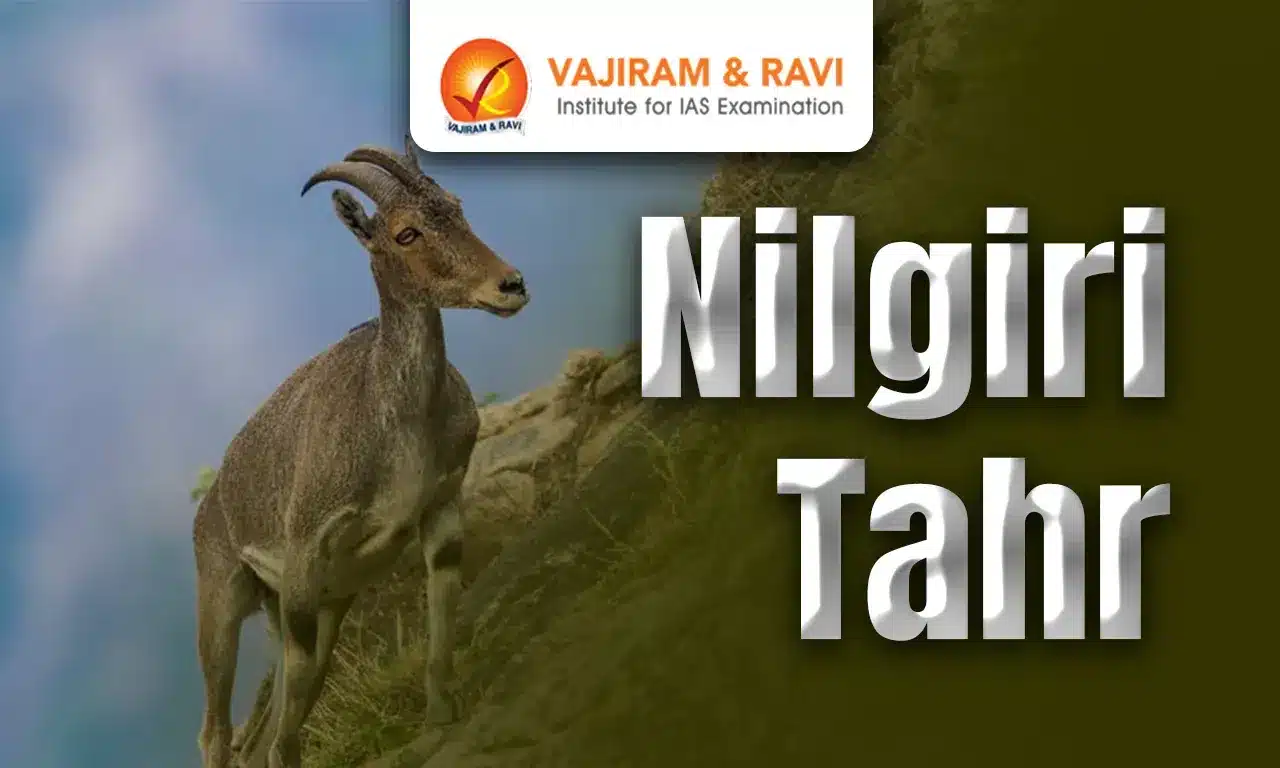
Nilgiri Tahrs Latest News
Recently, a joint census in Kerala and Tamil Nadu has reported a population of 2,668 Nilgiri tahrs.
About Nilgiri Tahrs
- The Nilgiri Tahr is a mountain ungulate endemic to the southern part of the Western Ghats.
- It is also known by the name Nilgiri Ibex or simply Ibex. Locally the animal is called ‘Varayaadu’.
- It is the only mountain ungulate in southern India.
Features of Nilgiri Tahr
- These are stocky goats with short, coarse fur and a bristly mane.
- The males are found to be larger than the females, and have a darker color when mature.
- Both sexes have curved horns, which are larger in the males.
- There are facial markings, particularly distinct in mature males.
Habitat and Distribution of Nilgiri Tahr
- It is found in a roughly 400 km stretch in the Western Ghats, which falls in the states of Kerala and Tamil Nadu.
- These tahrs inhabit the open montane grassland habitat of the southwestern ghats montane rain forests ecoregion.
- At elevations ranging from 1200 to 2600 m, the jungle opens into grasslands interspersed with pockets of stunted forests, known as ‘sholas.’
- The Eravikulam National Park (Kerala) has the highest density and largest surviving population of Nilgiri tahr.
Conservation Status Nilgiri Tahr
- IUCN Red List: Endangered
- Wildlife (Protection) Act of India, 1972: Schedule I
Source: TH
Nilgiri Tahr FAQs
Q1: What is the IUCN status of Nilgiri tahr?
Ans: Endangered
Q2: Where is Nilgiri Tahr endemic to?
Ans: The Nilgiri Tahr (also known as Nilgiri Ibex) is found primarily in the Western Ghats of southern India.
Q3: The Nilgiri Tahr is the state animal of which Indian state?
Ans: Tamil Nadu
