
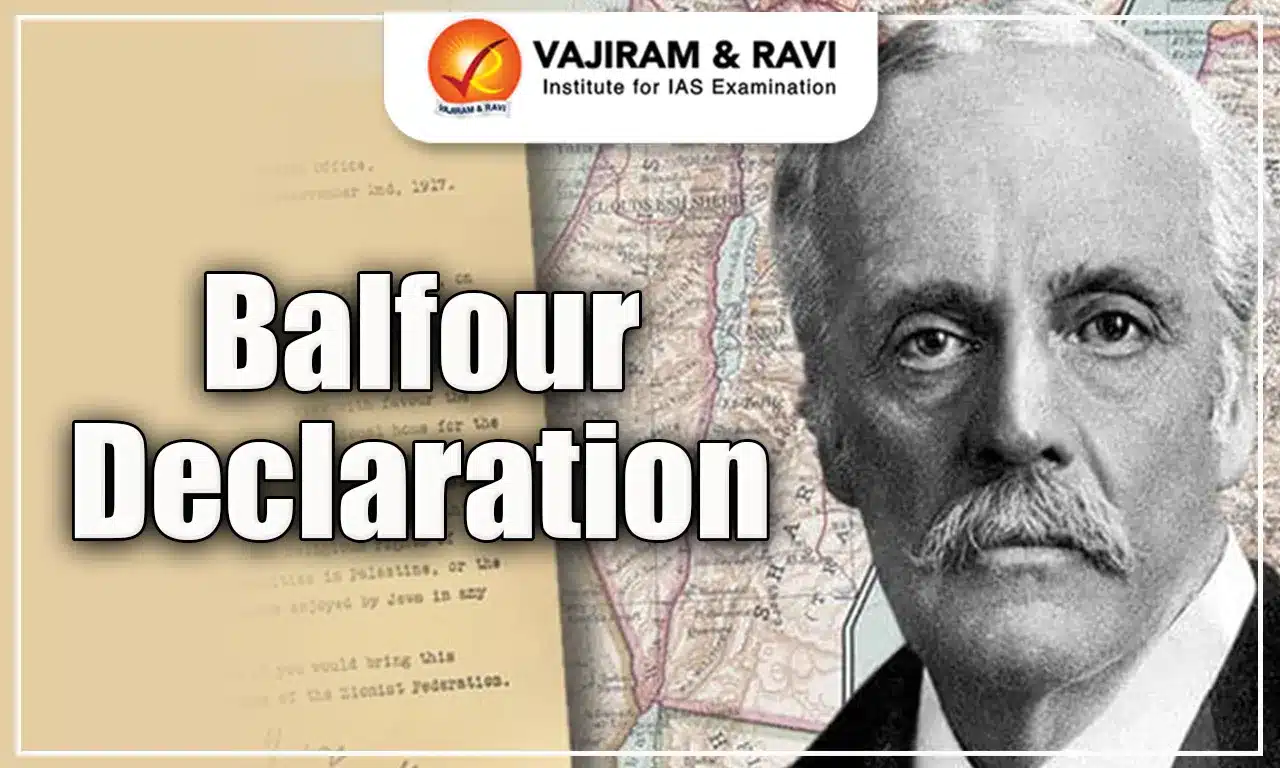
The Balfour Declaration is a public statement that the British Government issued on 2nd November, 1917 at the time of World War I. In the declaration, the government made a promise to support the establishment of a “national home for the Jewish people” in Palestine. Arthur Balfour, the Foreign Secretary, had made this declaration to Lord Rothschild, a popular leading Jewish Figure. The declaration became a source of controversy and conflict ever since it was announced. The process involved transfer of governance from the territories that were defeated in war- Germany, Austria-Hungary, the Ottoman Empire and Bulgaria to the victorious nations. In this article, we are going to cover all about the Balfour Declaration.
Balfour Declaration
The Balfour Declaration was issued by the British Government as a public statement during World War I in 1917. The declaration aimed to support the establishment of a “national home for the Jewish people” in Palestine, the Ottoman region along with a small minority Jewish population.
Balfour Declaration Historical Background
- The Zionist Movement starting in the late 19th century, spreading the word about a Jewish homeland in Palestine.
- When World War I began, the movement had already gained momentum and thousands of Jews had already started settling in Palestine.
- The British Government saw the Zionist cause as an important and a strategic ally against the Ottoman Empire during WWI.
- The British Government issued the Balfour Declaration on 2 November 1917, showing support for setting up a “national home for the Jewish people” in Palestine.
- This declaration shaped the future of israeli-Palestinian conflict and remains an important moment in Middle Eastern History.
Balfour Declaration Document
- The Balfour Declaration was given in a letter format by Arthur Balfour to Lord Rothschild, a leader of the British Jewish Community.
- The Balfour Declaration Document aimed to declare British Support for the Jewish Homeland while stating:
"Nothing shall be done which may prejudice the civil and religious rights of existing non-Jewish communities in Palestine." - The document did not mention any political or national rights for the Arab population and failed to recognise them by name.
- In the Arab World, the Balfour Declaration is still remembered as the Nakba, marking the beginning of dispossession and conflict.
Balfour Declaration Importance
The Balfour Declaration is important due to the following reasons:
- The declaration was the first official endorsement by the world power to accept Jewish national cause.
- The document paved the way for British mandate in Palestine and increased the Jewish immigration to the region.
- This also caused rift in between Jewish and Arab population in the Middle East.
- Many Islamic Nations saw the Balfour Declaration as a betrayal by the British.
- The term “Balfour Report” of 1926 also refers to a British document leading to Canada’s independence, later formalising in the Statute of Westminster(1931) unrelated to the 1917 declaration.
Balfour Declaration Results
The Balfour Declaration significantly influenced the geopolitical landscape of the Middle East and left a lasting legacy on regional politics and identity.
- It marked a turning point for the Zionist movement, eventually leading to the creation of the State of Israel in 1948.
- The vague assurance of a “national home for the Jewish people” in Palestine created deep-rooted tensions between Jews and Arabs, particularly over territorial claims.
- For Palestinians, the declaration signaled displacement, loss of homeland, and decades of statelessness fueling grievances that persist to this day.
- The declaration was perceived by many Arabs as a colonial strategy to divide the region, thereby intensifying anti-British sentiment and fueling Arab nationalism.
- It contributed indirectly to the formation of the United Nations in 1945, which attempted to mediate the Jewish-Arab conflict but has struggled to bring lasting resolution.
- The declaration laid the groundwork for a series of Arab-Israeli conflicts, beginning with the 1948 war and followed by wars in 1956, 1967, and 1973, each altering regional boundaries and power dynamics.
- Its legacy continues to shape the discourse around identity, occupation, and sovereignty in the Middle East, making it one of the most consequential documents in modern history.
Balfour Declaration FAQs
Q1: What was the Balfour Declaration of 1927?
Ans: The 1927 Balfour Declaration reaffirmed British support for the development of self-governing dominions within the British Empire.
Q2: When was the Balfour Declaration 1926?
Ans: The 1926 Balfour Declaration was issued on 18 November 1926 at the Imperial Conference.
Q3: What was the letter from Lord Balfour to the Rothschilds?
Ans: The 1917 Balfour Declaration was a letter from Arthur Balfour to Lord Rothschild expressing British support for a Jewish homeland in Palestine.
Q4: When did the World War-I begin?
Ans: World War I began on 28 July 1914.
Q5: What was the Zionist Movement?
Ans: The Zionist Movement was a political and nationalist movement advocating for the establishment of a Jewish homeland in Palestine.

