
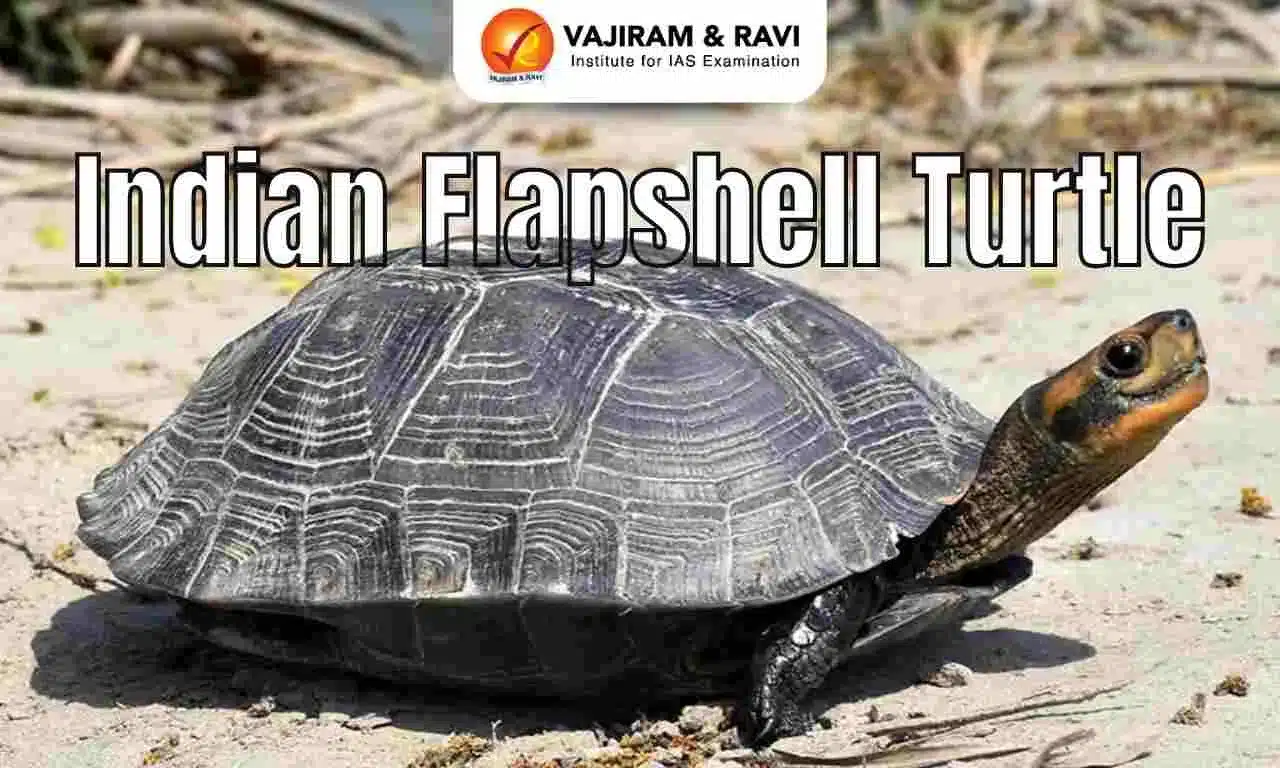
Indian Flapshell Turtle Latest News
In a rare sighting, an albino Indian flapshell turtle with a striking yellow shell and skin was recently spotted in a freshwater lake at Chikodra village, Gujarat.
About Indian Flapshell Turtle
- It is a freshwater turtle commonly found in tropical South Asian Countries.
- Scientific Name: Lissemys punctata
- Distribution: They are mainly found in Pakistan, India, Sri Lanka, Nepal, Bangladesh , and Myanmar.
- Habitat:
- They live in the shallow, quiet, often stagnant waters of rivers, streams, marshes, ponds, lakes and irrigation canals, and tanks.
- These turtles prefer waters with sand or mud bottoms because of their tendency to burrow.
Indian Flapshell Turtle Features
- Its identifiers are the femoral flaps that extend from the shell and cover the limbs when the turtle withdraws into its shell.
- The oval soft shell of the flapshell turtle is an evolutionary connection to hardshell turtles.
- They can grow up to 370 mm in length and live for about 20 years.
- They are omnivores.
- They are generally solitary and active during the day.
- They are highly adaptable beings. They can survive in extreme droughts for about 120-160 days.
Indian Flapshell Turtle Conservation status
- IUCN Red List: Vulnerable
- CITES: Appendix I
- Wildlife (Protection) Act, 1972: Schedule I
What is Albinism?
- Albinism is a rare genetic condition that affects the level of melanin, or what pigments hair, skin, and eyes in mammals, birds, reptiles, amphibians, and fish.
- This is a mutation that is passed from parent to offspring.
- It is a recessive trait that occurs in every one out of 10,000 births.
- Both of the parents of the offspring must carry the gene in order for the animal to be albino.
- Some animals are full albino while others possess albino traits.
- Partial albinism is known as leucism. Animals that are leucistic might have white fur, scales, or skin, but their eyes will not be pink or red.
Source: TOI
Indian Flapshell Turtle FAQs
Q1: What is the scientific name of the Indian Flapshell Turtle?
Ans: Lissemys punctata
Q2: What unique feature gives the Indian Flapshell Turtle its name?
Ans: Flaps of skin that cover the limbs when withdrawn into the shell.
Q3: What is the IUCN Red List status of the Indian Flapshell Turtle?
Ans: Vulnerable
Q4: What is the typical lifespan of the Indian Flapshell Turtle?
Ans: 20 years
