
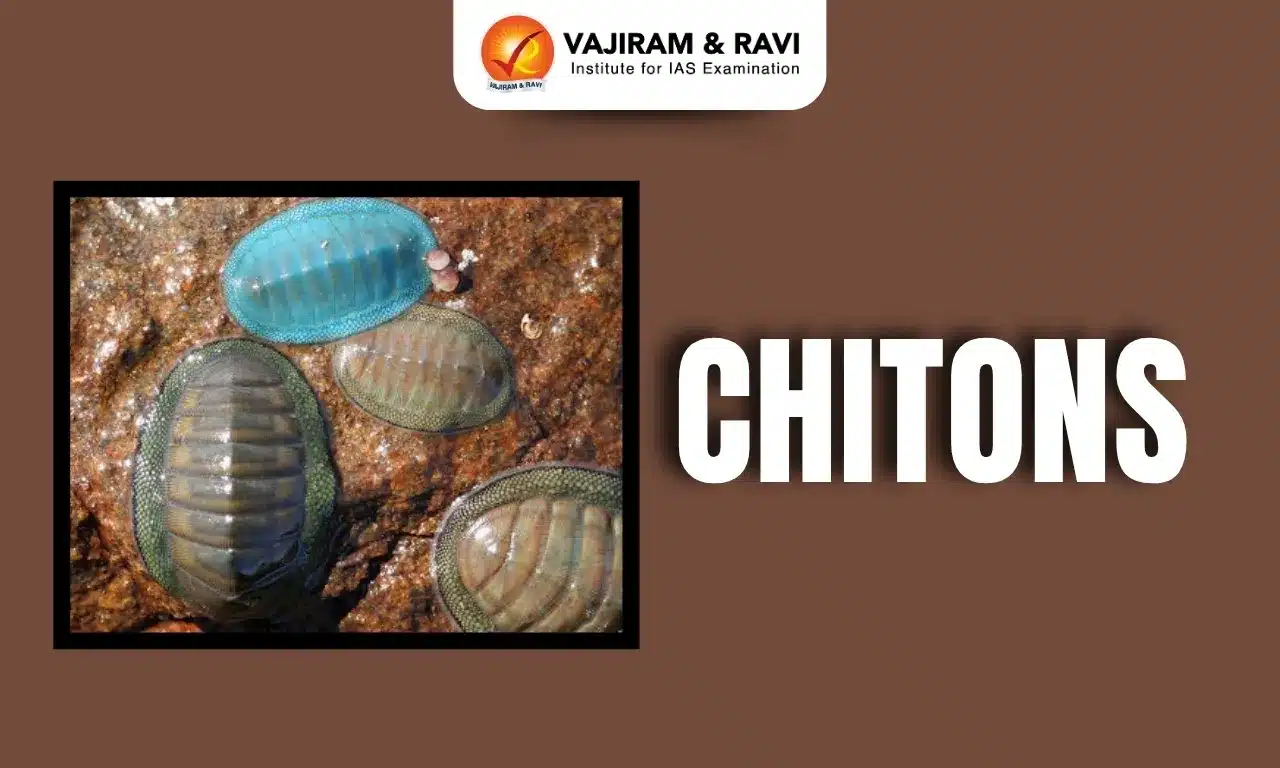
Chitons Latest News
A groundbreaking new study published recently reveals that chitons grow teeth that aren’t just hard; they're harder than stainless steel, zirconium oxide, and even human enamel.
About Chitons
- They are flattened, bilaterally symmetrical marine invertebrates.
- Chitons belong to the phylum Mollusca (along with sea snails, sea slugs, and bivalves).
- Chitons occur only in marine habitats. They are worldwide in distribution but most abundant in warm regions.
- The approximately 600 species are usually placed in the class Placophora, Polyplacophora, or Loricata.
Chitons Features
- Chitons are usually oval in shape.
- They vary in appearance and can be found in shades of grey and brown, red, green, and pink.
- On the dorsal (upper) surface is a row of eight overlapping plates surrounded or covered by a tough girdle.
- Chitons use a large, flat foot for creeping along and clinging to rocks; they also have a well-developed radula (filelike structure) with which to scrape algae and other plant food from rocks.
- On either side of the foot is a groove containing the gills.
- About 5 cm (2 inches) is the maximum length of most chitons.
- Chitons are very flexible and can fit snugly into rock crevices or curl into a ball when detached.
- They can also adhere so firmly to rocks that they may be injured when pried loose.
- Life span typically ranges from a few years to 20 years.
- Most are nocturnal in habit.
Source: TOI
Chitons FAQs
Q1: Chitons belong to which phylum?
Ans: Chitons belong to the phylum Mollusca.
Q2: What is the typical maximum length of most chitons?
Ans: 5 cm (2 inches)
Q3: The lifespan of chitons typically ranges from how many years?
Ans: Life span of chitons typically ranges from a few years to 20 years.
