
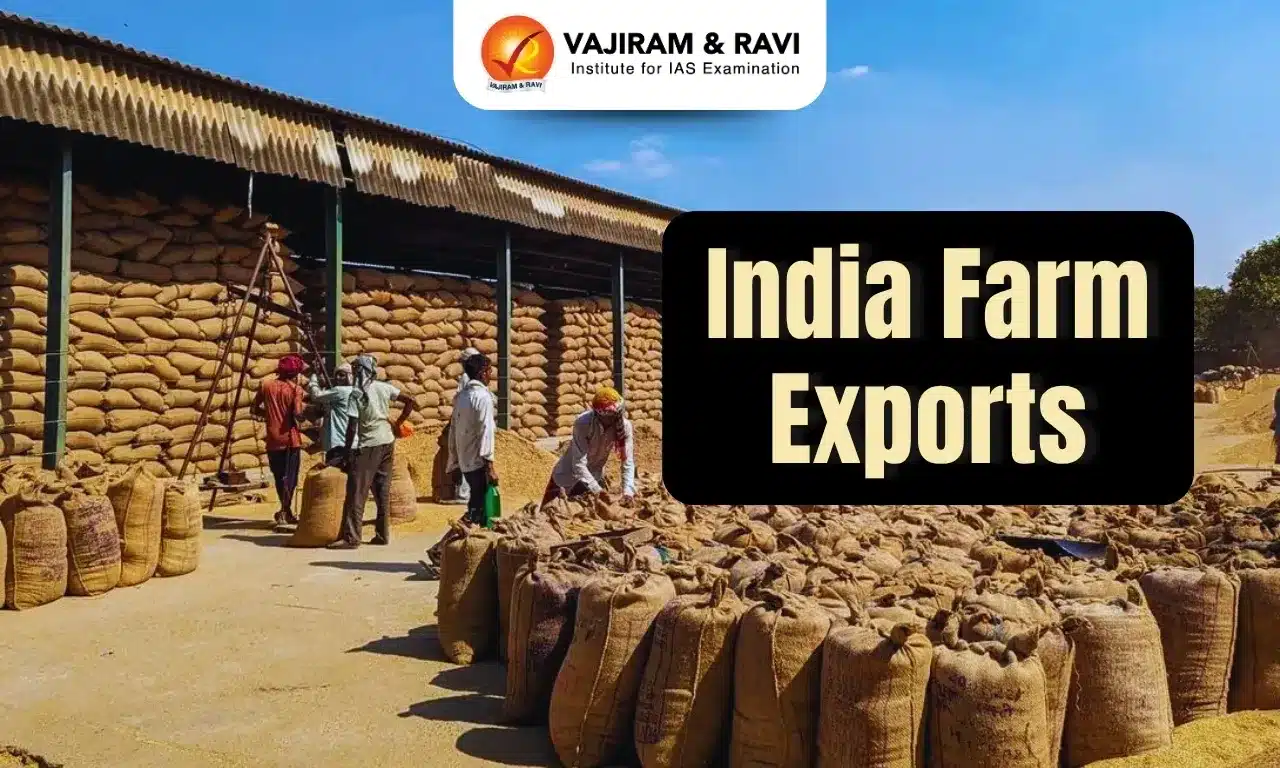
India Farm Exports Latest News
- While overall merchandise export growth remains flat and unlikely to exceed the 2022-23 peak of $451.1 billion, agricultural exports are driving India’s export momentum, showing resilience and record-breaking potential.
India’s Export Performance in 2024-25
- In 2024-25, India’s merchandise exports stood at $437.4 billion, just 0.1% higher than the $437.1 billion in 2023-24.
- During April-June 2025, exports rose to $112 billion, a 1.7% increase from $110.1 billion in the same period last year.
- Union govt expressed confidence that exports this fiscal would surpass last year’s levels, despite potential disruptions from U.S. President Donald Trump’s tariff measures, including a 50% duty on Indian goods.
Agricultural Exports: Strong Upward Trend
- Agricultural exports recorded robust growth of 6.4%, increasing from $48.8 billion in 2023-24 to $51.9 billion in 2024-25.
- The first quarter of 2025-26 posted a further 5.8% year-on-year rise.
- If current trends continue, farm exports could reach $55 billion in 2025-26, surpassing the previous record of $53.2 billion in 2022-23.
- India’s agricultural exports to the U.S. have been particularly strong, growing by 24.1% during January-June 2025 compared to the same period in 2024.
Drivers and Risks for India’s Farm Exports
- India’s farm exports surged from $7.5 billion in 2003-04 to $43.3 billion in 2013-14, later peaking at $53.2 billion in 2022-23 due to a global agri-commodity price boom.
- The FAO food price index rose from 96.4 (2019-20) to 140.6 (2022-23).
- The 2023-24 decline was driven by drought and government curbs on wheat, rice, sugar, and onion exports to control food inflation.
- These restrictions eased in 2024-25 as monsoon-aided farm output improved, with a second consecutive above-normal monsoon likely allowing sugar export resumption.
- Sugar net exports fell sharply from $5.5 billion (2022-23) to $771.3 million (2024-25).
- In Q1 2025-26, major items like marine products, non-basmati rice, buffalo meat, coffee, tobacco, and fruits & vegetables posted strong growth.
- Coffee exports benefited from low global stocks due to poor harvests in Brazil and Vietnam, while tobacco shipments rose following output shortfalls in Brazil and Zimbabwe.
- Brazil and Vietnam are the world’s biggest producers of arabica and robusta varieties respectively.
- India mostly exports robusta beans and powder used in instant coffee and espresso blends.
Tariff Risks and Competitive Pressures
- From August 27, 2025, U.S. tariffs of 50% on Indian goods could hit marine products hardest, with the U.S. taking 35% of India’s exports in this category.
- Frozen shrimps and prawns alone sent $1.9 billion of the $4.5 billion total to the U.S.
- Similar tariffs on Brazilian goods may divert their coffee surplus to other markets, potentially lowering prices and hurting Indian exports.
India’s Agricultural Import Trends and Growing Dependence
- India maintained a $13.4 billion agricultural trade surplus in 2024-25, with farm exports ($51.9 billion) exceeding imports ($38.5 billion), even as the surplus has fallen sharply from $27.7 billion in 2013-14 due to faster import growth.
- Agricultural imports remain concentrated in a few commodities, with over two-thirds coming from vegetable oils, pulses, and fresh fruits.
- Fresh fruit imports — worth $1.7 billion, largely from the U.S. — include almonds, pistachios, walnuts, apples, grapes, kiwis, figs, pears, and dates.
- Pulses imports hit a record 7.3 million tonnes ($5.5 billion) in 2024-25 after duty cuts following the 2023-24 El Niño drought, though they have reduced this year with a bumper harvest.
- Vegetable oil imports (palm, soyabean, sunflower) continue rising as domestic production lags demand.
- Cotton and natural rubber imports have also grown due to declining domestic output since their peaks in 2013-14 and 2012-13, respectively.
Agriculture Emerges as a Sticking Point in India–US Trade Talks
- PM Modi’s recent statement that India will never compromise the interests of its farmers, livestock rearers, and fisherfolk underscores the government’s firm stance in stalled trade negotiations with the US.
- The key point of contention is opening India’s market to US farm produce — including GM maize, soyabean, fuel ethanol, and dairy products — which New Delhi now wants excluded from any deal.
- This hardened position is shaped by domestic political sensitivities and US President Donald Trump’s tariff measures, including a 50% duty on Indian imports, part of which penalises oil purchases from Russia.
India Farm Exports FAQs
Q1: What was India’s agricultural export value in 2024-25?
Ans: $51.9 billion, up 6.4% from the previous year.
Q2: Which products saw strong export growth in Q1 2025-26?
Ans: Marine products, non-basmati rice, buffalo meat, coffee, tobacco, fruits, and vegetables.
Q3: What factors boosted coffee exports?
Ans: Poor harvests in Brazil and Vietnam reducing global stock levels.
Q4: What is India’s agricultural trade surplus in 2024-25?
Ans: $13.4 billion, with exports exceeding imports.
Q5: Why is agriculture a sticking point in India–US trade talks?
Ans: India refuses to open its market to US farm products like GM maize and soyabean.
