
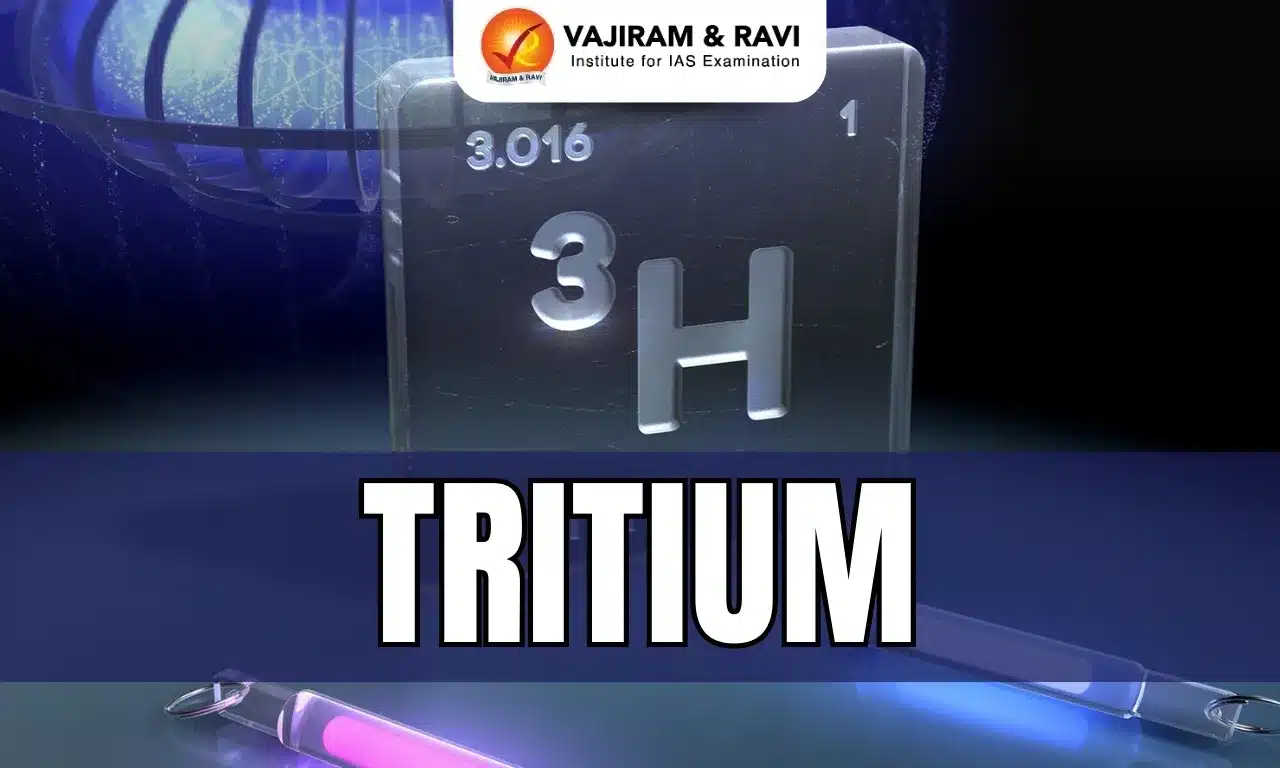
Tritium Latest News
A recent global ocean model study by the University of Tokyo and Fukushima University researchers have confirmed that the Fukushima Daiichi Nuclear Power Plant’s tritium wastewater release poses minimal impact on ocean waters.
About Tritium
- Tritium is a radioactive isotope of hydrogen.
Features of Tritium
- It has the same number of protons and electrons as hydrogen but has 2 neutrons, whereas regular hydrogen does not have any. This makes tritium unstable and radioactive.
- It is produced naturally from interactions of cosmic rays with gases in the upper atmosphere.
- Tritium can also be produced by man during nuclear weapon explosions, in reactors intended to produce tritium for nuclear weapons.
- It is the only radioactive isotope of hydrogen and like hydrogen it reacts with oxygen to form water.
- The transformation of tritium to tritiated water is a complex and slow process. Tritium is a colorless, odorless gas with a half-life of 12.3 years.
- As a liquid, tritium moves easily through the environment just like water.
- It occurs naturally in the environment in very low concentrations.
Uses of Tritium
- It can be combined with phosphor to create glow-in-the-dark lighting such as exit signs, emergency lighting in buildings, and airport runway lights.
- Medical Field: It is also used as a tracer in biomedical research to study and diagnose heart disease, cancer and AIDS.
- Electricity Generation: It may also be used to generate electricity in fusion reactors.
Source: TH
Tritium FAQs
Q1: What is tritium used for?
Ans: It is used to make luminous dials and as a source of light for sarety signs.
Q2: Is tritium toxic to humans?
Ans: Tritium is a hazard only when taken inside the body.
