
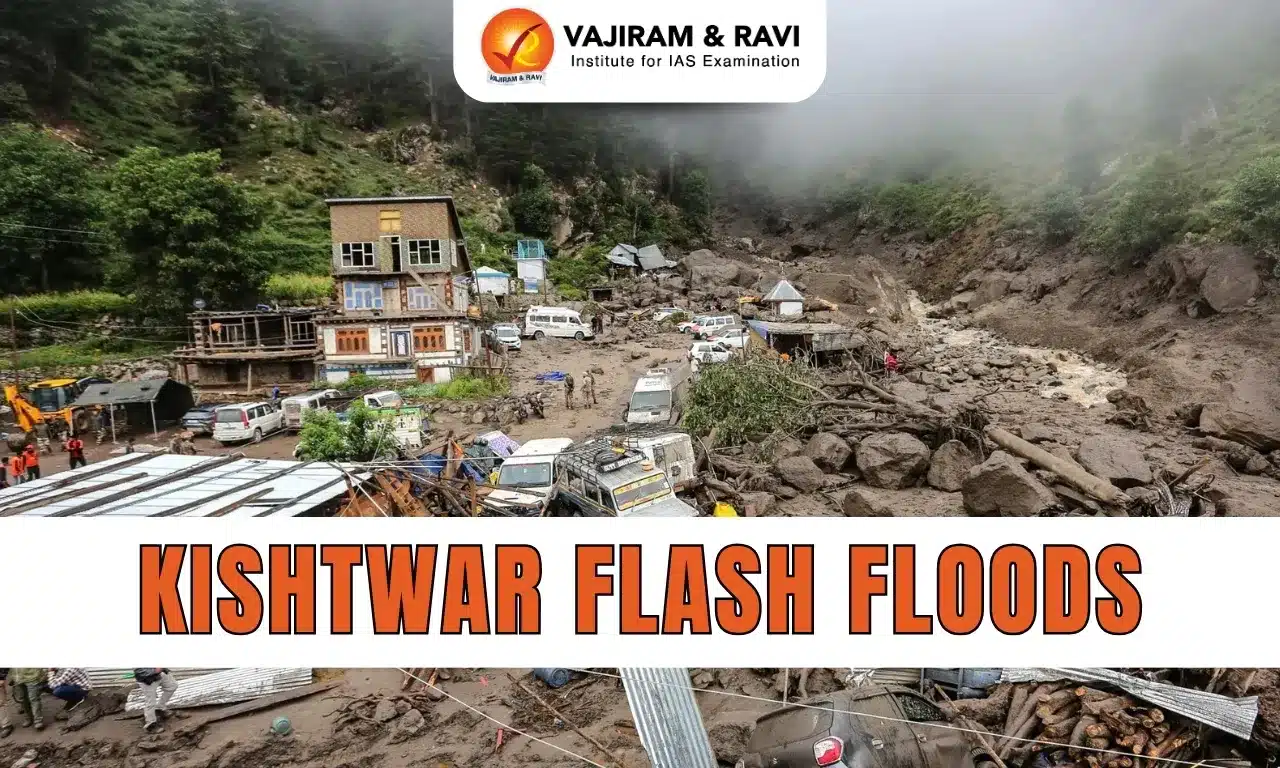
Kishtwar Flash Floods Latest News
- At least 65 people died and over 50 remain missing after a flash flood triggered by torrential rain hit Chasoti village in Kishtwar, Jammu & Kashmir. The disaster struck near the route to the Machail Mata temple.
- While scientists caution against linking any single extreme event directly to climate change, they note that rising global temperatures and shifting weather patterns have made such incidents — including flash floods and wildfires — more frequent and severe.
- In Jammu & Kashmir, as elsewhere in India, the increasing frequency of extreme weather events driven by climate change has already caused the deaths of thousands in recent years.
Extreme Weather Events in Jammu & Kashmir (2010–2022)
- Between 2010 and 2022, Jammu & Kashmir experienced 2,863 extreme weather events that claimed 552 lives, according to a 2024 study published in Mausam by IMD scientists.
- The most frequent occurrences were thunderstorms (1,942 incidents) and heavy rain (409 incidents), while flash floods (168 incidents) and landslides (186 incidents) also posed significant threats.
- Although heavy snow was less frequent (42 incidents), it caused the highest fatalities — 182 deaths — making it the deadliest weather phenomenon during this period.
- The study also highlighted that Kishtwar, Anantnag, Ganderbal, and Doda districts recorded the highest number of deaths from flash floods.
- Overall, the research concluded that while heavy rain and heavy snow remain the primary weather-related killers, other hazards such as flash floods, thunderstorms, and windstorms are increasingly emerging as major threats in Jammu & Kashmir.
Key Drivers of Extreme Weather Events in J&K
- Although several factors contribute to the occurrence of extreme weather events in J&K, the three significant drivers behind these events are rising temperatures, the changing pattern of Western Disturbances, and the region’s topography.
Rising Temperatures and Their Impact on J&K
- The western Himalayas, where Jammu & Kashmir lies, have warmed at twice the rate of the Indian subcontinent since 2000.
- This sharp rise in temperature has intensified both mean and extreme precipitation.
- A warmer atmosphere can hold more moisture — about 7% extra water vapour for every 1°C rise — resulting in heavier and more frequent rainfall events that often trigger severe flooding.
- Higher temperatures have also accelerated glacial shrinkage, increasing the number of unstable glacial lakes.
- These lakes, being relatively young, have fragile edges prone to erosion, melting, and sudden breaches.
- When heavy rainfall occurs, they overflow, releasing slush and sediment that cause catastrophic downstream floods.
- As per climate experts, these unstable lakes make the region particularly vulnerable.
- Intense rain not only swells rivers but also destabilises glacial lakes, compounding the risk of flash floods and large-scale destruction.
Changing Nature of Western Disturbances
- Western Disturbances (WDs) are east-moving rain-bearing wind systems that originate beyond Afghanistan and Iran, gathering moisture from the Mediterranean, Black, Caspian, and Arabian Seas.
- Traditionally active in winter months (December–March), they are now increasingly affecting weather outside the winter season.
- This increases the risk of floods and heavy rainfall in India’s Himalayan states, including Jammu & Kashmir.
- Climate change has altered their behaviour. The rapid warming of the Arabian Sea releases more moisture into these systems.
- When WDs extend into the North Arabian Sea, they absorb this excess moisture, intensifying rainfall over the hills.
- This shift means that global warming is strengthening and prolonging the influence of WDs, making extreme rainfall and flash floods more frequent in the region.
Topography and Vulnerability of J&K
- Jammu & Kashmir’s hilly and mountainous terrain amplifies its exposure to extreme weather events.
- The Himalayas consist of diverse ranges that significantly influence local weather systems.
- One of the key processes is orographic rainfall.
- As moist air is forced to ascend over the mountains, it cools and condenses, resulting in heavy precipitation.
- This process makes the region more prone to sudden and intense rain, often triggering flash floods, landslides, and cloudbursts.
- The unique Himalayan topography acts as a natural trigger for extreme events, meaning that climate change impacts — like warming temperatures and shifting Western Disturbances — are magnified by the terrain.
Kishtwar Flash Floods FAQs
Q1: What caused the Kishtwar flash floods?
Ans: Torrential rains triggered flash floods, intensified by climate change and fragile Himalayan terrain.
Q2: How has climate change impacted J&K?
Ans: Rising temperatures, shifting western disturbances, and shrinking glaciers increased extreme rainfall and flooding.
Q3: Which events are frequent in J&K?
Ans: Thunderstorms, heavy rain, landslides, flash floods, and heavy snowfall dominate extreme weather events.
Q4: Why is J&K more vulnerable?
Ans: Its mountainous topography amplifies orographic rainfall and unstable glacial lakes, making it disaster-prone.
Q5: What did IMD studies reveal?
Ans: Between 2010–2022, J&K saw 2,863 extreme events, causing 552 deaths, with heavy snow deadliest.
