Kalai-II Hydroelectric Project

Kalai-II Hydroelectric Project

Kalai-II Hydroelectric Project Latest News

The Arunachal Pradesh State Pollution Control Board (APSPCB) recently conducted a public hearing for environmental clearance for the proposed 1,200 MW Kalai-II hydroelectric project in Anjaw district, being developed by THDC India Limited.

About Kalai-II Hydroelectric Project

  • It is a 1,200 MW hydropower project planned on the Lohit River (a tributary of the Brahmaputra River) in the Anjaw District of Arunachal Pradesh.
  • The project is being developed and currently owned by THDC India Limited (formerly Tehri Hydro Development Corporation Limited).
  • It is a run-of-river with pondage project. 
  • The project involves construction of a concrete gravity dam, upstream & downstream coffer dam, diversion tunnel, intake tunnel, pressure Shafts, underground Powerhouse complex, surge chamber, and Tail Race Tunnel, etc. 
  • The hydro reservoir capacity is planned to be 318.8 million cubic meters. 
  • The gross head of the project will be 125 m.
  • It consists of 6 turbines, each with 190 MW nameplate capacity.

Source: TOI

Kalai-II Hydroelectric Project FAQs

Q1: On which river is the Kalai-II Hydroelectric Project planned?

Ans: Lohit River

Q2: What is the total installed capacity of the Kalai-II Hydroelectric Project?

Ans: 1,200 MW

Q3: What type of hydroelectric project is Kalai-II?

Ans: Run-of-river with pondage project.
Didayi Tribe

Didayi Tribe

Didayi Tribe Latest News

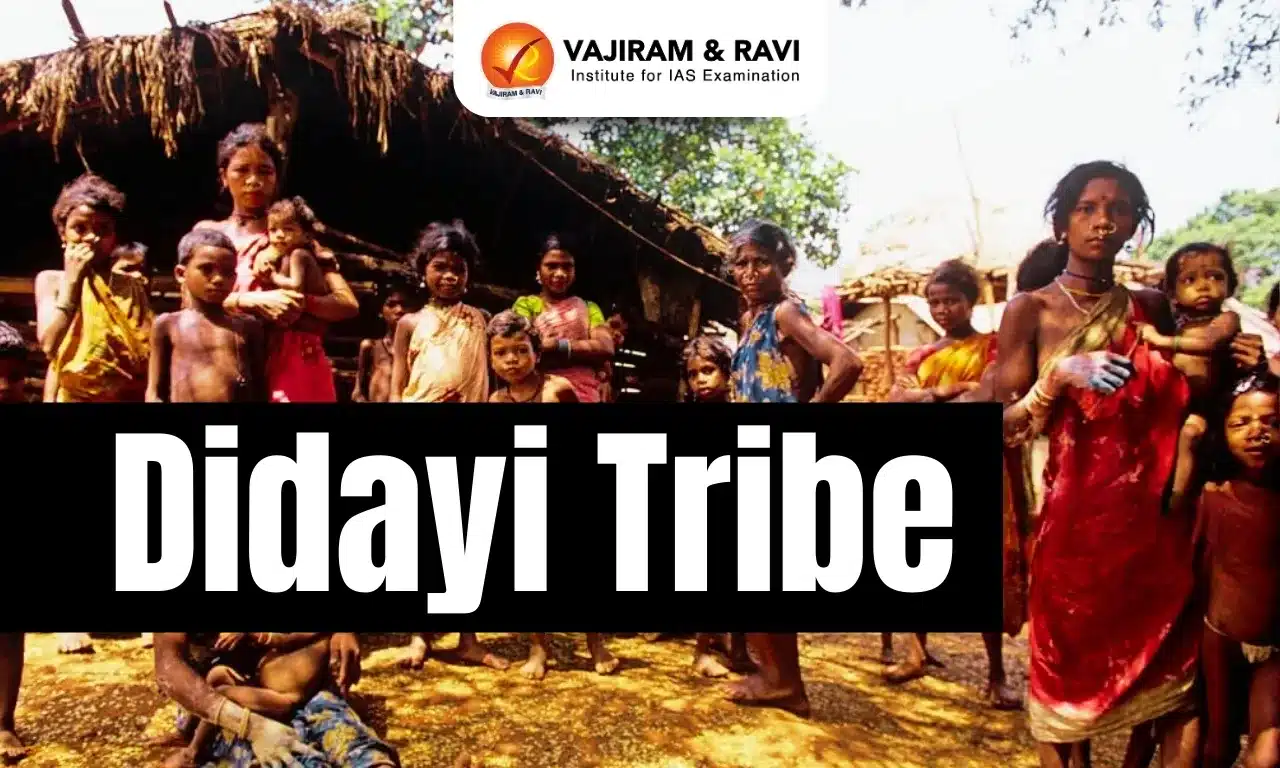
Champa Raspeda, a student from Odisha’s Malkangiri district, has made history by becoming the first member of the Didayi, a Particularly Vulnerable Tribal Group (PVTG), to clear NEET 2025.

About Didayi Tribe

  • The Didayi tribe, also known as the Didai people or Didiya tribe, is an indigenous tribal community residing in the Malkanagiri district of Odisha.
  • They are one of 13 Particularly Vulnerable Tribal Groups (PVTG) in Odisha.
  • They belong to the Proto-Australoid racial stock. 
  • They speak a language which has been included under the Austroasiatic language family.
  • The Didayi’s social structure is patriarchal, and their religious beliefs are rooted in animism, with a deep reverence for the natural world. 
  • They live in small, remote forest villages, often in the Eastern Ghats hills.
  • Villages have a traditional council of elders that settles disputes.
  • Houses are typically thatched huts built with mud walls and bamboo.
  • The primary occupation of the Didayi tribe traditionally revolves around agriculture, hunting, gathering, and fishing.

Source: IT

Didayi Tribe FAQs

Q1: The Didayi Tribe resides in which state?

Ans: Odisha

Q2: What is the primary occupation of the Didayi tribe?

Ans: Agriculture, hunting, gathering, and fishing.

Q3: The Didayi tribe belongs to which racial stock?

Ans: Proto-Australoid racial stock

GIAHS Programme

GIAHS Programme

GIAHS Programme Latest News

Recently, the Minister of State for Agriculture and Farmers Welfare informed the Lok Sabha that India currently hosts three Globally Important Agricultural Heritage Systems (GIAHS).

About GIAHS Programme

  • The Globally Important Agricultural Heritage Systems (GIAHS) is a Food and Agriculture Organization’s programme launched at the World Summit for Sustainable Development in 2002.
  • It was launched in response to global threats to family farming and traditional agricultural systems, such as climate change, community displacements and
    biodiversity loss.
  • It is aiming to strike a balance between conservation, sustainable adaptation and socioeconomic development, the programme helps to mitigate the threats faced by farmers while enhancing the benefits of farming systems.
  • It uses a multistakeholder approach, GIAHS provides
    • Technical assistance, promotes the value of traditional agricultural knowledge and stimulates markets for agricultural products, agrotourism and other market opportunities.

India’s GIAHS

  • Koraput region (Odisha): It is renowned for its subsistence paddy cultivation, predominantly on highland slopes, and is home to a vast diversity of paddy landraces and farmer-developed varieties.
  • It also harbors rich genetic resources of medicinal plants, deeply interwoven with the indigenous tribal communities and their traditional knowledge systems.
  • Kuttanad system (Kerala): It is a unique below-sea-level farming landscape, comprising wetlands for paddy cultivation and fish catching, garden lands for coconut and food crops, and inland water bodies for fishing and shell collection.
  • Saffron Park of Kashmir: It represents a rich agro-pastoral system characterized by traditional saffron cultivation, intercropping, and the use of organic farming practices, all of which contribute to maintaining local biodiversity and soil health.

Source: PIB

GIAHS Programme FAQs

Q1: What are the GIAHS of India?

Ans: Koraput region in Odisha, Kuttanad farming system in Kerala, and the Saffron Heritage of Kashmir

Q2: Where is the headquarters of the Food and Agriculture Organization (FAO)?

Ans: Rome, Italy

Made in India Label Scheme

Made in India Label Scheme

Made in India Label Scheme Latest News

The Made in India Label Scheme promotes domestic manufacturing and informs consumers about product origin and the Government has proposed INR 995 crores for three years.

About Made in India Label Scheme

  • It is an initiative that lends support to the manufacturing industry by building a brand reputation, stronger identity and wider reach for made in India products. 
  • Aim: To strengthen the reputation of the products manufactured in India. It also guarantees authenticity of the products originating from India and/or crafted with locally sourced raw materials.
  • This is a voluntary certification scheme to help manufacturers demonstrate that their products are manufactured in India and are of good quality.
  • The label displays a QR code and a logo with the information around location of manufacturing, validity of the label and other product specific information.
  • The initiative is being led by the Department for Promotion of Industry and Internal Trade (DPIIT).
  • The Quality Council of India and the India Brand Equity Foundation are actively collaborating with DPIIT in an advisory capacity.

Objectives of the Made in India Label Scheme

  • The scheme provides identity to the product based on its origin
  • It develops a mechanism to qualify and brand the products of Indian origin
  • It also supports in recognising the products of Indian origin in domestic as well as international market
  • The Made in India Label strengthens the positioning of the product in the competitive market, as the label would indicate authenticity, quality and differentiation among other products.

Eligibility Criteria

  • Manufacturers and producers who manufacture or assemble their products wholly or substantially in India.
  • Each product has a specific quality and manufacturing criteria set by relevant regulatory bodies which needs to be met before obtaining the permission.

Source: PIB

Made in India Label Scheme FAQs

Q1: What are the 4 pillars of Make in India initiative?

Ans: The four pillars of Make in India are: New processes, new infrastructure, new sectors, and new mindset.

Q2: What is the slogan of Make in India?

Ans: "Zero Defect Zero Effect"

Pseudomonas Aeruginosa

Pseudomonas Aeruginosa

Pseudomonas Aeruginosa Latest News

Recently, a team of researchers, led by scientists from the Helmholtz Centre for Infection Research in Germany, has reported that a gene in the bacterium Pseudomonas aeruginosa shows bistable expression.

About Pseudomonas Aeruginosa

  • It is a gram-negative, aerobic, non-spore forming rod shaped bacterium.
  • It is capable of causing a variety of infections in both immunocompetent and immunocompromised hosts.
  • It is commonly found in the environment, particularly in freshwater.
  • It can cause a wide array of community-acquired infections like folliculitis, puncture wounds leading to osteomyelitis, pneumonia, otitis externa, and many others.
  • It is commonly an opportunistic pathogen and is also an important cause of nosocomial infections like ventilator-associated pneumonia, catheter-associated urinary tract infections, and others.
  • Most burn victims succumb to secondary P. aeruginosa infections.
  • It is a major cause of keratitis, an eye infection, and also infects urinary catheters.

What is a Bistable Expression in Bacteria?

  • Two bacterial cells with identical genomes — and even from the same colony — can be quite different from each other.
  • One cell might express a particular gene at a high level while the other might express it at a low level or not at all.
  • Each bacterium goes on to transmit its expression level to its offspring in a process called epigenetic inheritance.
  • Such variations among identical cells and organisms are called bistability.
  • Bistability might be a survival strategy that single-celled organisms use to adapt to fluctuating environmental conditions.

Source: TH

Pseudomonas Aeruginosa FAQs

Q1: Which disease is caused by Pseudomonas aeruginosa?

Ans: P. aeruginosa is a frequent cause of hospital-acquired pneumonia and ventilator-associated pneumonia

Q2: How is Pseudomonas aeruginosa transmitted?

Ans: Most common transmission is via the hands of healthcare workers, caretakers or through contaminated equipment.

Krishna River

Krishna River

Krishna River Latest News

A flood-like situation prevails across the Krishna River basin as incessant rainfall continues in the region.

About Krishna River

  • It is a river of south-central India. 
  • One of India’s longest rivers, it has a total course of about 800 miles (1,290 km).
  • Course
    • The river rises in western Maharashtra state in the Western Ghats range near the town of Mahabaleshwar, not far from the coast of the Arabian Sea. 
    • It passes through the Indian states of Maharashtra, Karnataka, Telangana, and Andhra Pradesh and meets the Bay of Bengal at Hamasaladeevi in Andhra Pradesh, on the east coast.
  • The Krishna River Basin extends over an area of about 258,948 sq. km, which is nearly 8 percent of the total geographical area of the country. 
  • It is bounded by the Balaghat range on the north, by the Eastern Ghats on the south and the east, and by the Western Ghats on the west.
  • The principal tributaries joining Krishna are the Ghataprabha, the Malaprabha, the Bhima, the Tungabhadra, and the Musi.

Source: TOI

Krishna River FAQs

Q1: What is the total length of the Krishna River?

Ans: 800 miles (1,290 km)

Q2: Where does the Krishna River originate?

Ans: Western Ghats near Mahabaleshwar, Maharashtra

Q3: Into which water body does the Krishna River flow?

Ans: Bay of Bengal

Agni-5 Missile

Agni-5 Missile

Agni-5 Missile Latest News

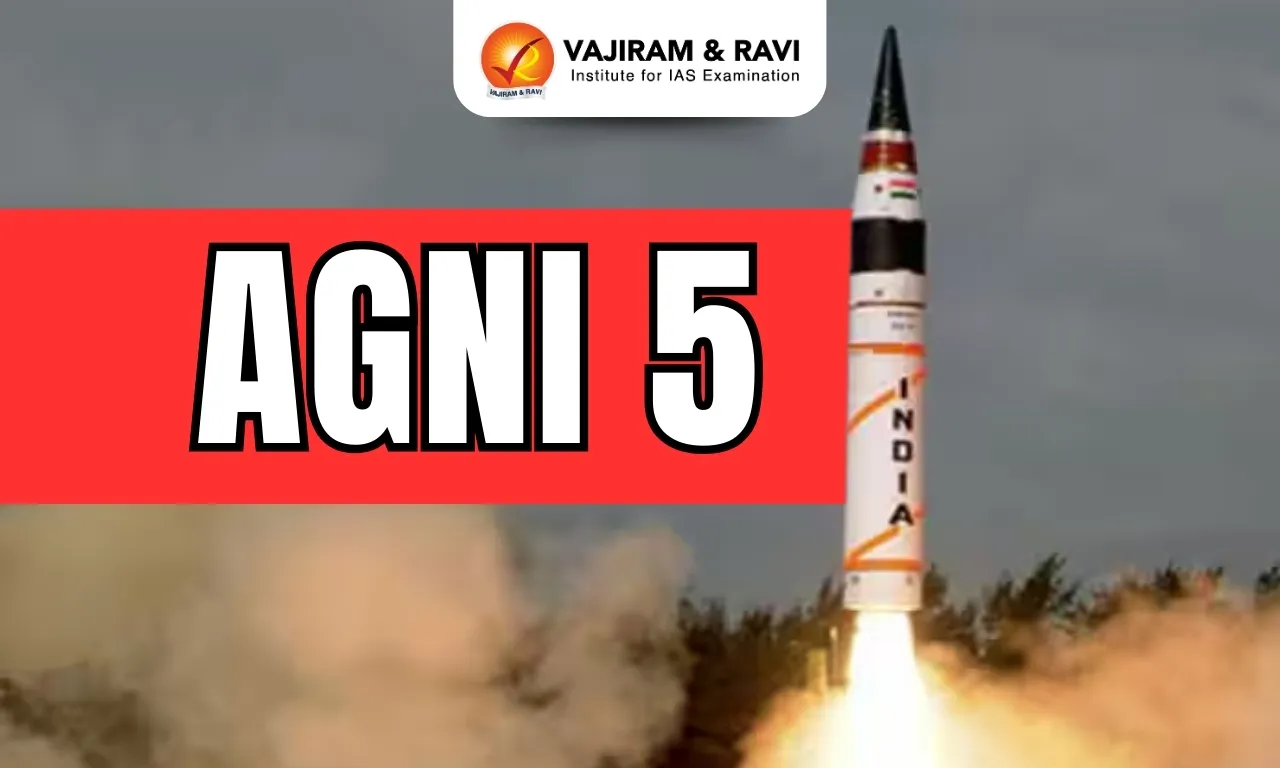
India successfully test-fired its intermediate-range ballistic missile Agni-5 from the Integrated Test Range at Chandipur, Odisha.

About Agni-5 Missile

  • It is a nuclear-capable land-based Intercontinental Ballistic Missile (ICBM) with Multiple Independently Targetable Reentry Vehicle (MIRV) capability.
  • It is developed by the Defence Research and Development Organisation (DRDO).

Features of Agni-5 Missile

  • Range: It is one of India’s most advanced long-range missiles, capable of striking targets well beyond 5,000 kilometers
  • It is designed with modern navigation, guidance, warhead, and engine technologies and strengthens India’s strategic deterrence capability.
  • Warhead Capacity: It is capable of carrying and firing up to three nuclear warheads simultaneously.

What is a Ballistic Missile?

  • It is a rocket-propelled, self-guided strategic-weapons system that follows a ballistic trajectory to deliver a payload from its launch site to a predetermined target.
  • They are powered initially by a rocket or series of rockets in stages, but then follow an unpowered trajectory that arches upwards before descending to reach its intended target.
  • They can carry conventional high explosives as well as chemical, biological, or nuclear munitions.
  • They can be launched from aircraft, ships, and submarines, in addition to land-based silos and mobile platforms.
  • There are four general classifications of ballistic missiles based on their range, or the maximum distance the missile can travel:
    • Short-range: less than 1,000 kilometers (approximately 620 miles), also known as “tactical” ballistic missiles.
    • Medium-range: between 1,000 and 3,000 kilometers (approximately 620-1,860 miles), also known as “theater” ballistic missiles.
    • Intermediate-range: between 3,000 and 5,500 kilometers (approximately 1,860-3,410 miles)
    • Long-range: more than 5,500 kilometers (approximately 3,410 miles), also known as intercontinental or strategic ballistic missiles.

Source: TH

Agni-5 Missile FAQs

Q1: What is the range of Agni-5 in KM?

Ans: The Agni-V is an Indian intercontinental ballistic missile (ICBM) with a range of over 5,000 km.

Q2: How many stages are in the Agni-5 missile?

Ans: Three-stage

Enquire Now