
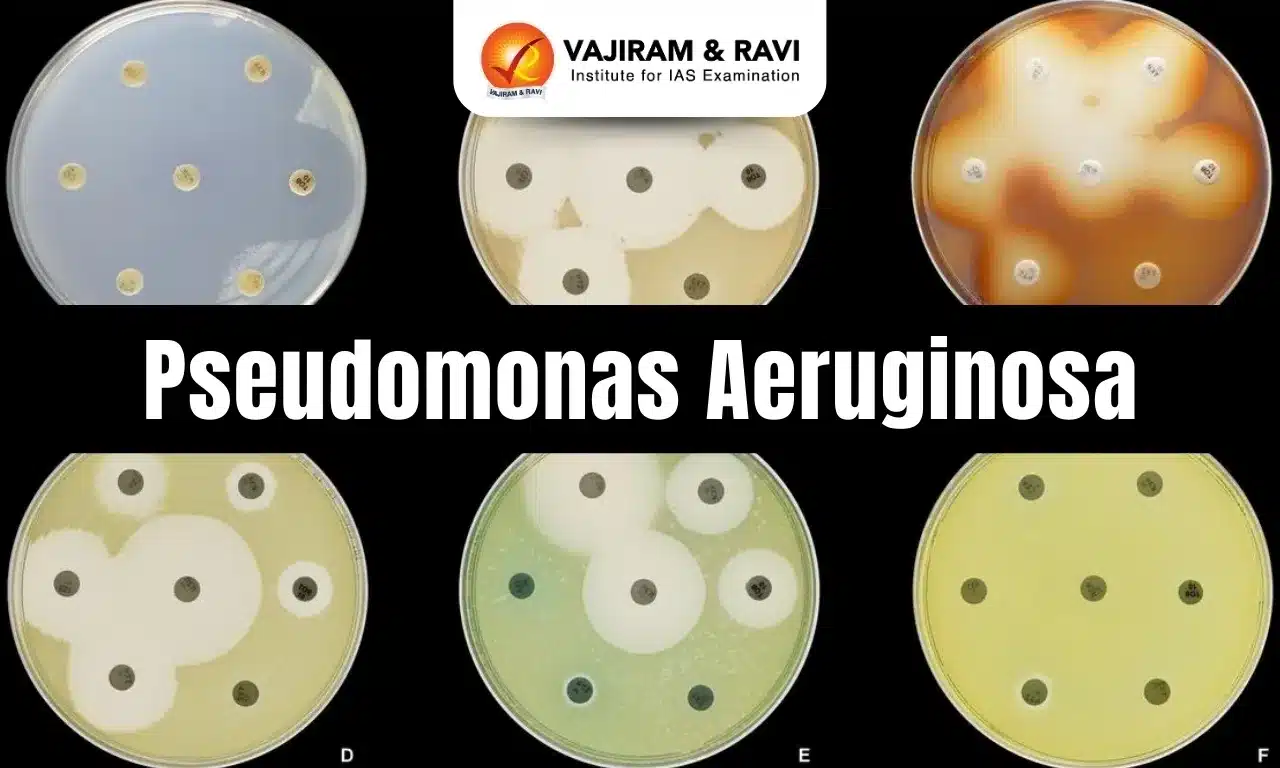
Pseudomonas Aeruginosa Latest News
Recently, a team of researchers, led by scientists from the Helmholtz Centre for Infection Research in Germany, has reported that a gene in the bacterium Pseudomonas aeruginosa shows bistable expression.
About Pseudomonas Aeruginosa
- It is a gram-negative, aerobic, non-spore forming rod shaped bacterium.
- It is capable of causing a variety of infections in both immunocompetent and immunocompromised hosts.
- It is commonly found in the environment, particularly in freshwater.
- It can cause a wide array of community-acquired infections like folliculitis, puncture wounds leading to osteomyelitis, pneumonia, otitis externa, and many others.
- It is commonly an opportunistic pathogen and is also an important cause of nosocomial infections like ventilator-associated pneumonia, catheter-associated urinary tract infections, and others.
- Most burn victims succumb to secondary P. aeruginosa infections.
- It is a major cause of keratitis, an eye infection, and also infects urinary catheters.
What is a Bistable Expression in Bacteria?
- Two bacterial cells with identical genomes — and even from the same colony — can be quite different from each other.
- One cell might express a particular gene at a high level while the other might express it at a low level or not at all.
- Each bacterium goes on to transmit its expression level to its offspring in a process called epigenetic inheritance.
- Such variations among identical cells and organisms are called bistability.
- Bistability might be a survival strategy that single-celled organisms use to adapt to fluctuating environmental conditions.
Source: TH
Pseudomonas Aeruginosa FAQs
Q1: Which disease is caused by Pseudomonas aeruginosa?
Ans: P. aeruginosa is a frequent cause of hospital-acquired pneumonia and ventilator-associated pneumonia
Q2: How is Pseudomonas aeruginosa transmitted?
Ans: Most common transmission is via the hands of healthcare workers, caretakers or through contaminated equipment.
