
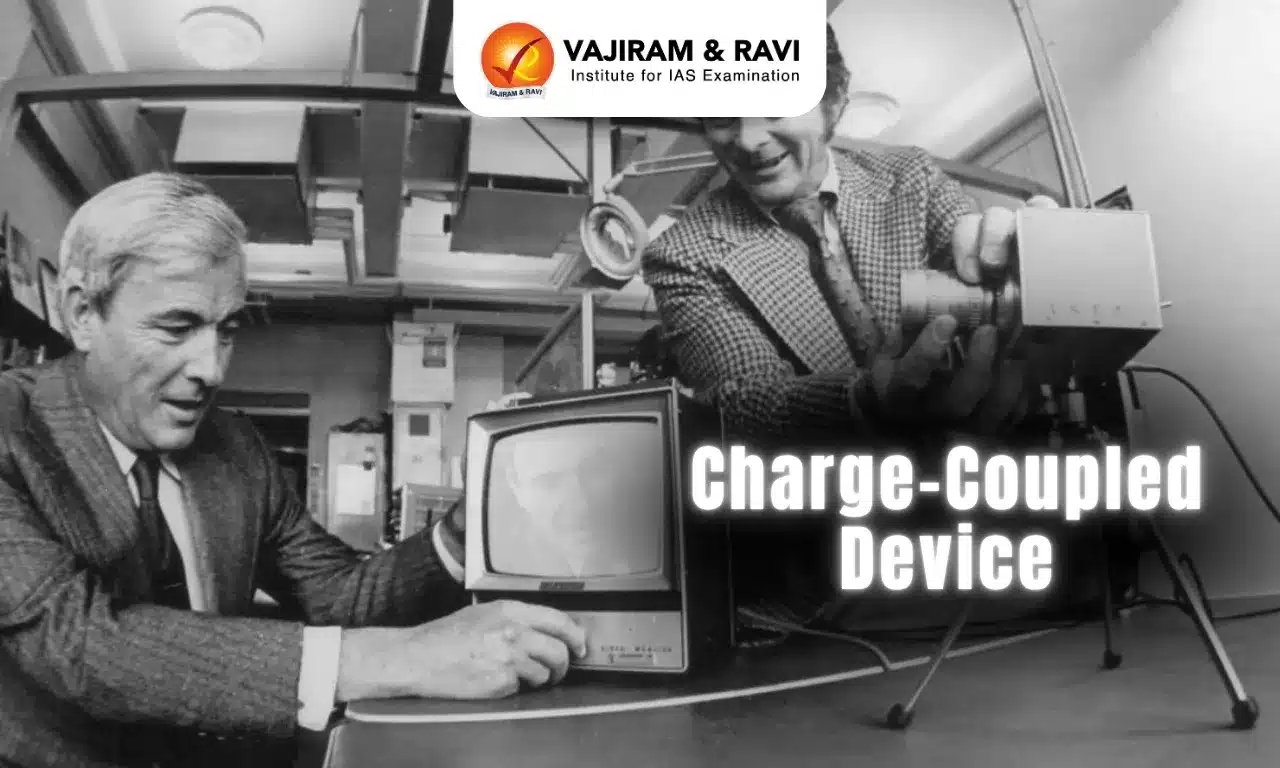
Charge-Coupled Device Latest News
A charge-coupled device (CCD) is a remarkable electronic component whose invention marked a significant milestone in technology and influenced many fields.
About Charge-Coupled Device
- It was a pioneering technology that converted light into electrical signals using an array of capacitors that transferred electric charges in a sequence.
- A CCD consists of an integrated circuit made up of an array of small picture elements called pixels.
- Each pixel acts like a small light sensor that collects photons (the particles of light) and converts them into electrical charges.
- These charges are then transferred across the device, one pixel at a time, to be read and processed into a digital image.
Working of Charge-Coupled Device
- It operates using the photoelectric effect, where light that falls on the device generates electron-hole pairs in the semiconductor material.
- Specifically, when photons enter a CCD, they strike the semiconductor material beneath each pixel.
- This energy knocks electrons loose, creating a small group of electrons proportional to the intensity of light in that pixel.
- Each pixel is essentially a small capacitor that holds these electrons. The amount of charge in each pixel varies depending on how much light the pixel has received.
- A voltage is applied to electrodes placed over the pixels in a sequence that moves the charges from one pixel to the next, like passing buckets of water along a line.
- This is why it’s called a “charge-coupled” device, and this process continues until all the charge has reached a readout register.
- The accumulated charge from each pixel is then converted into a voltage signal, which can be amplified and digitised by connected electronics to form a digital image.
- This sequential transfer and reading process allows the CCD to create a precise and high-quality representation of a scene being captured.
Applications of Charge-Coupled Device
- Household: CCDs made possible the rise of digital cameras by replacing film with sensors that captured images electronically. They’re also used in CCTV cameras to provide high-quality video feeds for security in places like banks, shopping malls, and hospitals.
- Medical diagnostics: CCDs play a vital role in medical diagnostics, including in X-ray imaging, computed tomography (CT) scans, and endoscopy.
- These CCDs are also used in microscopes, spectrometers, and particle detectors where they allow scientists to analyse images in detail.
- Astronomy: Telescopes fit with CCDs can capture faint and distant celestial objects with more sensitivity and accuracy than traditional photographic plates.
Source: TH
Charge-Coupled Device FAQs
Q1: What is the Charge Coupled Device?
Ans: It is a light-sensitive integrated circuit that captures images by converting photons to electrons.
Q2: Why are Charge Coupled Devices used in telescopes?
Ans: It is because astronomical sources are usually very faint, astronomers allow CCDs to collect light for time intervals ranging from a fraction of a second to several hours.
