
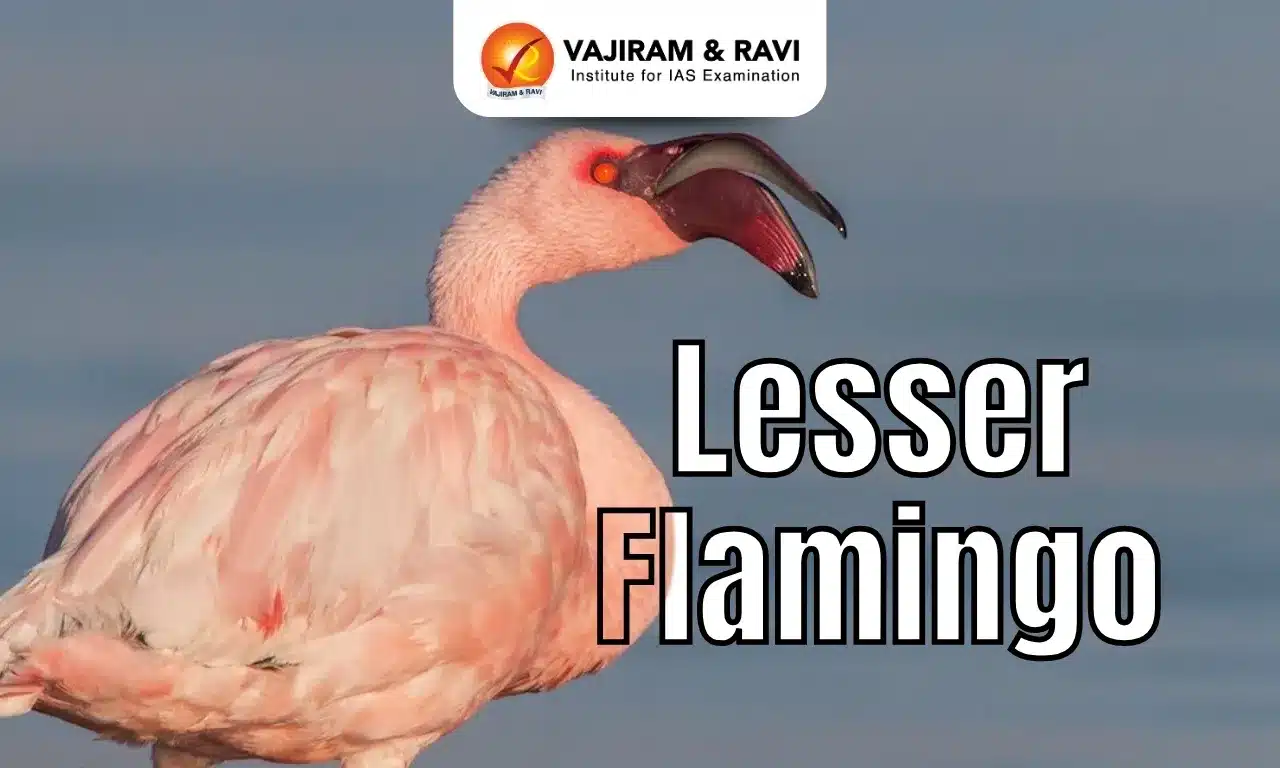
Lesser Flamingo Latest News
A rare sighting of a lesser flamingo (popularly known as Raj Hamsa) near the Fish Mill in Malpe has created excitement among bird enthusiasts and ornithologists alike.
About Lesser Flamingo
- It is the smallest and most numerous of the world’s flamingo species.
- Scientific Name: Phoeniconaias minor
- Distribution: This species is indigenous to sub-Saharan Africa and western India, with occasional sightings further north, typically regarded as vagrants.
- Habitat: Lesser flamingos favor environments with highly alkaline or saline lakes, lagoons, and mudflats.
Lesser Flamingo Features
- Lesser Flamingos stand out with their vivid pink colouring, long thin legs, and striking red eyes.
- Their bills are unique, deep red with a prominent black tip, and are specially adapted to filter-feed on microscopic algae and diatoms.
- It possesses the “hallux” or hind toe, that some other flamingos do not have.
- On average, adult males measure significantly larger than females.
- It is serially monogamous, meaning they form pairs that remain together while they are raising the young.
- It is a gregarious bird, often found in large flocks. They are known for their synchronized movements and group behaviors.
Lesser Flamingo Conservation Status
It is classified as 'Near Threatened' under the IUCN Red List.
Source: DAJ
Lesser Flamingo FAQs
Q1: What is the scientific name of the Lesser Flamingo?
Ans: Phoeniconaias minor
Q2: Which type of habitat do Lesser Flamingos prefer?
Ans: Lesser flamingos favor environments with highly alkaline or saline lakes, lagoons, and mudflats.
Q3: What is the IUCN conservation status of the Lesser Flamingo?
Ans: Near Threatened

