
Migration and Globalisation Latest News
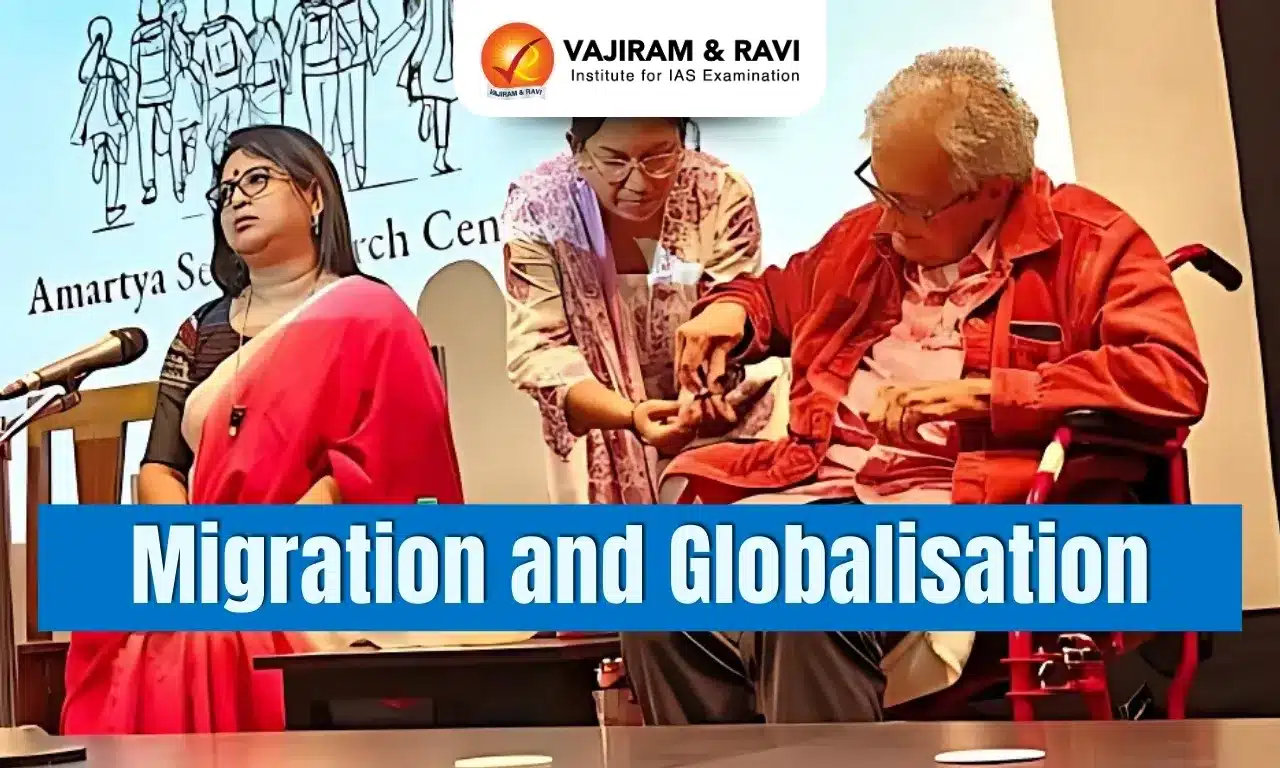
- Nobel laureate Amartya Sen, during an interaction with students in Kolkata on August 22, 2025, highlighted that migration is essential to globalisation and has historically driven human progress.
- He further stressed that diversity is the foundation of Indian society, fostering genuine growth and development for the nation and its people.
Linkages Between Migration and Globalisation
- Migration is both a cause and consequence of globalisation. It represents the mobility of people across and within borders in search of opportunities shaped by global economic changes.
- While often portrayed as problematic, migration contributes significantly to sustainable development.
- In poorer regions, remittances improve household security and support local economies, while in ageing industrial societies, migrant workers fill labour shortages and sustain welfare systems.
Migration and Global Economic Changes
- International Migration: Driven by global restructuring of labour markets, especially demand for semi-skilled and unskilled workers in developed countries.
- Migrants often find employment in informal sectors such as textiles, construction, and agriculture.
- Internal Migration: Linked to relocation of industries and tourism growth in the Global South, where rural workers, especially women, migrate for low-paying but vital jobs.
- Migration is also a path for youth to gain independence and exposure.
Contributions of Migrants
- Economic Support: Remittances are critical for household survival, investment in agriculture, housing, and local enterprises.
- Skill Transfer: Returning migrants bring new skills and open non-farm opportunities if adequate infrastructure exists.
- Social Impact: Migration fosters cultural exchange and reshapes community expectations, especially for women and youth seeking autonomy.
Key Challenges
- Restrictive Policies: Immigration controls often strengthen illegal smuggling networks and exploitative employers, rather than addressing underlying labour market needs.
- Exclusion from Urban Services: Internal migrants face difficulties in accessing housing, healthcare, and education due to restrictive policies.
- Informal Labour Exploitation: Many undocumented migrants work under poor conditions with limited rights and protections.
- Unequal Benefits: Skilled migrants earn more and invest productively, while unskilled migrants face lower incomes and limited capacity to send remittances.
- Gender Disparities: Women migrants often face social pressures but can be strong agents of change where they have access to land and resources.
Policy Imperatives
- The report stresses that migration should be recognised as both a choice and a contributor to development, not merely a problem to be controlled.
- Policies must:
- Protect migrants’ rights and improve working conditions.
- Support productive use of remittances through training and infrastructure.
- Ensure equitable access to resources, especially for women.
- Reduce structural constraints that force people into migration as the only survival strategy.
Amartya Sen on Migration and Diversity
- During an interaction with students in Kolkata, Nobel laureate Amartya Sen underscored that migration is fundamental to globalisation and has historically driven human progress.
- He explained that cultural, linguistic, scientific, and artistic advancements—such as the repeated Arabic translations of Brahmagupta’s mathematical works—reflect migration’s role in collaboration and knowledge-sharing.
- Stressing that “almost nothing would happen” without the movement of people, Sen noted that migration enriches societies through food, music, culture, and ideas.
- He also highlighted that diversity forms the bedrock of Indian society, enabling true growth of the nation and its people.
- His remarks come amid recent attacks on migrants from West Bengal in other states, which have caused livelihood losses.
Conclusion
- Migration is deeply linked with globalisation and has long been central to human survival and progress.
- Its contributions to economic growth, cultural exchange, and sustainable development are undeniable.
- However, without supportive policies, migrants remain vulnerable to exploitation, exclusion, and inequality.
- Recognising their role and safeguarding their rights is essential to harness migration as a force for inclusive global development.
Migration and Globalisation FAQs
Q1: What did Amartya Sen say about migration and globalisation?
Ans: He said migration has been a major source of global progress and is essential for cultural and economic advancement.
Q2: Why does Sen emphasise migration’s importance?
Ans: He argued that without migration, “almost nothing would happen,” as it fosters collaboration in culture, knowledge, food, and music.
Q3: What role does diversity play according to Sen?
Ans: He stated that diversity is the bedrock of Indian society and crucial for the nation’s genuine growth and development.
Q4: What historical example did Sen cite?
Ans: He mentioned that Brahmagupta’s mathematics book was translated six times into Arabic, showing migration’s role in knowledge exchange.
Q5: What is the contemporary context of his remarks?
Ans: His comments come amid rising attacks on Bengali migrants in other states, causing livelihood losses and political controversy.
