
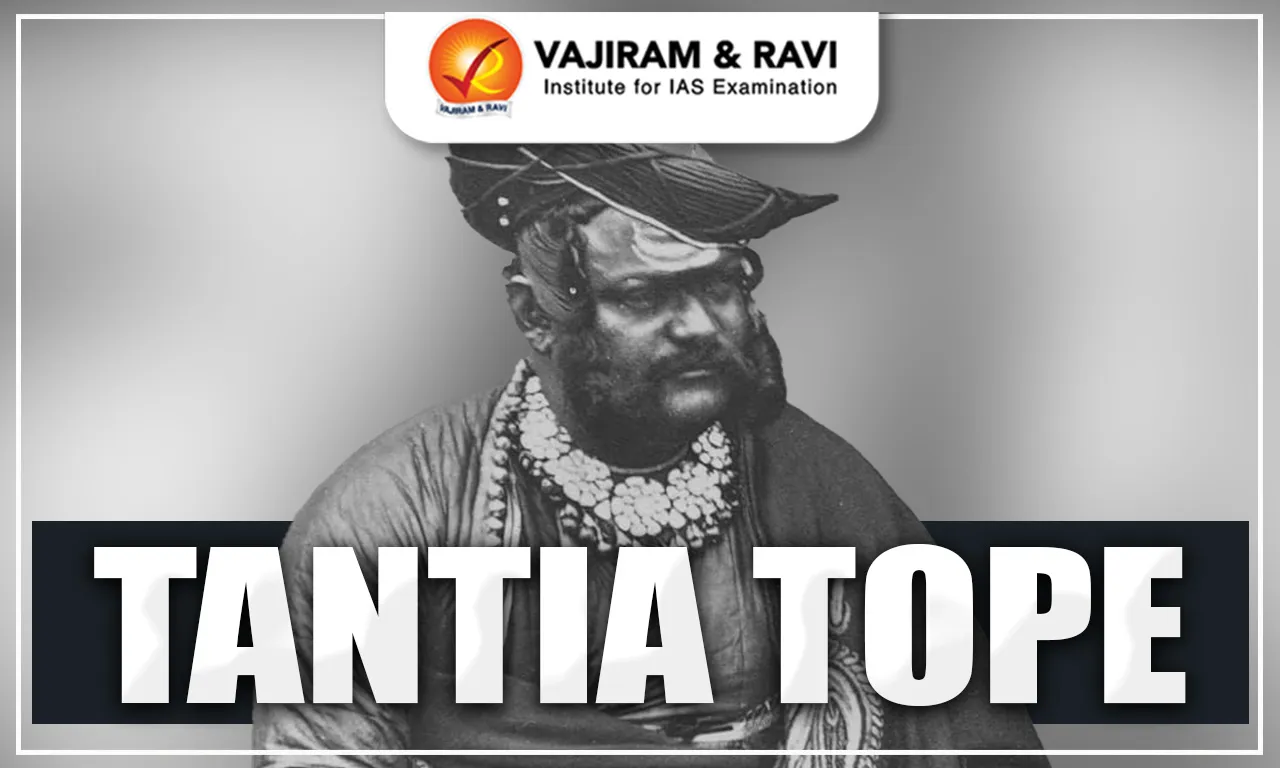
Tatya Tope emerged as a prominent leader during the Indian Rebellion of 1857, remembered for his exceptional courage and military expertise. Widely regarded as one of the foremost architects of the uprising, he is credited with spearheading what came to be known as the First War of Independence against British colonial authority. His strategic brilliance and leadership provided both direction and strength to the resistance movement. Tatya Tope’s spirit and sacrifice continue to symbolize the determined struggle for India’s freedom during a critical chapter of colonial oppression.
Tantia Tope
Tantia Tope, also known as Tatya Tope, was born as Ramchandra Pandurang Rao. He emerged as one of the prominent leaders of the Revolt of 1857 and took a determined stand against the English East India Company. A close companion of Nana Saheb and a favored associate of Peshwa Baji Rao, he shared deep ties with the Maratha leadership. Belonging to a Maratha Brahmin family, Tatya Tope initially served Baji Rao, the former Peshwa of the Maratha confederacy, and later extended his loyalty to Nana Saheb, the adopted son of the Peshwa.
Tatya Tope Important Facts
- Born in Nashik, Maharashtra in 1814, to Pandurang Rao Tope and Rukhmabai.
- Played a major role as an Indian leader of the 1857 Rebellion.
- Defeated the East India Company’s Indian troops in Kanpur in May 1857.
- Known for his guerrilla warfare tactics, which created fear among the British.
- Forced General Windham to withdraw from Gwalior.
- Fought alongside Rani Lakshmi Bai of Jhansi in capturing Gwalior.
- Performed Rani Lakshmi Bai’s last rites after her death in battle.
- Participated in around 150 engagements with the British.
- Credited with causing the deaths of 10,000 British soldiers.
Tantia Tope Early Life
Tantia Tope displayed a strong inclination towards martial pursuits from an early age. He acquired proficiency in handling the rifle, sword, and horse-riding. It is believed that he briefly served with the East India Company’s artillery regiment in the Bengal Army. However, he was not retained, owing to his independent temperament and exceptional skills as a strategist.
Tantia Tope Contribution In India’s Freedom Struggle
- From a young age, Tantia Tope displayed a strong interest in martial skills, which set the foundation for his future role as a military leader.
- He mastered the use of rifles and swords, along with exceptional horsemanship, skills that later made him a formidable figure in the revolt of 1857.
- Historical accounts suggest that he briefly worked with the East India Company’s artillery regiment in the Bengal Army, gaining exposure to military strategies and weaponry.
- Despite his skill and knowledge, his independent and uncompromising nature led to his rejection for a permanent position, highlighting his strong will and self-reliance.
Tantia Tope Role in the Revolt of 1857
- Tantia Tope was a close associate and loyal follower of Nana Sahib, one of the principal leaders of the 1857 uprising. When the revolt gathered momentum, he played a decisive role in organizing resistance against the British.
- He initially led forces in Kanpur, where he defeated the East India Company’s troops, establishing Nana Sahib’s authority. When the British regained control of the city, Tantia Tope regrouped with the Gwalior contingent and compelled General Windham to retreat temporarily.
- After Kanpur fell to the British, he shifted base to Kalpi, where he joined hands with Rani Lakshmibai of Jhansi. Together, they launched campaigns in Bundelkhand and posed serious challenges to British forces.
- At Kalpi and later Gwalior, Tantia Tope and his allies confronted General Hugh Rose. In one of these battles, Rani Lakshmibai was martyred, marking a turning point in the resistance.
- Following these defeats, Tantia Tope embarked on an extraordinary campaign of guerrilla warfare. He carried out rapid, unpredictable strikes across Malwa, Central India, Bundelkhand, Rajputana, and Khandesh, using the Vindhya and Aravali ranges as cover. His tactics frustrated and baffled some of the most seasoned British commanders.
- Though eventually captured and executed, Tantia Tope’s resilience, mobility, and skill in irregular warfare established his reputation as one of the most resourceful and daring leaders of the Revolt of 1857.
Tantia Tope Death
- The British forces chased Tantia Tope for nearly 2,800 miles, covering forests, hills, plains, and even across flooded rivers, yet he constantly evaded capture.
- His deep knowledge of terrain and mastery in guerrilla tactics made him a difficult target, frustrating the British for months.
- This long pursuit showed his determination to keep the rebellion alive even after major defeats elsewhere.
- Eventually, he was betrayed by a local ally, which led to his arrest.
- On April 18, 1859, the British executed him at Shivpuri, Madhya Pradesh, marking the end of one of the most remarkable rebel commanders of 1857.
Tantia Tope FAQs
Q1: Who was Tantia Tope?
Ans: Tantia Tope was a prominent leader of the 1857 Revolt against British rule in India.
Q2: When was Tantia Tope born?
Ans: He was born in 1814 in Yeola, present-day Maharashtra.
Q3: What was Tantia Tope’s role in the 1857 Revolt?
Ans: He led several battles, supported Rani Lakshmibai, and organized guerrilla warfare against the British.
Q4: Which battle made Tantia Tope famous?
Ans: He became well-known after leading forces in the Battle of Kanpur during 1857.
Q5: Was Tantia Tope connected to Rani Lakshmibai?
Ans: Yes, he fought alongside Rani Lakshmibai during the revolt and supported her campaigns.

