
Glanders Latest News
Recently, the Department of Animal Husbandry & Dairying (DAHD) under the Ministry of Fisheries, Animal Husbandry & Dairying has issued the Revised National Action Plan on Glanders.
About Glanders
- It is caused by the bacterium Burkholderia mallei.
- It primarily affects equines such as horses, mules, and donkeys, and poses risks to other animals as well as humans.
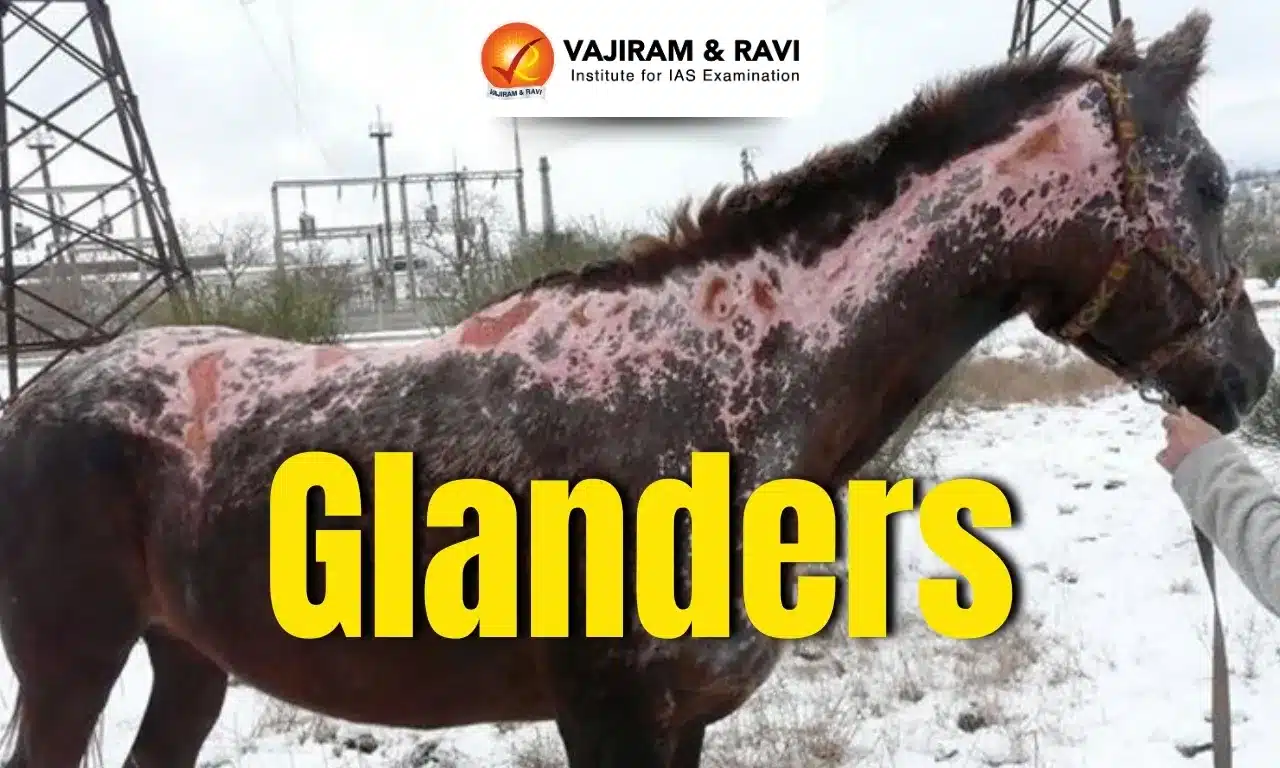
- Signs: The disease causes nodules and ulcerations in the respiratory tract and lungs in animals. A skin form, known as ‘farcy’, also occurs.
- Glanders is commonly contracted via the following routes:
- Ingestion of food or water contaminated with nasal discharge from infected (carrier) animals
- Contact with contaminated harness components
- Ingestion of infected horse meat
- Glanders has traditionally been clinically categorized into nasal, pulmonary and cutaneous forms based on the most commonly affected organ systems in equines.
- It remains sporadically reported in a number of Asian, African, Middle Eastern, and South American countries.
- Glanders is an WOAH-listed disease as described in the Terrestrial Animal Health Code of the World Organisation for Animal Health (WOAH). As indicated in the WOAH Terrestrial Animal Health Code any occurrence of glanders must be notified to the WOAH.
- The disease is notifiable under the Prevention and Control of Infectious and Contagious Diseases in Animals (PCICDA) Act, 2009.
Source: PIB
Glanders FAQs
Q1: What is the disease called glanders?
Ans: Glanders is an infectious and life-threatening disease that mainly affects horses, donkeys or mules caused by the bacterium Burkholderia mallei.
Q2: What is another name for glanders?
Ans: Glanders has also been known by other names viz., equinia, malleus, droes and farcy.
