
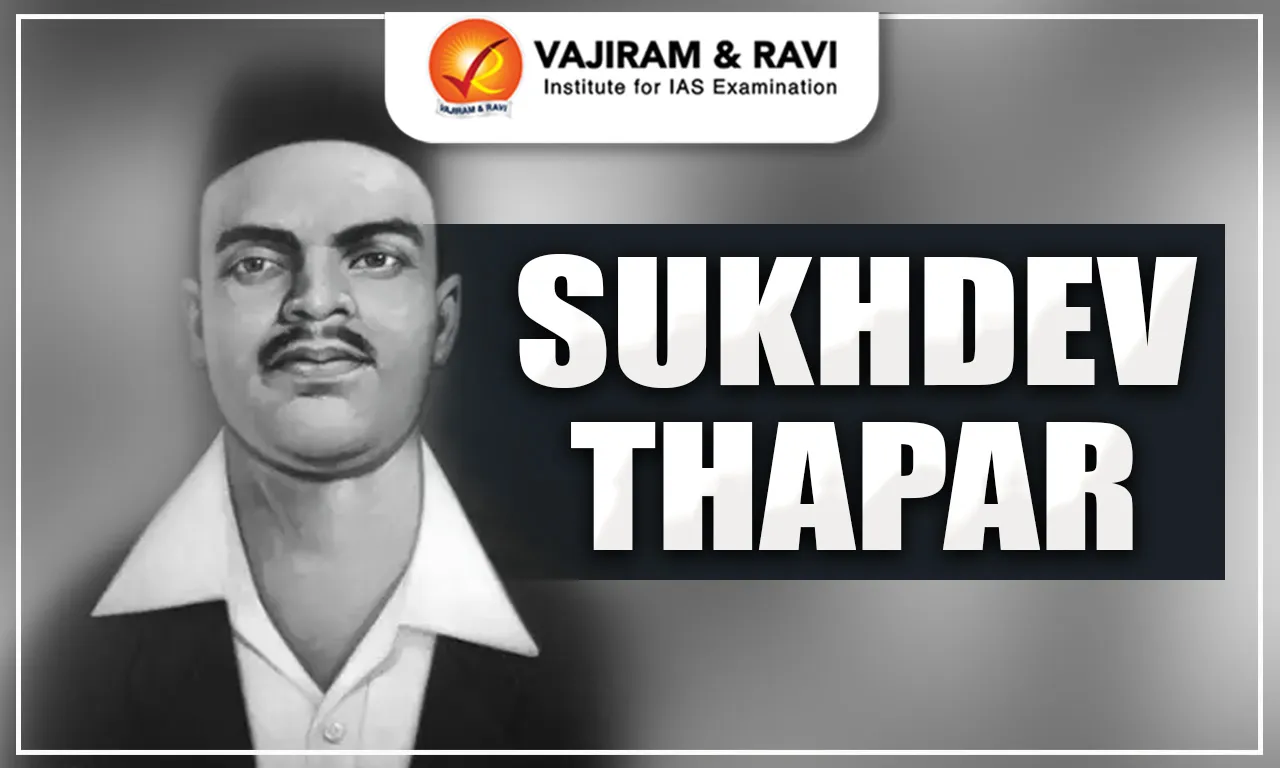
Sukhdev Thapar was a revolutionary and a prominent figure in India’s struggle for independence. Born in Ludhiana, Punjab, he became actively involved in the freedom movement at a young age. As a dedicated member of the Hindustan Socialist Republican Association (HSRA), Sukhdev worked closely with Bhagat Singh and Rajguru, planning and executing several revolutionary activities against British rule. He was deeply committed to inspiring Indian youth to rise against colonial oppression and often organized study circles to spread nationalist ideas.
Along with Bhagat Singh and Rajguru, he was sentenced to death in the Lahore Conspiracy Case and was executed by the British on 23 March 1931. His sacrifice, remembered as Shaheed Diwas, continues to inspire generations of Indians in their pursuit of justice and freedom.
Sukhdev Thapar Early Life
Sukhdev Thapar was born on 15 May 1907 in the Naughara locality of Old Ludhiana, Punjab, then under British India. His parents were Ramlal Thapar and Ralli Devi. Following the untimely demise of his father during his childhood, he was brought up by his uncle, Lala Achintram. He hailed from a Hindu Punjabi Khatri family.
Sukhdev Thapar Revolutionary Activities
Sukhdev played an active and influential role in India’s freedom struggle. He became a member of two prominent revolutionary organisations, the Hindustan Socialist Republican Association (HSRA) and the Naujawan Bharat Sabha both committed to liberating the nation from British colonial rule through revolutionary means.
He was instrumental in initiating several nationalist activities in Punjab and other regions of northern India, and also served as the leader of the HSRA in Punjab. Sukhdev participated in a number of significant events during the movement, including the historic hunger strike undertaken by revolutionaries in prison in 1929.
Role in Saunder’s Assassination
Sukhdev was closely associated with the significant event of the assassination of British police officer J.P. Saunders on 17 December 1928. The act, carried out by Bhagat Singh and Rajguru, was intended as retribution for the death of Lala Lajpat Rai, who had suffered injuries sustained during a protest against colonial rule.
Lahore Conspiracy Case
Sukhdev was a principal accused in the Lahore Conspiracy Case, 1929, officially recorded as Crown versus Sukhdev and others. The British authorities charged him with involvement in planning the Central Legislative Assembly bomb attack in Delhi on 8 April 1929. Following his arrest, along with his companions, he was tried, found guilty, and sentenced to death.
Execution and Secret Cremation
Sukhdev, Bhagat Singh, and Rajguru were hanged in Lahore Central Jail on 23 March 1931, despite widespread appeals for clemency. The colonial government feared mass unrest, so after the execution, their bodies were smuggled out of the jail and secretly cremated near the banks of the Sutlej River under heavy police guard. Even this attempt at concealment failed to silence the people; news of the execution spread quickly, sparking grief and anger across the country. Their martyrdom transformed them into enduring symbols of courage and resistance, inspiring generations to join the struggle for independence.
Reactions to the Hanging
The execution of Bhagat Singh, Rajguru, and Sukhdev sent shockwaves across India. News of their hanging spread quickly, leaving people heartbroken and furious. The timing was significant, it coincided with the Indian National Congress session in Karachi, where leaders and citizens gathered in mourning and outrage. Demonstrations broke out in several cities, with processions, strikes, and black flags symbolizing the nation’s grief.
Even Dr. B.R. Ambedkar strongly condemned the British action, calling it a calculated move to appease public opinion in Britain and to satisfy demands within the British Parliament. To many Indians, the decision exposed the colonial government’s arrogance and cruelty, but it also turned the three martyrs into immortal symbols of courage and sacrifice in the freedom struggle.
Sukhdev Thapar Legacy
Sukhdev Thapar is remembered as one of the most courageous revolutionaries of India’s freedom struggle. His commitment to the cause of independence has earned him a place among the nation’s greatest heroes.
To honor his sacrifice, the National Martyrs Memorial was established at Hussainiwala in Punjab, the very site where Sukhdev, along with Bhagat Singh and Rajguru, was cremated after their execution in 1931. This memorial stands as a symbol of their valor and continues to inspire generations. Every year on 23 March, Shaheed Diwas (Martyrs’ Day) is observed across the country to pay tribute to these revolutionaries who gave their lives for India’s freedom.
In recognition of his legacy, several institutions and landmarks have been named after Sukhdev. The Shaheed Sukhdev College of Business Studies (SSCBS) in Delhi, founded in 1987, stands as a prestigious academic institution dedicated to his memory. Additionally, the Amar Shaheed Sukhdev Thapar Inter-State Bus Terminal in Ludhiana ensures that his name remains deeply rooted in the daily lives of the people.
Through these memorials, institutions, and annual commemorations, Sukhdev’s ideals of courage, patriotism, and sacrifice continue to live on in the collective memory of the nation.
Sukhdev Thapar FAQs
Q1: Who was Sukhdev Thapar?
Ans: Sukhdev Thapar was a revolutionary freedom fighter, member of HSRA, and close associate of Bhagat Singh and Rajguru.
Q2: When was Sukhdev Thapar born?
Ans: He was born on 15 May 1907 in Ludhiana, Punjab.
Q3: Which organization was Sukhdev associated with?
Ans: He was an active member of the Hindustan Socialist Republican Association (HSRA).
Q4: What was Sukhdev’s role in the Lahore Conspiracy Case?
Ans: He played a crucial role in planning and execution, leading to his arrest.
Q5: With whom was Sukhdev executed?
Ans: He was hanged along with Bhagat Singh and Rajguru on 23 March 1931.

