
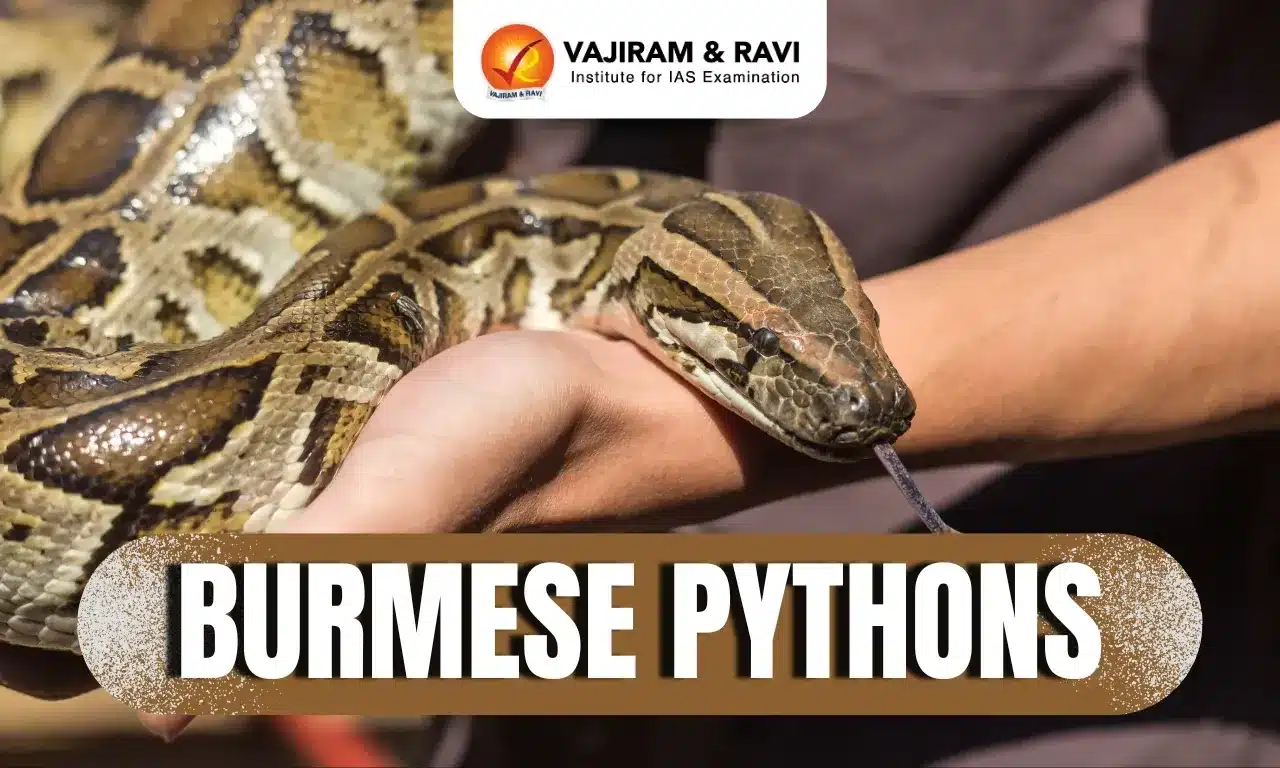
Burmese Python Latest News
Authorities in Florida have turned to robot rabbits for help to control the population of Burmese pythons.
About Burmese Python
- It is one of the largest snake species in the world. It can grow up to 20 feet and weigh more than 250 pounds, with females being larger than males.
- It is a non-venomous, solitary and mainly nocturnal forest dweller snake.
- It is also an excellent swimmer and is able to stay submerged for up to half an hour. Burmese pythons spend the majority of their time hidden in the underbrush and will usually move only when hunting or when threatened.
- Until 2009, it was considered a subspecies of Python molurus, but is now recognized as a distinct species.
- Habitat of Burmese Pythons: They live in grasslands, marshes, swamps, wet rocky areas, caves, woodlands, rainforests, mangrove forests, river valleys, and jungles with open clearings.
- Conservation Status of Burmese Pythons: IUCN: Vulnerable
Distribution of Burmese Pythons
- It is native to the tropical rainforests and subtropical jungles of eastern and northeastern India, Myanmar, southern China, Southeast Asia, and to some extent of the Indonesian archipelago. Its distribution also encompasses eastern Nepal, Bhutan, and Bangladesh.
- It is an invasive species in Florida as a result of the pet trade.
Source: IE
Burmese Python FAQs
Q1: How poisonous is a BuBurmese pythons are a non-venomous constrictor, meaning they wrap their body around prey to suffocate it before swallowing the meal whole.rmese python?
Ans: Burmese pythons are a non-venomous constrictor, meaning they wrap their body around prey to suffocate it before swallowing the meal whole.
Q2: What is the Burmese python also known as?
Ans: Common Name Burmese python, Asiatic rock python, tiger python
