
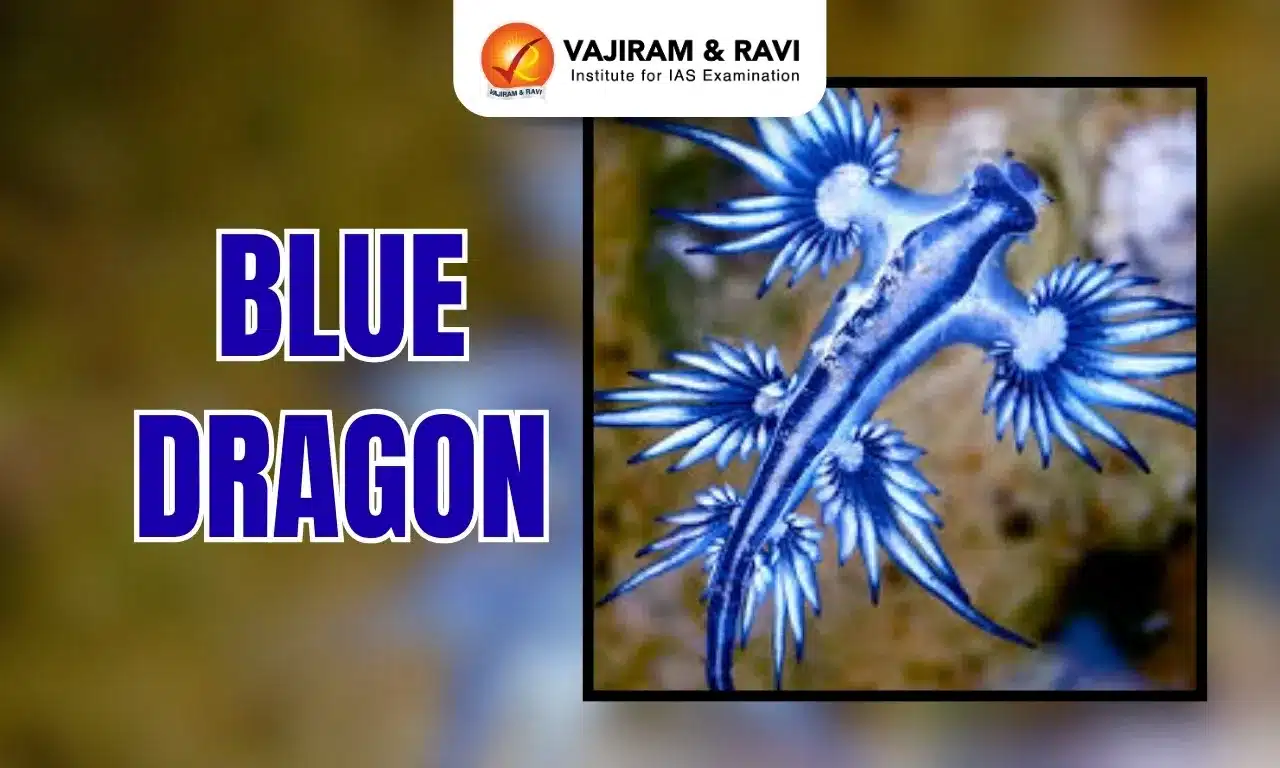
Blue Sea Dragon Latest News
Recently, several beaches in Spain were forced to shut down after an unusual invasion of blue sea dragons.
About Blue Sea Dragon
- The blue dragon (Glaucus atlanticus) is a type of mollusk known as a nudibranch.
- They also are known as blue sea slugs, blue angels, and sea swallows.
- Distribution: It can be found drifting on the surface of the Atlantic, Pacific and Indian oceans in temperate and tropical waters.
- They are hermaphrodites, meaning they have both male and female reproductive organs.
Diet of Blue Sea Dragon
- They feed on venomous siphonophores such as the Portuguese man-o-war and bluebottle, which also occur in ocean surface waters.
- When a blue sea dragon consumes its venomous prey, it doesn’t just digest the toxins. Instead, through a complex biological process, it transports the stinging cells or nematocysts from its digestive system to specialised finger-like projections called cerata on its back and sides.
- They incorporate these cells into multiple finger-like structures protruding from their body which provides them with a potent form of protection from predators.
- The slug isn’t venomous all on its own, however, it stores the stinging nematocysts created by the creatures on which it feeds.
How does the Blue Sea Dragon Affect Humans?
- Its sting can cause problems, especially to children and elderly.
- One sting from this little creature can lead to nausea, pain, vomiting, acute allergic contact dermatitis, and post-inflammatory hyperpigmentation.
Source: IE
Blue Sea Dragon FAQs
Q1: How venomous is the blue sea dragon?
Ans: The blue dragon stores the man o' war's stinging nematocysts within its finger-like appendages, making itself equally venomous to predators.
Q2: What is an example of a hermaphrodite?
Ans: Earthworms, flatworms, mollusks, and fish(rarely) are all examples of each member who can act as both a man and a woman.
