
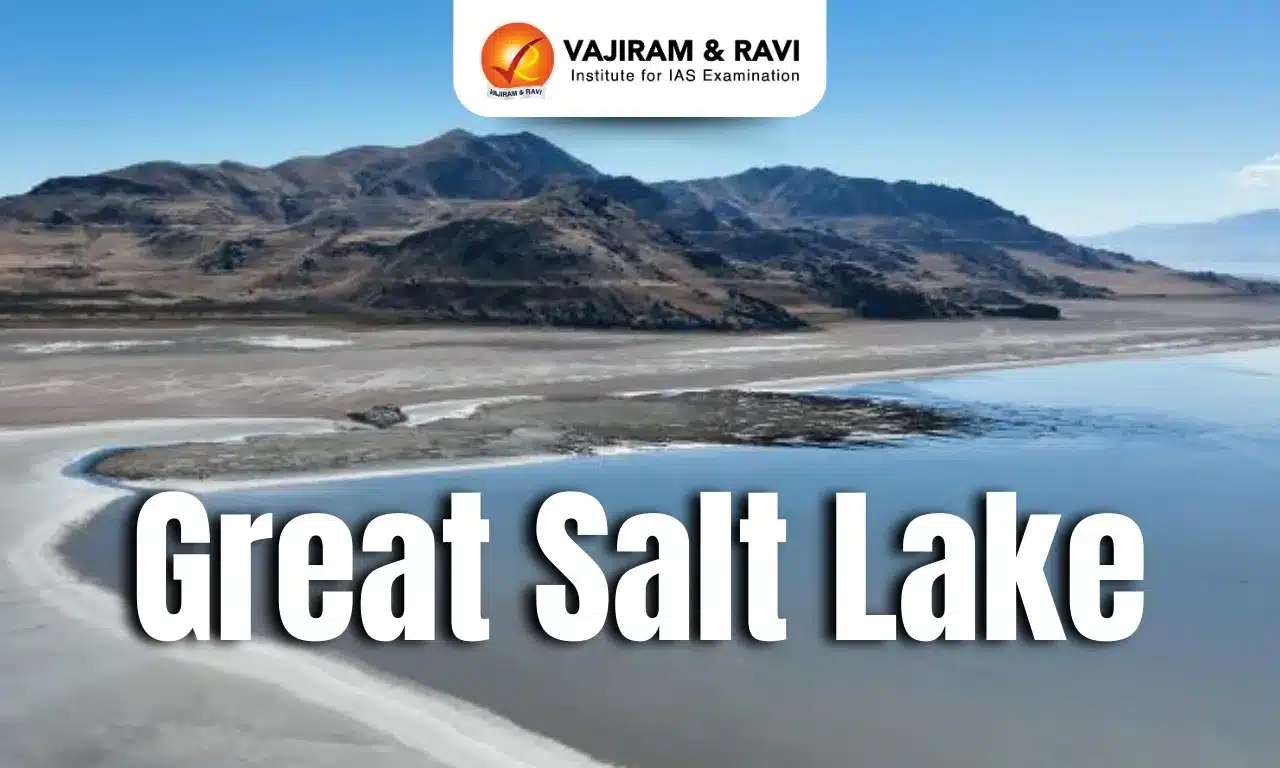
Great Salt Lake Latest News
As the Great Salt Lake shrinks, scientists are uncovering mysterious groundwater-fed oases hidden beneath its drying lakebed.
About Great Salt Lake
- It is a saline lake located in northern Utah, United States.
- It is the largest inland body of salt water in the Western Hemisphere and one of the most saline inland bodies of water in the world.
- The lake is fed by the Bear, Weber, and Jordan rivers and has no outlet.
- The lake has fluctuated greatly in size, depending on the rates of evaporation and the flow of the rivers that feed it.
- Its surface area has varied from about 6,200 sq.km. at its highest levels in 1873 and the mid-1980s to about 2,300 sq.km. at its lowest level in 2022.
- It has a length of 120 km and a maximum width of 45 km.
- The lake reaches an average depth of 4.9 m and a maximum depth of 10 m.
- Like the Dead Sea, the Great Salt Lake exists within an arid environment and has chemical characteristics similar to that of the oceans.
- It has a much greater salinity than the oceans, however, since natural evaporation exceeds the supply of water from the rivers feeding the lake.
- Surrounded by great stretches of sand, salt land, and marsh, the Great Salt Lake remains eerily isolated from the nearby cities, towns, and other human habitations.
- The salts are primarily sodium chloride, but there are also sulfates, magnesium, and potassium.
Source: SD
Great Salt Lake FAQ's
Q1: The Great Salt Lake is located in which country?
Ans: United States
Q2: Which rivers feed the Great Salt Lake?
Ans: The lake is fed by the Bear, Weber, and Jordan rivers.
Q3: Why is the Great Salt Lake considered similar to the Dead Sea?
Ans: Both are hypersaline and exist in arid regions.
