
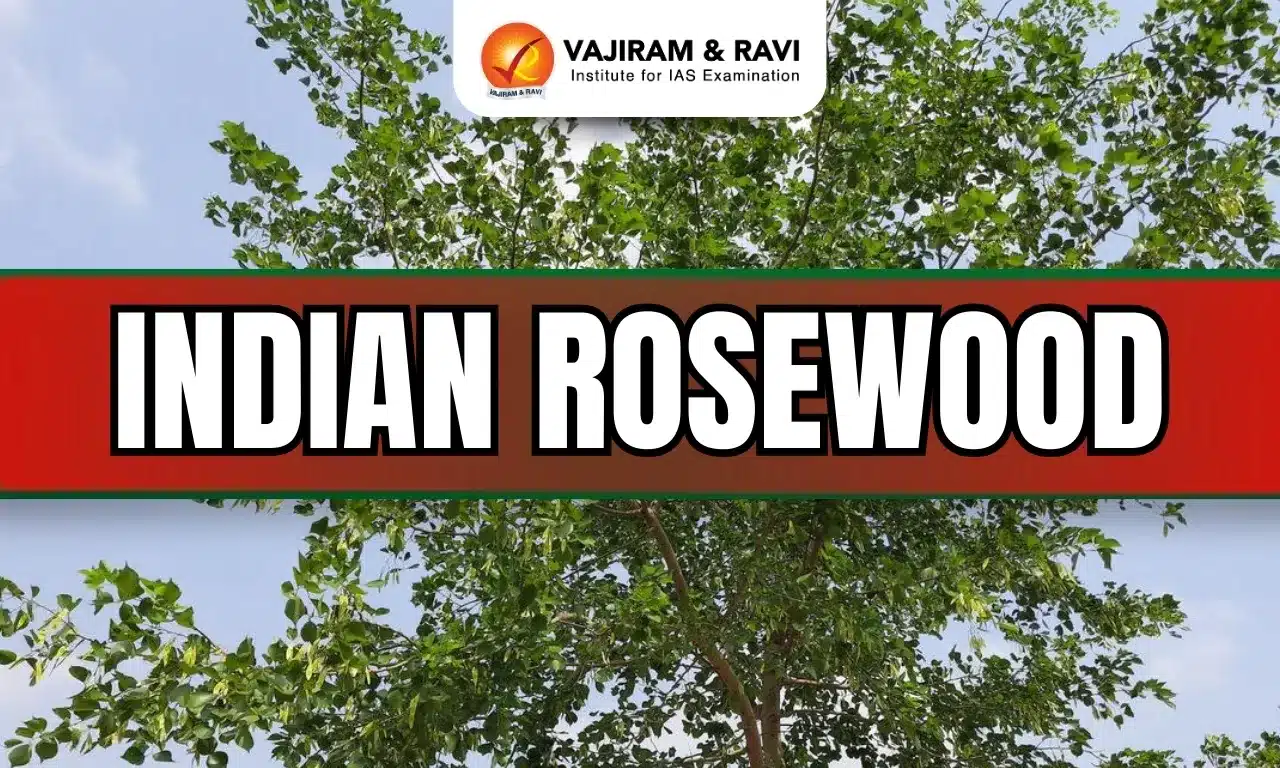
About Indian Rosewood Latest News
According to recent habitat modelling by the Institute of Wood Science and Technology (IWST), Bengaluru, only 17.2% of India’s suitable habitat for Dalbergia latifolia — Indian rosewood — lies within protected areas.
About Indian Rosewood
- Indian Rosewood i.e Dalbergia sissoo (North Indian rosewood) is often called the “ivory of the forests,”
- Indian Rosewood is a fast-growing, hardy, deciduous crooked rosewood
- Distribution: It is native to the foothills of the Himalayas, ranging from Afghanistan in the west to Bihar, India, in the east.
- Habitat: It is primarily found growing along river banks above 200 m (700 ft) elevation, but can range naturally up to 1,400 m (4,600 ft).
- It has long, leathery leaves and whitish or pink flowers.
- Indian rosewood is prized for its rich grain, deep colour, and exceptional durability.
- It serves as both a premium timber resource for the furniture and handicraft industries and a keystone ecological species.
- It is commonly used for furniture, musical instruments, decorative items and veneers.
- Ecological Significance: Rosewood trees improve soil fertility through nitrogen fixation, support bird and insect diversity, and act as long-term carbon sinks.
- Concerns: Researchers observed that populations are dominated by mature, ageing trees with almost no regeneration in the wild. Seedlings are rare, and in many areas, entirely absent.
Conservation status of Indian Rosewood
- IUCN: Vulnerable
- CITES list: Appendix II
Source: TH
Indian Rosewood FAQs
Q1: What is rosewood called in India?
Ans: Sheesham
Q2: What is Indian Rosewood used for?
Ans: It is used for furniture, paneling, ornamental work, ordinance work, agricultural implements, etc.
