
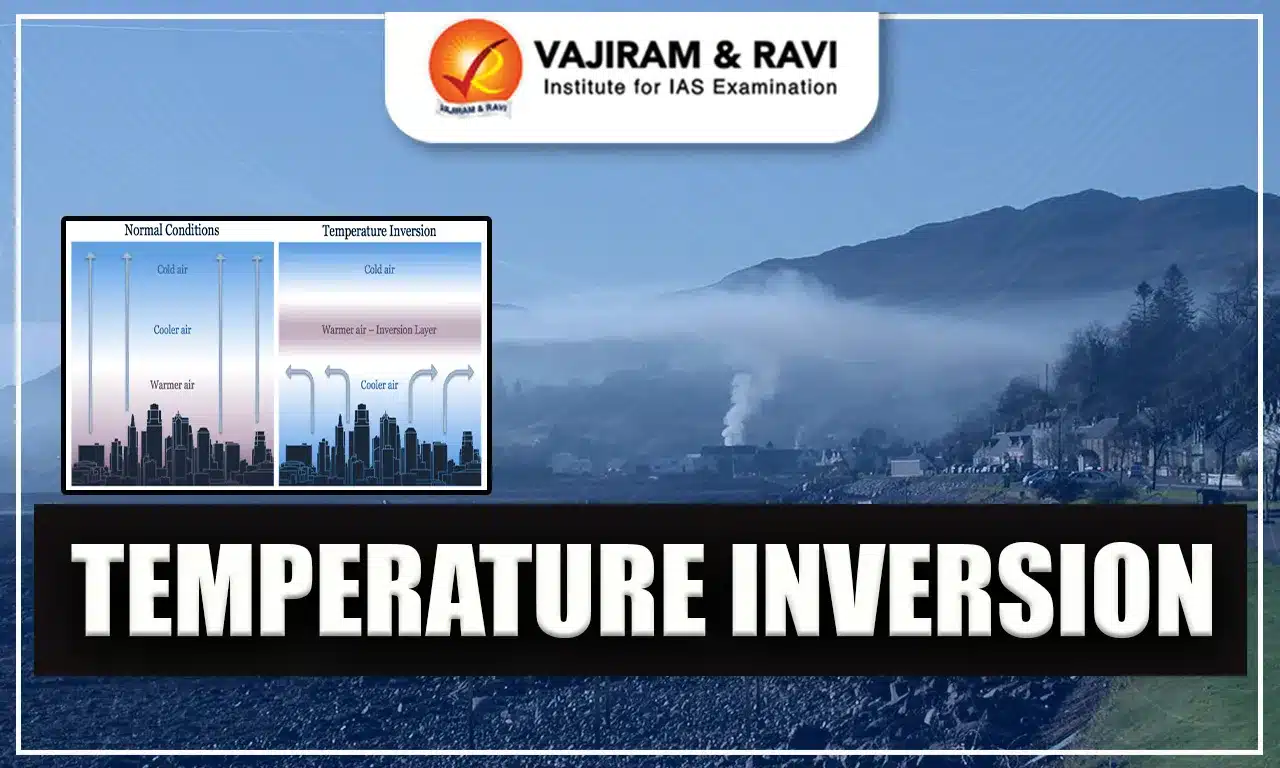
A Temperature Inversion takes place when a layer of warm air settles above cooler air close to the ground, reversing the usual pattern of rising and mixing. This shift prevents vertical circulation in the atmosphere, causing the air to become stagnant. As a result, pollutants remain trapped, often worsening air quality and giving rise to fog, haze, or smog. Studying this process is essential for understanding pollution build-up, local weather behavior, and visibility issues.
Temperature Inversion
Temperature Inversion is a weather phenomenon where a layer of warm air settles above cooler air near the ground, reversing the normal temperature trend. Usually, air cools as it rises, but during an inversion, the cooler air is trapped beneath warmer air. This warm layer acts like a lid, preventing vertical air movement and creating stagnant conditions near the surface.
Temperature Inversions commonly form at night or in the early morning, when the ground loses heat quickly, cooling the air just above it more than the air higher up. In cities, this can trap smoke, dust, and other pollutants, leading to degraded air quality and smog. They can also influence local weather, causing fog, cloud buildup, and shifts in wind patterns.
These inversions are most likely to occur in valleys, along coasts, or during calm, clear nights. While often short-lived, prolonged inversions can have serious environmental and health consequences, particularly in densely populated areas.
Temperature Inversion Types
Temperature Inversions can occur in several ways, depending on the atmospheric conditions:
- Radiation Inversion: This type forms when the ground cools quickly at night, making the air near the surface colder than the air above. It’s most common on clear, calm nights when heat radiates away from the Earth’s surface.
- Advection Inversion: This happens when warm air moves horizontally over a cooler surface. Coastal regions often experience this, as warm ocean air drifts inland over cooler land, trapping the cold air beneath.
- Subsidence Inversion: Occurs when air from higher altitudes sinks and compresses as it descends, warming in the process. This warm layer then caps the cooler air below. Subsidence inversions are common during high-pressure systems and in areas near mountains.
- Frontal Inversion: This type arises when a warm air mass slides over a cooler air mass at the surface, usually linked with a moving weather front. It creates a stable warm layer over the cooler ground air.
Temperature Inversion Significance
- Temperature Inversions can lead to the formation of fog, frost, and dew, affecting visibility and daily weather conditions.
- These inversions trap pollutants near the ground, causing smog and poor air quality, particularly in cities and industrial zones. This can worsen respiratory and heart-related health problems.
- Radiation inversions may cause frost that harms crops, reducing yields. In some cases, they can even shield crops by limiting frost under specific conditions.
- Inversions can create turbulence, lower visibility, and alter aircraft performance, posing significant challenges for safe flight operations.
- By changing temperature distribution near the ground, inversions can impact heating and cooling needs, influencing energy consumption in buildings.
- Studying inversions is essential for understanding regional climate, especially in valleys or basins where persistent inversions are common.
- Inversions restrict vertical air movement, trapping heat and smoke close to the ground. This complicates firefighting efforts and worsens air quality near wildfires.
Phenomena Associated with Temperature Inversion
- Cities such as Los Angeles and Beijing often face smog problems because temperature inversions trap pollutants near the ground, significantly lowering air quality.
- On calm, clear nights, radiation inversions can cause the cooler air near the surface to mix with moisture, forming thick fog. Valleys like California’s San Joaquin Valley commonly experience this.
- In farming areas, rapid nighttime cooling during radiation inversions can cause frost, damaging crops. Vineyards in Napa Valley, for instance, are particularly affected.
- Cities surrounded by mountains, such as Mexico City or Salt Lake City, often endure prolonged inversions that trap pollutants, creating persistent air quality issues.
- Subsidence inversions can prevent wildfire smoke from dispersing, keeping it near the ground. This phenomenon is observed during wildfire seasons in places like California and Australia.
- In Arctic and Antarctic regions, cold air can get trapped beneath warmer layers, creating unusually stable atmospheric conditions that influence local weather patterns.
- Advection inversions, where warm air moves over cooler seas, can lead to dense sea fog, reducing visibility for shipping and coastal activities, such as in the North Sea.
Temperature Inversion Effects
- Temperature Inversions trap cooler, moisture-laden air near the ground, causing condensation that forms fog, especially on calm, clear nights.
- Fog, haze, or smog resulting from inversions can drastically lower visibility, impacting transportation and everyday activities.
- Inversions act like a lid over the lower atmosphere, preventing warm air from rising. This restricts convection and limits cloud formation, leaving clear skies above the inversion.
- Dust, smoke, and industrial emissions often get trapped near the surface during inversions, deteriorating air quality and creating smog in urban and industrial zones.
- The cool air under an inversion can cause chilly nights, while restricted mixing with upper layers reduces daytime temperature moderation.
- Radiation inversions can quickly lower ground temperatures, leading to frost that can harm crops and vegetation.
- Inversions create stable atmospheric layers, slowing wind speeds and causing prolonged stagnant weather patterns in affected areas.
- Vertical air movement is limited under inversions, suppressing rainfall and sometimes extending dry spells, contributing to drought conditions.
- Strong inversions can prevent thunderstorms by blocking warm, moist air from rising. If the inversion breaks, accumulated energy can trigger severe storms suddenly.
Temperature Inversion FAQs
Q1: What is temperature inversion?
Ans: Temperature inversion occurs when the normal decrease of air temperature with height reverses, and warmer air traps cooler air near the surface.
Q2: Why are temperature inversions a problem?
Ans: They trap pollutants, smoke, and dust near the surface, leading to poor air quality, smog formation, and health hazards.
Q3: What is temperature inversion in India?
Ans: In India, it commonly occurs in winter in the Indo-Gangetic plains, trapping cold air, fog, and pollution near the ground.
Q4: What is meant by inverse temperature?
Ans: Inverse temperature is another term for temperature inversion, describing the situation where temperature increases with altitude instead of decreasing.
Q5: What are the 4 steps of temperature inversion?
Ans: Formation of a cold surface layer, Trapping of warm air above, Accumulation of pollutants, Dissipation only after weather changes.

