
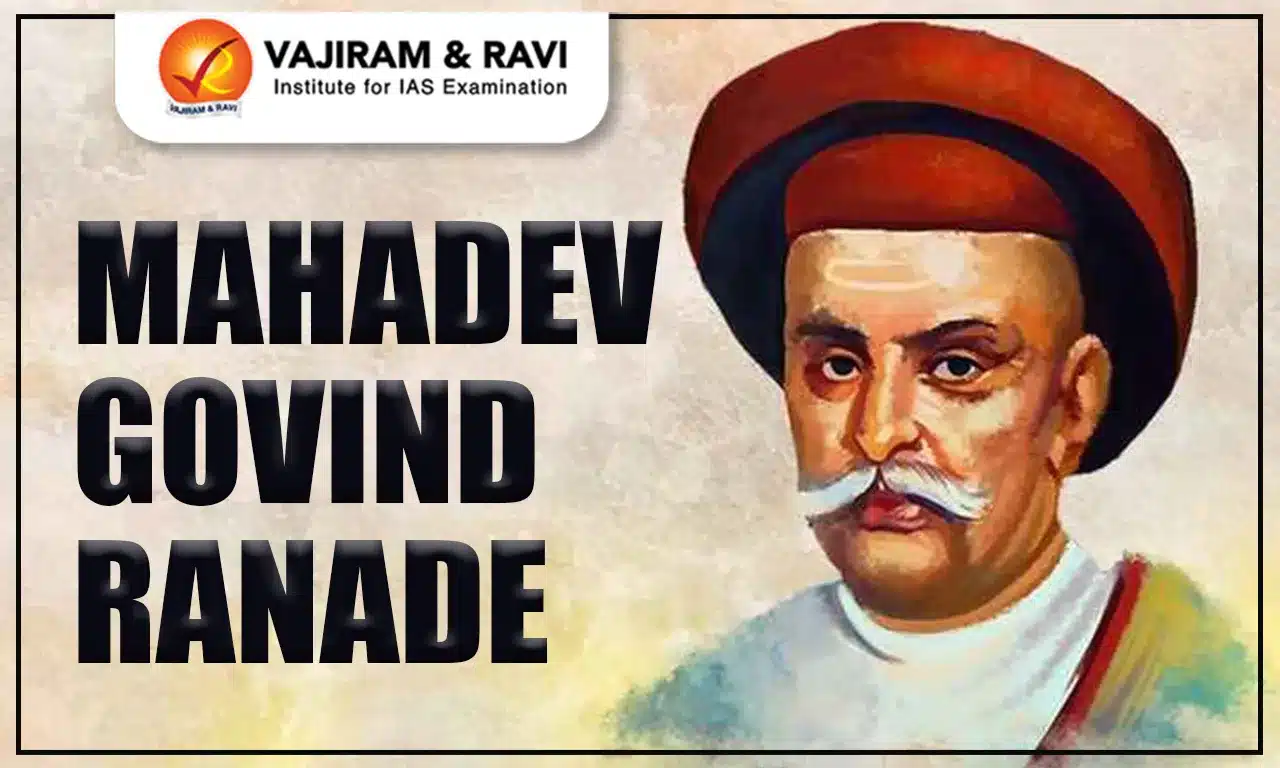
Mahadev Govind Ranade, born in 1842 in Nashik, Maharashtra, was a renowned nationalist, jurist, scholar, and one of the leading social reformers of 19th-century India. Often remembered as the “Socrates of Maharashtra,” Ranade dedicated his life to promoting progressive ideas such as education, social justice, and economic reform. Deeply influenced by the reformist ideals of the Prarthana Samaj, Arya Samaj, and Brahmo Samaj, he worked tirelessly to challenge regressive practices and uplift Indian society.
He co-founded the Deccan Educational Society, advocated the establishment of the Indian National Congress, and served with distinction as a judge of the Bombay High Court. His contributions to education, social reform, and nation-building make him an important figure for understanding India’s socio-political awakening under colonial rule.
Mahadev Govind Ranade Background
Mahadev Govind Ranade was born on January 18, 1842, into a middle-class Maharashtrian family in Niphad, Nashik. He began his education at a Marathi school in Kolhapur before moving to an English-medium institution. At the age of 14, he joined Elphinstone College in Bombay and later became part of the first batch of students at the University of Bombay. He earned his BA in 1862 and completed his LLB in 1866.
Ranade played a key role in introducing vernacular languages into the university curriculum. His judicial career began with his appointment as Presidency Magistrate of the Bombay Small Causes Court in 1871, and in 1893 he rose to the position of Judge at the Bombay High Court. Alongside his legal career, he also served as a history professor at Elphinstone College, where his deep interest in Maratha history led him to write the seminal work Rise of Maratha Power in 1900.
Beyond academics and law, Ranade was a reformer and a nationalist. He was instrumental in the founding of the Indian National Congress in 1885, contributing significantly to the political awakening of modern India.
Mahadev Govind Ranade Ideology
- Mahadev Govind Ranade reformist ideas were shaped by Western thought and the colonial context.
- He worked in spheres like religious reform, public education, and family reform, often criticizing traditional Indian customs.
- He believed Hinduism was overly tied to rituals and duties, neglecting deeper spiritual values.
- Sought to emphasize spiritual growth over ritual practices, drawing inspiration from reformed Christianity, which he saw as more spiritually centered.
- Viewed many Indian practices as obstacles to progress and worked to reshape them in line with rational and ethical ideals.
- Advocated indigenous products, balancing Western influence with a nationalist economic vision.
Mahadev Govind Ranade Contributions
- Mahadev Govind Ranade believed Hinduism focused excessively on rituals and social duties. He sought to infuse it with spiritual values, inspired by his study of Western thought and reformed Christianity.
- He worked actively for public education, especially advocating reforms within the Indian family system, including women’s education and widow remarriage.
- Deeply shaped by colonial exposure, he often compared Indian customs with Western practices, favoring reform in line with modern rational ideals.
- He envisioned an Indian society grounded in higher spiritual values rather than mechanical traditions.
- Mahadev Govind Ranade strongly supported the Swadeshi movement, urging the use of indigenous products as a path to self-reliance.
Mahadev Govind Ranade on Women Empowerment
- Mahadev Govind Ranade's reformist vision aimed to humanize and equalize Indian society, with women at the core of his efforts.
- He actively opposed the purdah system, advocating for women’s dignity, mobility, and participation in public life.
- In 1861, while still a teenager, Ranade co-founded the Widow Marriage Association to encourage Hindu widow remarriages.
- This initiative directly questioned rigid Hindu customs that banned widow remarriage.
- His association also acted as native collaborators (compradors) in supporting the colonial government’s legal project to pass widow remarriage laws.
Mahadev Govind Ranade FAQs
Q1: What is Ranade best known for?
Ans: Mahadev Govind Ranade is best known as a social reformer, judge, and one of the founding members of the Indian National Congress. He worked for widow remarriage, women’s education, removal of caste restrictions, and economic reforms.
Q2: Which book was written by M.G. Ranade?
Ans: His most notable work is Rise of the Maratha Power (1900), which studied the history and political influence of the Marathas. He also wrote extensively on economics, religion, and social reforms.
Q3: What is the caste of Ranade?
Ans: M.G. Ranade belonged to the Chitpavan Brahmin community of Maharashtra.
Q4: Which organization was founded by M.G. Ranade?
Ans: He co-founded the Indian National Social Conference (1887), which worked alongside the Indian National Congress to promote social reform.
Q5: Who is called Mahadev Govind Ranade?
Ans: Mahadev Govind Ranade (1842-1901) was a renowned Indian social reformer, scholar, historian, and judge of the Bombay High Court, often remembered as one of the leading figures of India’s 19th-century reform movement.

