
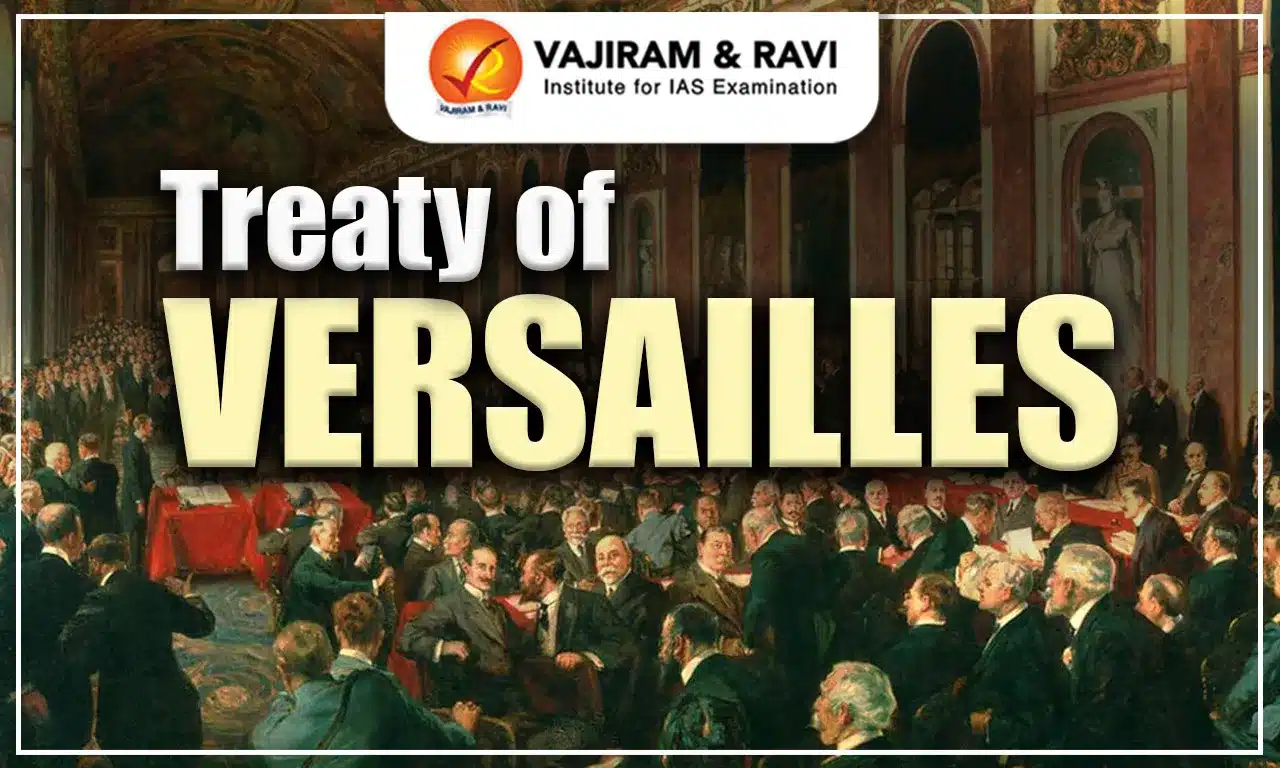
The Treaty of Versailles was a document signed in between Allied powers and Germany in 1919. The Treaty was responsible for officially ending World War I that took place in between Germany and the Allied Powers. The document was signed at the Palace of Versailles near Paris and hence is known by the name Treaty of Versailles. The treaty was an important contributing factor in the outbreak of the Second World War. In this article, we are going to cover the Treaty of Versailles, its historical background, important points and implementation process.
Treaty of Versailles
The Treaty of Versailles was signed in 1919 and marked the end of World War I. The treaty focused on Germany and imposed penalties on the nation. Germany was blamed for the war and had to face harsh terms, including territorial losses, disarmament and massive reparations. This was done to weaken Germany and prevent its resurgence. After the signing of this treaty, the League of Nations was established. It was an international organisation that was responsible for maintaining peace and cooperation between the nations. This helped prevent future conflicts. The Treaty of Versailles also criticized its harshness and the economic difficulties imposed on Germany and contributed to the grievances that led to World War II.
Treaty of Versailles Provisions
Treaty of Versailles had the following key provisions:
- Prohibition of secret agreements among countries
- Reduction of armaments and standing forces
- Recognising the right of self-determination, restricting one nationality from dominating another.
- Compulsory membership for all nations in the League of Nations
Treaty of Versailles 1919 Background
The peace agreement came after the conclusion of war in 1918 and the Russian Revolution and ongoing events in Russia. The agreement was signed in the Palace of Versailles near Paris by Germany and the Allied Powers. The negotiators were David Lloyd George of Britain, George of Britain, Georges Clemenceau of France and Woodrow Wilson of the United States. The allies were unwilling to show leniency towards Germany and its defeated partners, making them directly accountable for the war. Germany was excluded from the drafting process. The backdrop included the deadly Spanish flu outbreak of mid 1918 killing nearly 25 million people, heightening anger across Europe, mostly directly at Germany. After months of debate among the “Big Three,” the treaty was signed on June 28, 1919.
The Paris Peace Settlement
Delegates from 32 nations gathered in Paris in 1919 to draft the peace terms. The decision-making authority rested with the “Big Three,” with Italy playing a smaller role. The settlement resulted in five major treaties that are the Versailles, St. Germain, Trianon, Neuilly, and Sevres/Lausanne.The Treaty of Versailles was specifically concerned with Germany, dominating discussions throughout the conference, while the other treaties dealt with territorial and economic restructuring in Europe.
Treaty of Versailles and Wilson’s Fourteen Points
In 1918, U.S. President Wilson addressed Congress during what he called “the war to end all wars.” He presented an optimistic vision of global peace, suggesting territorial adjustments if the Allies triumphed and emphasizing that nationalities should govern themselves. His most significant proposal was the creation of an international body to resolve disputes and prevent wars. This later became the League of Nations. On November 11, 1918, Germany agreed to an armistice, assuming Wilson’s ideals would shape the eventual peace. However, the final treaty largely disregarded his vision. His Fourteen Points included:
- Transparency in diplomacy with no secret treaties.
- Freedom of navigation during war and peace.
- Equal trade opportunities for all nations.
- Reduction of military capacities worldwide.
- Negotiation of colonial disputes.
- Recognition of Russia’s independence.
- Restoration of Belgium.
- Return of Alsace-Lorraine to France.
- Adjustment of Italy’s borders through diplomacy.
- Autonomy for Austria-Hungary.
- Redefinition of Balkan boundaries for Romania, Serbia, and Montenegro.
- Establishment of Turkey with free passage through the Dardanelles.
- Formation of an independent Polish state.
- Founding of a League of Nations to uphold cooperation.
Treaty of Versailles Implementation
The agreement of Versailles was monumental and enforced tough penalties on Germany. Its outcomes can be grouped into three areas:
- Reparations: Germany had to compensate the victorious nations, as it was blamed for the war. The figure was set at 132 billion gold marks, about 269 billion USD today. The already weakened German economy worsened under this burden.
- Territorial Changes: Germany’s borders were redrawn. Lands were ceded to Poland, including the “Polish Corridor,” while other territories went to France, Belgium, and Denmark. This loss reduced Germany’s size and population, creating resentment among Germans.
- Rhineland Occupation: The Rhineland in western Germany was occupied by Allied troops. This demilitarized zone ensured Germany could not mount aggression, but it bred further German hostility. The occupation lasted until 1930.
- The treaty was expected to maintain long-term peace but instead bred dissatisfaction, setting the stage for another global conflict.
Treaty of Versailles Impact
The Treaty of Versailles had the following impacts:
- Territorial Losses:
- The Saar Basin was placed under League of Nations control.
- A new Polish state was established with West Prussia and Posen.
- Alsace-Lorraine was restored to France.
- Danzig became a “free city.”
- Referendums were held in Schleswig, Upper Silesia, and West Prussia.
- German colonies and overseas investments were lost.
- Military Restrictions
- The German army was capped at 100,000 men.
- No air force was permitted, and only a minimal navy remained.
- Conscription was abolished.
- Allied forces occupied the Rhineland for 15 years.
- Commissions overseeing German military affairs remained until 1927.
- Reparations:
- Germany had to pay £6,600 million.
- Payments were made through gold and goods.
- By 1923, when Germany defaulted, France occupied the Ruhr.
German Reaction to the Treaty
Germany had anticipated milder terms shaped by Wilson’s principles. The nation objected to:
- Accepting blame for the war.
- Being excluded from the discussions.
- Signing under compulsion without negotiations.
- Harsh reparations and territorial concessions.
- Denial of self-determination in German-inhabited areas.
The population viewed the treaty as humiliating and demanded its reversal.
Treaty of Versailles FAQs
Q1: What are the main points of the Treaty of Versailles?
Ans: The provisions of Treaty of Versailles included Disarmament of Germany, territorial losses, war reparations, and creation of the League of Nations.
Q2: What are the 5 treaties of Versailles?
Ans: The 5 treaties of Versailles are Versailles, St. Germain, Trianon, Neuilly, and Sevres (later Lausanne).
Q3: What are the 4 things the Treaty of Versailles did?
Ans: The treaty of Versailles imposed reparations, reduced Germany’s military, redrew European borders, and established the League of Nations.
Q4: How many countries signed the Treaty of Versailles?
Ans: The peace settlement involved representatives of 32 nations, though Germany signed under compulsion.
Q5: Which Indian signed the Treaty of Versailles?
Ans: Maharaja Ganga Singh of Bikaner signed on behalf of India.
