
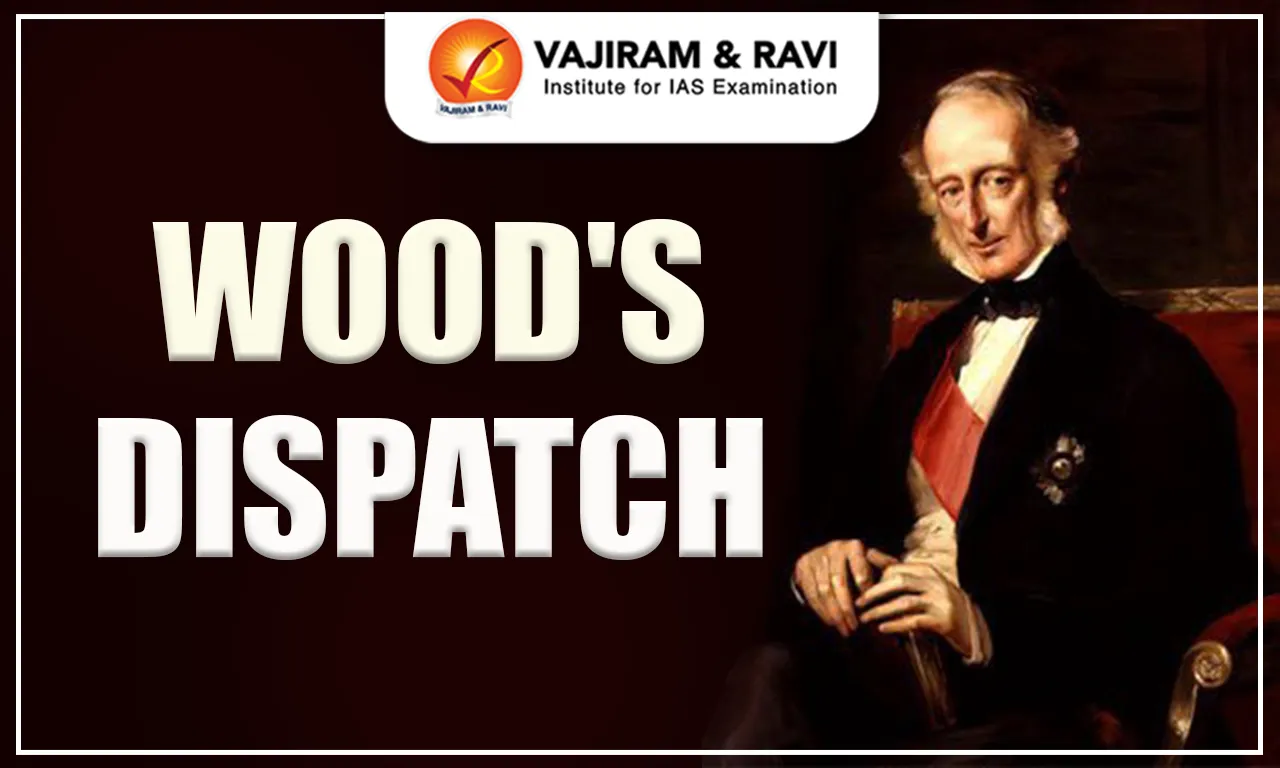
Wood’s Dispatch was introduced by Sir Charles Wood in 1854. Sir Charles Wood was the president of the Board of Control of the East India Company and he addressed a letter to Lord Dalhousie, then Governor- General of India and proposed a blueprint for education in India. He focused on a three-tier language policy with vernacular languages at the primary level, anglo-vernacular at the secondary stage and English as the medium of higher education. This important document, informally called Wood’s dispatch, is called the “Magna Carta of English Education in India.” In this article, we are going to cover Wood's Dispatch, its objectives, its recommendation and its impact.
Wood’s Dispatch
The Wood’s Dispatch was also known as the “Magna Carta of English Education in India” and was a significant landmark in shaping modern education. The act placed the responsibility of Indian Education on the company and focused on spreading European Literature, science and philosophy through English while promoting Indian language at the primary level. The Dispatch recommended the creation of a Department of Public Instruction in every province and setting up of a graded school system and introduction of a grant-in-aid system for private institutions.
While the Dispatch gave a strong push to secondary and higher education and laid the foundation of an organized system, many of its provisions were delayed or implemented in a distorted form. Mass education and vernacular high schools were neglected, and universal literacy remained unrealized. After the 1857 Revolt, education took a backseat as the British Crown focused more on consolidating power than on reform.
Wood’s Dispatch Objectives
The Wood’s Dispatch was introduced for the purpose of introducing bridging cultures and promoting growth. These objectives include:
- To provide western knowledge and cultural ideas to Indians.
- To prepare a class of Indians who serve as efficient government officials.
- To motivate intellectual and moral growth of Indian youth.
- Promotes vocational and practical skills and boosts indigenous industries and markets.
Wood’s Dispatch Recommendation
The recommendations made by wood’s dispatch helped lay down foundations for modern learning. These recommendations include:
- Proposed departments of public instruction in Bengal, Bombay, Madras, Punjab and North-western provinces.
- Focused on mass education and expansion of primary, middle and high schools.
- Advocated universities in Calcutta, Bombay and Madras modeled on the University of London.
- Suggested the establishment of faculties for law, civil engineering, Arabic, Sanskrit and Persian.
- Introduced the grant-in-aid system to support private education.
- Stressed on the importance of dual vernaculars and English in instruction.
- Motivated women to seek education and teacher-training institutes in every province.
- Proposed a graded system of schools all over the country to provide uniform learning.
Wood’s Dispatch Impact
Introduced in 1854, by Charles Wood, the wood’s dispatch had an impact of shaping India’s educational future. This includes:
- Universities were established in Bombay, Madras and Calcutta in 1857.
- Provincial education departments were set up.
- Bethune School in Calcutta focused on women’s education.
- Agricultural and engineering institutes were set up at Pusa(Bihar)n and Roorkee.
- British India’s education was increasingly westernised with European faculty heading institutions.
Wood's Dispatch FAQs
Q1: What are the main objectives of Wood's Dispatch?
Ans: To spread Western education, promote Indian languages, expand mass education, train teachers, and create a class of educated Indians for administration.
Q2: What was the Wood's Dispatch 1857?
Ans: It led to the establishment of the first three universities in Calcutta, Bombay, and Madras in 1857.
Q3: What was Wood's Despatch 1854 called?
Ans: It was called the “Magna Carta of English Education in India”.
Q4: Why is Wood's Despatch called Magna Carta?
Ans: Because it laid the foundation of a systematic, organized, and comprehensive education policy in India.
Q5: Who founded Wood's Despatch?
Ans: It was authored by Sir Charles Wood, the President of the Board of Control of the East India Company.
