
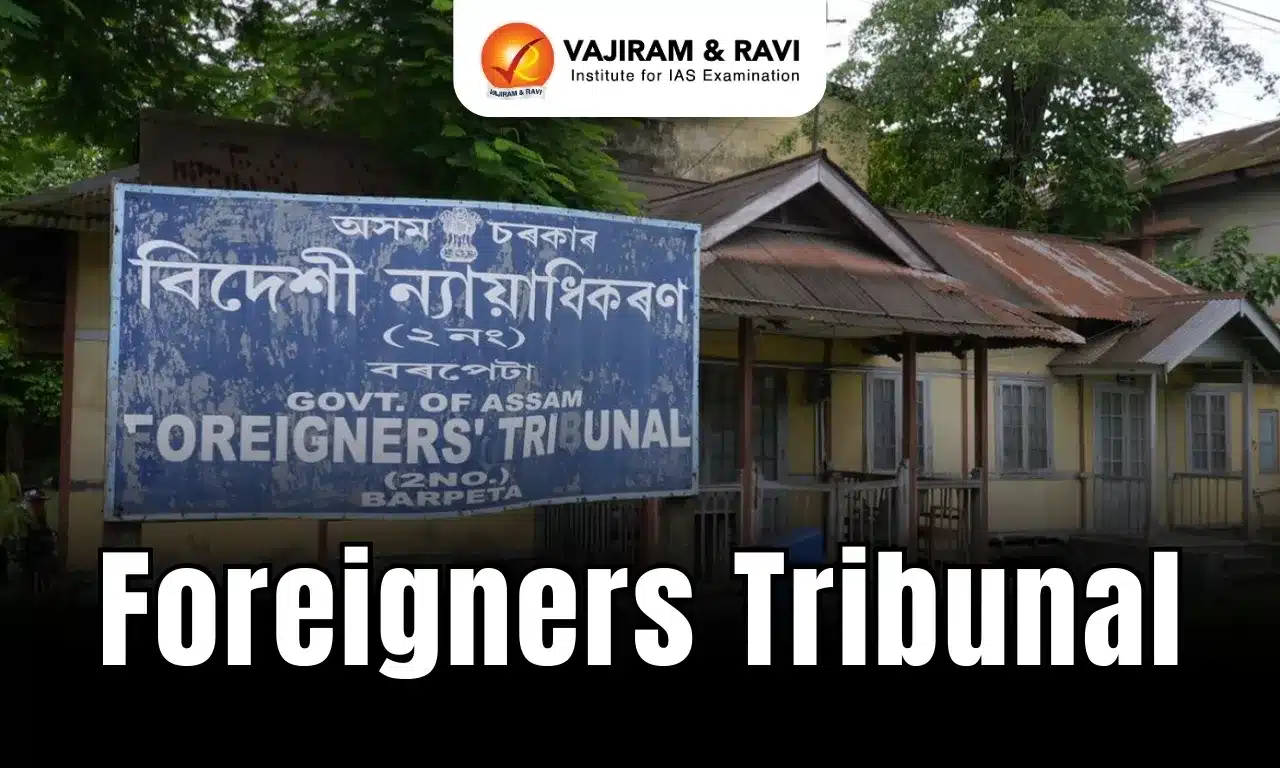
Foreigners Tribunal Latest News
The Union Ministry of Home Affairs (MHA) has given Foreigners Tribunals (FT), so far unique to Assam, the powers of a first class judicial magistrate.
About Foreigners Tribunal
- These are quasi-judicial bodies formed through the Foreigners (Tribunals) Order of 1964 under Section 3 of the Foreigners’ Act of 1946, to let local authorities in a State refer a person suspected to be a foreigner to tribunals.
- Are FTs meant only for Assam?
- The Foreigners (Tribunals) Order, 1964, applies to the whole of India, yet FTs exist only in Assam as of now.
- In other states, if any illegal immigrant is found, he is produced before a local court and dealt with as per the Foreigners Act, 1946.
- Prior to the 2019 amendment to the Foreigners (Tribunals) Order, 1964, only the Centre was empowered to establish FTs in states, but after this amendment, the power has been granted to states as well.
- Composition: Each FT is headed by a member drawn from judges, advocates, and civil servants with judicial experience.
- Powers: According to the 1964 order, an FT has the powers of a civil court in certain matters, such as summoning and enforcing the attendance of any person and examining him or her on oath and requiring the production of any document.
Foreigners Tribunal Functioning
- A tribunal is required to serve a notice in English or the official language of the State to a person alleged to be a foreigner within 10 days of receiving the reference from the authority concerned.
- Such a person has 10 days to reply to the notice and another 10 days to produce evidence in support of his or her case.
- An FT has to dispose of a case within 60 days of reference.
- If the person fails to provide any proof of citizenship, the FT can send him or her to a detention centre, now called transit camp, for deportation later.
Immigration and Foreigners Order, 2025:
- The order is part of recently passed Immigration and Foreigners Act, 2025. This order replaces the Foreigners (Tribunal) Order, 1964.
- It allows FTs to issue arrest warrants and detain individuals who can't prove they're not foreigners. This was previously done through executive orders.
- It empowers FTs to issue arrest warrants if a person whose nationality is disputed fails to appear in person.
- FTs “shall have the powers of a civil court while trying a suit under the Code of Civil Procedure, 1908 (5 of 1908), and the powers of a judicial magistrate of the first class under the Bharatiya Nagarik Suraksha Sahita, 2023, (46 of 2023) in matters including-
- summoning and enforcing the attendance of any person and examining him on oath;
- requiring the discovery and production of any document;
- issuing commissions for the examination of any witness;
- directing the proceedee to appear before it in person;
- issuing a warrant of arrest against the proceedee, if he fails to appear before it.”
Source: TH
Foreigners Tribunal FAQs
Q1: Foreigners Tribunals (FTs) were constituted under which legal framework?
Ans: Foreigners Act, 1946
Q2: At present, Foreigners Tribunals exist only in which Indian state?
Ans: Assam
Q3: Who generally heads a Foreigners Tribunal?
Ans: Each FT is headed by a member drawn from judges, advocates, and civil servants with judicial experience.
Q4: Within how many days must a Foreigners Tribunal dispose of a case after receiving a reference?
Ans: 60 days
