
Jarosite Latest News
Researchers confirmed the presence of jarosite in Matanomadh in Kutch, Gujarat similar to what was discovered on Mars a couple of decades ago.
About Jarosite
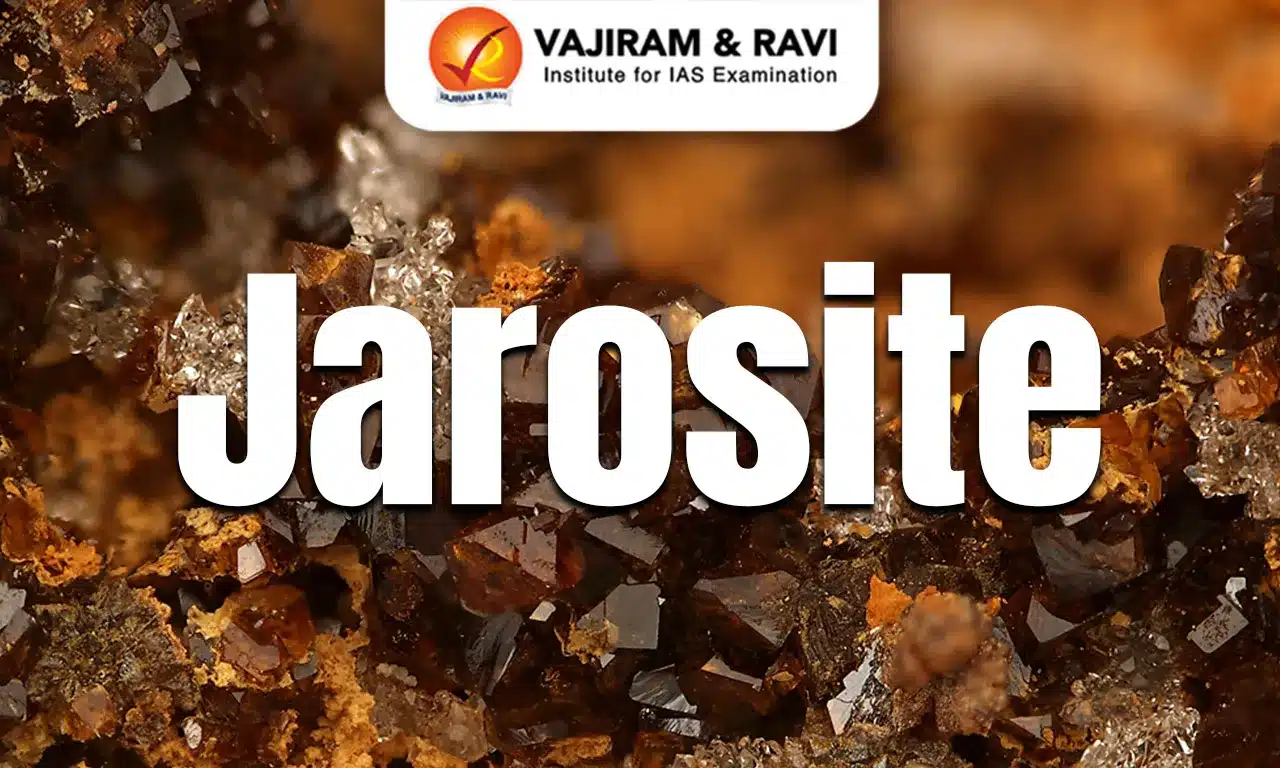
- Jarosite is a yellow-brown mineral composed of potassium, iron, and sulphate, commonly found in arid, saline environments.
- Jarosite formation is a signal of extreme geochemical conditions and a clue to unlocking complex environmental and planetary processes.
- On Earth, jarosite is formed when some minerals rich in oxygen, iron, sulphur and potassium react in the presence of water.
- Jarosite formation is typically associated with volcanic activity.
- In 2004, NASA’s Opportunity mission to Mars was the first to detect traces of jarosite at the Meridiani Planum landing site.
- The discovery of jarosite on Mars was one of the strongest pieces of evidence of the presence of water on the planet at some point of time.
- In Matanomadh, the mineral dating 55 million years old, corresponding with the Paleocene period in the geological timeline was found.
- In India its presence has also been confirmed along Kerala’s Varkala cliffs.
- Similar deposits have been found in Mexico, Canada, Japan, Spain, and in Utah and California in the US.
- Significance of the discovery: It could help decode the palaeo-evolution of the Martian geology and the past chemical interactions on the planet.
- Moreover, as sulphates such as jarosite could trap organic molecules and elements that support life within them, examining these samples in Kutch could open a window of opportunity for designing strategies for future Mars missions that will explore life on the red planet.
Source: IE
Jarosite FAQs
Q1: What is jarosite used for?
Ans: Jarosite precipitation is used in hydrometallurgy, especially the zinc industry, to control iron, sulfate and other impurities.
Q2: What is the significance of finding jarosite on Mars?
Ans: On Mars, Jarosite may represent the key to unlocking the geological history and environmental context of water on the red planet.
