
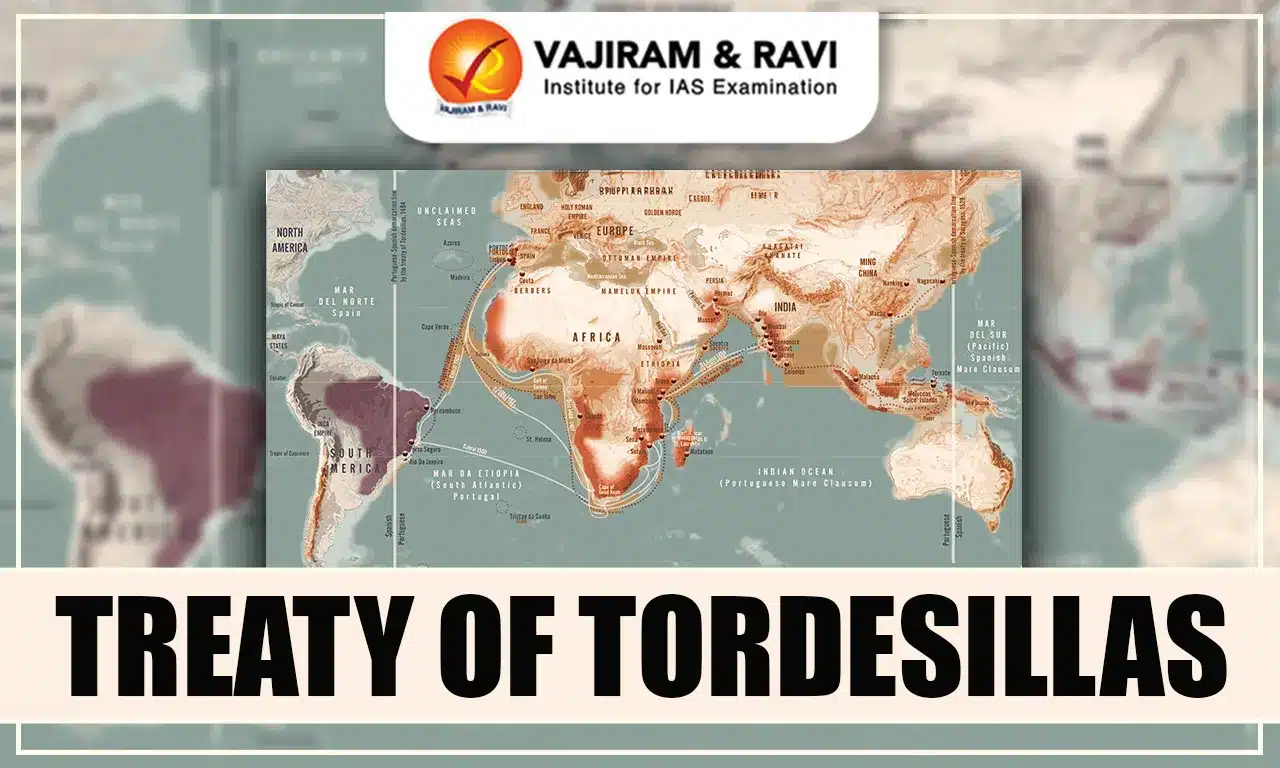
Treaty of Tordesillas was signed between Spain and Portugal in order to solve the dispute over territories that were discovered newly or explored by Christopher Columbus along with others during the late 15th century navigators. In this article, we are going to cover the Treaty of Tordesillas, its objectives and significance.
Treaty of Tordesillas
The Treaty of Tordesillas was signed in 1494. After 1493, after the news of Columbus’s voyages, Spain’s monarchs Ferinand and Isabella sought papal backing to secure their claims in the New World and block Portuguese or other rivals. To satisfy them, Pope Alexander VI, himself Spanish-born, issued bulls drawing a demarcation line from pole to pole, 100 leagues (about 320 miles) west of the Cape Verde Islands. Spain was granted exclusive rights to all new and undiscovered lands west of that line, while Portugal retained rights to explore eastward. Neither kingdom could seize territory already under a Christian ruler.
Other Atlantic-facing European powers rejected this papal division and the agreement based on it. Portugal’s King John II objected, claiming his nation’s rights in the New World and space for African voyages were too restricted. At Tordesillas in northwestern Spain, Portuguese and Spanish envoys renegotiated, shifting the line to 370 leagues (1,185 miles) west of Cape Verde, roughly 46°30′ W of Greenwich. Pope Julius II confirmed this adjustment in 1506. This new boundary later allowed Portugal to claim Brazil after Cabral’s discovery in 1500. Expansions deep into South America beyond that line would eventually secure Brazil’s vast territorial claims.
Treaty of Tordesillas Objectives
The treaty of tordesillas has the following objectives:
- To resolve disputes between Spain and Portugal over newly discovered lands by Columbus and other explorers.
- To avoid conflict by dividing the non-European world into two zones of influence, one for Spain and one for Portugal.
- To set up a demarcation line about 370 leagues west of the Cape Verde Islands, giving Spain rights to lands west of the line and Portugal rights to lands east of it.
- To gain papal approval and legitimacy for overseas expansion.
Treaty of Tordesillas Significance
The Treaty of Tordesillas was of the following importance:
- Peaceful division of territories: The treaty helped prevent immediate conflict between Spain and Portugal, the two major seafaring powers of the 15th century.
- Birth of colonial empires: Allowed Spain to dominate much of the Americas, while Portugal secured Brazil, Africa, and Asia.
- Global impact: Marked one of the first attempts at an international agreement to regulate colonization and exploration.
- Religious sanction: Strengthened the role of the Pope in legitimizing European territorial claims.
- Long-term consequences: Though ignored by other European powers later, it laid the foundation for Spain and Portugal’s early dominance in global exploration and colonization.
Treaty of Tordesillas FAQs
Q1: What is the Treaty of Tordesillas and why is it important?
Ans: The Treaty of Tordesillas (1494) was an agreement between Spain and Portugal dividing newly discovered lands outside Europe, shaping global colonial boundaries.
Q2: Who divided the Treaty of Tordesillas?
Ans: The division was agreed upon by Spain and Portugal.
Q3: Which pope created the Treaty of Tordesillas?
Ans: Pope Alexander VI issued the papal bull that laid the foundation for the treaty.
Q4: When was the Treaty of Tordesillas signed?
Ans: It was signed on 7 June 1494.
Q5: What was the objective of the Treaty of Tordesillas?
Ans: Its objective was to avoid conflict by dividing new lands between Spain and Portugal for exploration and colonization.
