
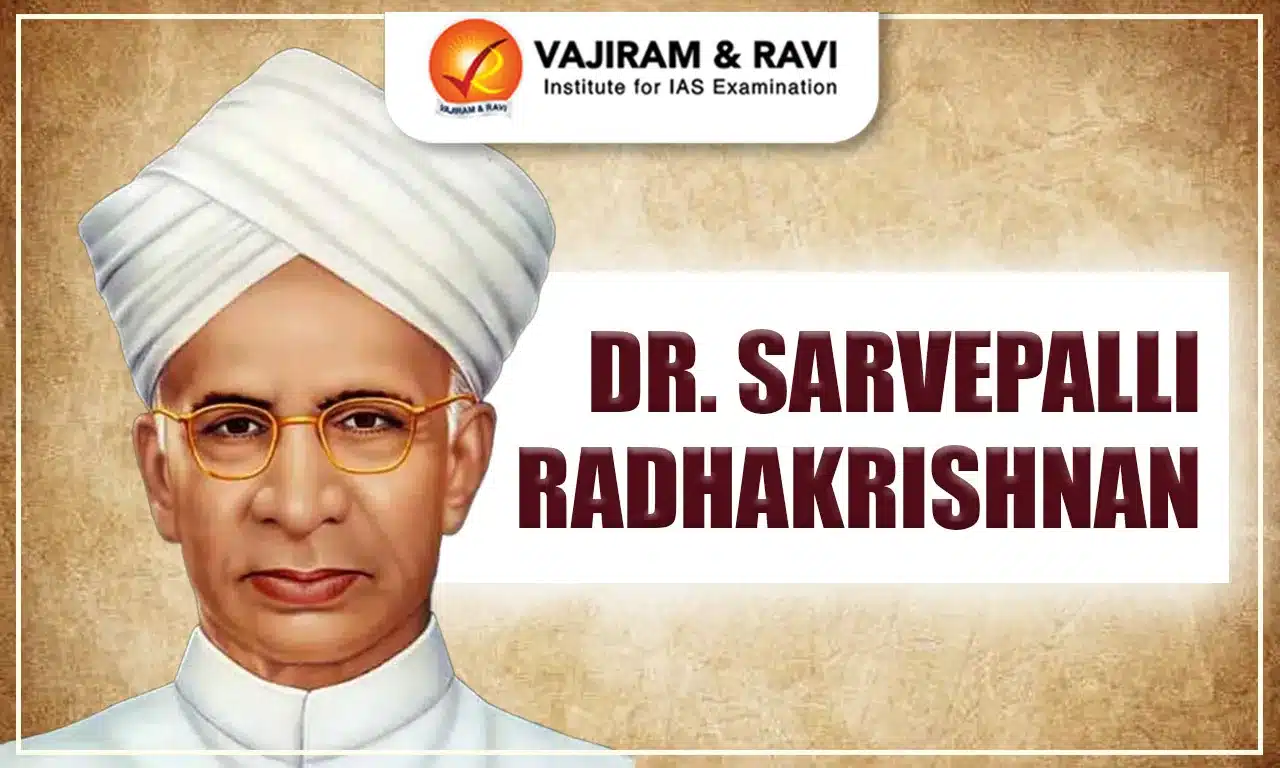
Dr. Sarvepalli Radhakrishnan (1888-1975) was a renowned Indian philosopher, scholar, and statesman. He became the First Vice President of India and later went on to serve as the Second President of India. Known for his deep commitment to education and learning, his contributions earned him immense respect, and his birthday, September 5, is observed across India as Teacher’s Day in his honor.
Dr. Sarvepalli Radhakrishnan Early Life
Dr. Sarvepalli Radhakrishnan was born on September 5, 1888, in Tiruttani, then part of the Madras Presidency (now in Tamil Nadu), into a Niyogi Brahmin family of Tamil background. His father worked as a revenue official in a modest position, and Radhakrishnan spent his early years in the spiritually significant towns of Tiruttani and Tirupati. A gifted student, he earned scholarships throughout his academic journey.
He studied at K.V. High School in Tiruttani, the Hermannsburg Evangelical Lutheran Mission School in Tirupati, and later at the Government High Secondary School in Walajapet. Pursuing higher education, he joined Voorhees College before moving on to Madras Christian College, where he completed both his bachelor’s and master’s degrees in philosophy by 1906. This strong academic foundation, coupled with exposure to culture and ethics during his formative years, shaped his future contributions to philosophy and education.
Dr. Sarvepalli Radhakrishnan Career
Though widely celebrated as a philosopher in India, Dr. Sarvepalli Radhakrishnan also earned a lasting reputation on the global stage. He began his academic journey in 1909 as a lecturer in philosophy at Madras Presidency College and later went on to teach at Maharaja’s College, Mysore, and the University of Calcutta.
His writings, particularly The Philosophy of Rabindranath Tagore and The Reign of Religion in Contemporary Philosophy, established him as a serious thinker and earned him recognition well beyond India. Representing the University of Calcutta at international forums, he delivered the prestigious Hibbert Lectures at Oxford, which were later published as An Idealist View of Life.
His leadership roles as Vice-Chancellor of Andhra University and Banaras Hindu University eventually led to his appointment as the Spalding Professor of Eastern Religions and Ethics at Oxford, where he built intellectual bridges between Indian thought and Western philosophy. Even today, his books and lectures remain an invaluable source of insight and inspiration for scholars, teachers, and students across the world.
Dr. Sarvepalli Radhakrishnan Political Leadership
Sarvepalli Radhakrishnan entered politics after establishing himself as a renowned academic and philosopher. Between 1946 and 1952, he represented India as a delegate to UNESCO and also served as the country’s Ambassador to the Soviet Union from 1949 to 1952. His political rise continued when he was elected the first Vice-President of India in 1952, a position he held for two consecutive terms until 1962. He then became the nation’s second President, serving from 1962 to 1967.
Though not directly involved with the Congress party or the freedom movement, Radhakrishnan was admired as a statesman who combined wisdom, moral authority, and a deep respect for India’s cultural and philosophical heritage. His presidency was noted for his emphasis on education, global understanding, and the promotion of peace. To honor his contribution to learning, his birthday, September 5, is celebrated nationwide as Teacher’s Day.
Dr. Sarvepalli Radhakrishnan Major Achievements
Dr. Sarvepalli Radhakrishnan’s contributions were recognized both in India and abroad with numerous honors. In 1931, he was knighted by King George V for his distinguished work in education. He later received India’s highest civilian honor, the Bharat Ratna, in 1954.
That same year, Mexico awarded him the Order of the Aztec Eagle, while Germany honored him with the Pour le Mérite for Sciences and Arts. His global reputation as a scholar also earned him a place as an Honorary Fellow of the British Academy in 1938, followed by membership in the United Kingdom’s prestigious Order of Merit in 1963.
In the literary and philosophical world, he became the first recipient of the Sahitya Akademi Fellowship in 1968 and had earlier been honored with the German Book Trade Peace Prize in 1961.
In 1975, the year of his passing, he was awarded the Templeton Prize for his lifelong efforts in promoting nonviolence and universal love. Remarkably, he was nominated for the Nobel Prize 27 times, 16 times in Literature and 11 times for Peace though he never received it. In India, his birthday on September 5 continues to be observed as Teacher’s Day, a tribute to his dedication to education and to the role of teachers in shaping society.
Dr. Sarvepalli Radhakrishnan Legacy
The Dr. Sarvepalli Radhakrishnan Legacy lies in the breadth of his contributions as a philosopher, teacher, and statesman. He bridged Indian and Western thought through his work in comparative philosophy, promoted religious harmony, and emphasized the transformative power of ethical education.
As India’s first Vice President and second President, he upheld democratic values and represented the country with dignity and cultural depth on the global stage. His lifelong commitment to learning is immortalized through Teacher’s Day, celebrated every year on his birthday as a tribute to educators.
Even today, his writings and ideas inspire leaders, scholars, and students, reminding us of the importance of wisdom, compassion, and education in shaping society. Dr. Radhakrishnan not only strengthened India’s intellectual and diplomatic foundations but also left behind a timeless vision of knowledge as the path to peace and human progress.
Dr. Sarvepalli Radhakrishnan and Teachers Day
In India, Teachers’ Day is celebrated on 5th September, the birth anniversary of Dr. Sarvepalli Radhakrishnan renowned educator, philosopher, and the second President of India. Widely admired for his profound scholarship in philosophy and unwavering dedication to education, Dr. Radhakrishnan taught at prestigious institutions such as the University of Mysore, Calcutta University, and Oxford University.
When he assumed the office of President in 1962, his students and friends proposed celebrating his birthday. Dr. Radhakrishnan, however, suggested that the day be dedicated to honoring teachers instead, recognizing their invaluable role in shaping society. Since then, September 5 has been observed as Teachers’ Day across the nation.
He famously said, “Teachers should be the best minds in the country.” For him, teaching was not just a profession but a noble calling, and he often described teachers as the true nation-builders and architects of the future.
Even today, his legacy continues to inspire both educators and students, reminding us of the transformative power of education. Teachers’ Day celebrations are marked with heartfelt tributes, activities, and expressions of gratitude, reflecting the respect and admiration students hold for their teachers.
Dr. Sarvepalli Radhakrishnan FAQs
Q1: Why is Radhakrishnan's birthday celebrated as Teacher's Day?
Ans: Dr. Radhakrishnan wished his birthday be marked to honor teachers, highlighting their role in shaping society, so 5th September became Teacher’s Day.
Q2: What is Dr. Radhakrishnan famous for?
Ans: He was a philosopher, scholar, India’s second President, and respected teacher, best known for his work in philosophy and promoting education worldwide.
Q3: Why did we celebrate Teacher's Day?
Ans: We celebrate Teacher’s Day to honor educators’ contributions, inspired by Dr. Radhakrishnan’s belief that teachers build the nation’s moral and intellectual foundation.
Q4: Which teacher day is 2025?
Ans: In 2025, Teacher’s Day in India will be celebrated on Friday, 5th September, marking Dr. Radhakrishnan’s birth anniversary.
Q5: When was the first Teachers Day celebrated in India?
Ans: The first Teacher’s Day in India was celebrated on 5th September 1962, after Dr. Radhakrishnan became President.
