
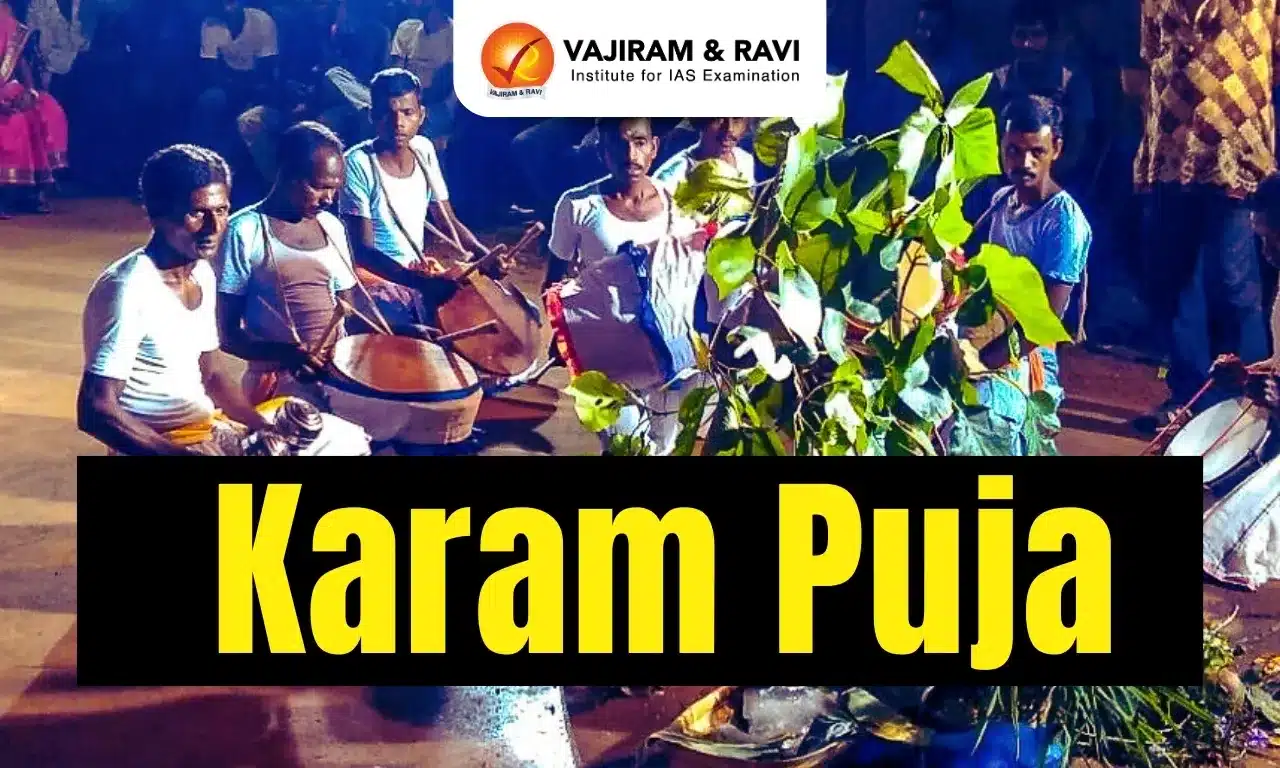
Karma Puja Latest News
The Prime Minister of India wished all fellow countrymen, especially the tribal community on the occasion of Karma Puja.
About Karma Puja
- It is also called Karam and Karam Parab - is one of the most important tribal festivals in India.
- It is related to the harvest and a tribute to the Karam tree. (Karam tree symbolises fertility, prosperity and everything that is auspicious).
- It is celebrated primarily in Jharkhand, Chhattisgarh, Odisha, Bihar, Madhya Pradesh, West Bengal, and Assam.
- It is popular especially among the Munda, Ho, Oraon, Baiga, Kharia, and Santhal peoples.
- It is traditionally celebrated on the Ekadashi tithi (eleventh day) which corresponds to August-September in the Gregorian calendar.
- How is it celebrated?
- About a week prior to the festival, young women bring clear sand from the river and sow seven types of grains.
- A Karam tree branch is planted in the courtyard or 'akhra' on the festival day.
- Devotees come with jawa (hibiscus) flowers, and the pahan (priest) worships the Karam Raja. Dancing and singing of traditional Karam songs follow.
- The festival concludes with the immersion of the Karam branch in a river or pond, and the jawa is distributed among the devotees.
- At the end of the Karam festival, branches from sal or bhelua trees are often planted in the fields with the hope that the Karam Raja/ Devta will protect their crops.
Source: PIB
Karma Puja FAQs
Q1: What happens in Karma Puja?
Ans: In this festival, the branch of the Karam tree is carried by the Karma dancers accompanied by singing and dancing.
Q2: In which state Karma Puja is celebrated?
Ans: Karma Puja, one of the most popular festivals of Jharkhand is related to the harvest and a tribute to the Karam tree.
