
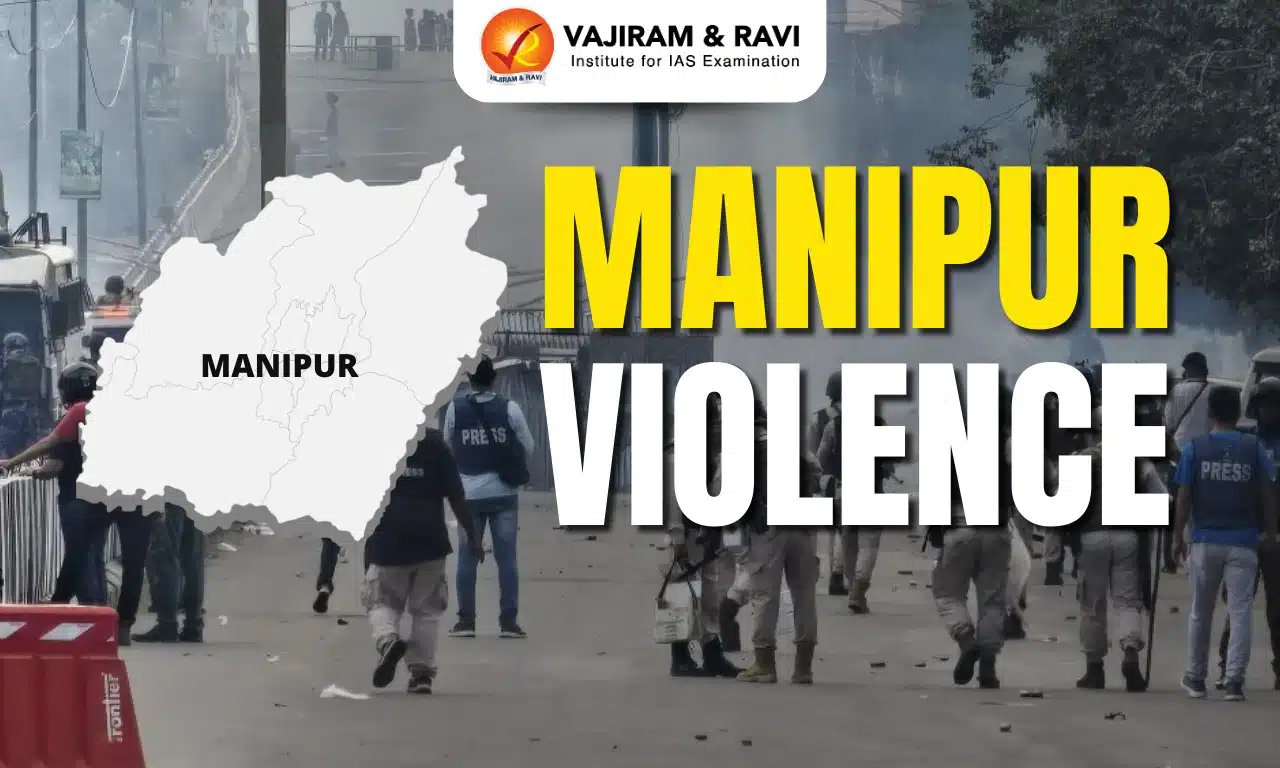
Manipur Violence Latest News
- The Centre has signed a revised Suspension of Operations pact with Kuki-Zo groups, tightening monitoring norms and relocating camps to restore peace in Manipur.
Introduction
- Manipur, plagued by ethnic violence between the Meitei and Kuki-Zo communities since May 2023, has witnessed a major policy development with the Centre announcing a revised Suspension of Operations (SoO) pact with Kuki-Zo insurgent groups.
- The move comes ahead of Prime Minister Narendra Modi’s scheduled visit to the state, marking the government’s most significant step to restore peace and stability.
- The new pact seeks to tighten oversight of cadres, relocate militant camps, and ensure compliance with the constitutional framework while opening channels for dialogue.
Free Movement and Confidence-Building Measures
- The Centre claimed that Kuki civil society groups had agreed to allow free movement along National Highway-02, a vital lifeline for commuters and essential goods in the state.
- This move was seen as the beginning of normalcy, but the Kuki-Zo Council (KZC) issued clarifications stating that the highway had never been officially blocked and that its appeal was limited to the Kangpokpi district stretch.
- While the government portrayed the development as an agreement on “free movement,” Kuki groups insisted that buffer zones between Meitei and Kuki areas would continue to be respected, highlighting persistent mistrust and the fragility of peace.
About The SoO Pact
- The new SoO pact was signed on September 4, 2025, between the Ministry of Home Affairs (MHA), the Government of Manipur, and 24 Kuki-Zo insurgent groups under the umbrellas of the Kuki National Organisation (KNO) and the United People’s Front (UPF).
- Key Features of the Revised Pact:
- Stricter Monitoring: A Joint Monitoring Group (JMG) led by the Manipur Principal Secretary (Home) will conduct physical verification of cadres, maintain detailed lists, and ensure removal of foreign nationals allegedly present in Kuki camps.
- Relocation of Camps: The pact mandates reducing the number of designated camps to six each for KNO and UPF, relocating them away from highways, populated areas, and the Myanmar border.
- Financial Transparency: Cadres will receive stipends only through Aadhaar-linked bank accounts, ensuring payments are restricted to those physically verified at camps.
- Restrictions on Activities: Groups are barred from recruiting new cadres, carrying weapons outside camps, associating with other armed outfits, or engaging in offensive operations.
- Respect for Constitution: The preamble emphasises that all signatories must abide by the Constitution of India and respect the territorial integrity of Manipur.
Political and Security Dimensions
- The signing of the pact has raised concerns among civil society groups.
- The Zomi Council, based in Churachandpur, rejected the KZC’s claim of representation, arguing that it does not legitimately represent the Zo people.
- This reflects deeper divisions within Kuki-Zo society and complicates negotiations.
- For the Meiteis, relocation of camps from valley-fringe areas to the hills addresses a long-standing demand, as these camps were allegedly used to launch attacks in the valley.
- Simultaneously, Naga groups such as the United Naga Council have voiced their displeasure over exclusion from talks, and have even threatened a trade embargo in response to the border fencing issue with Myanmar.
Path Towards a Political Settlement
- The revised SoO pact is designed as a confidence-building framework. It will be followed by a tripartite dialogue among the Centre, the Manipur government, and Kuki groups to pave the way for a negotiated political settlement within the Constitution.
- Parallelly, the Centre is working with other insurgent groups such as the United National Liberation Front (UNLF), for whom designated camps are being set up. This signals a wider attempt to bring insurgent movements under a structured peace process.
Manipur Violence FAQs
Q1: What is the Suspension of Operations (SoO) pact in Manipur?
Ans: The SoO pact is a ceasefire agreement between the Centre , Manipur government, and Kuki-Zo insurgent groups to suspend hostilities and negotiate peace.
Q2: What are the key changes in the revised SoO pact of 2025?
Ans: The revised pact mandates Aadhaar-linked stipends, relocation of camps, physical verification of cadres, and strict adherence to India’s Constitution.
Q3: Why is National Highway-02 significant in the Manipur peace process?
Ans: NH-02 is a vital supply route, and its free movement is seen as a step towards restoring normalcy between Meitei and Kuki areas.
Q4: What role does the Joint Monitoring Group (JMG) play in the pact?
Ans: The JMG verifies cadres, monitors compliance with ground rules, and ensures foreign nationals are excluded from insurgent lists.
Q5: What is the ultimate goal of the revised SoO agreement?
Ans: The pact aims to prepare the ground for a negotiated political settlement under the Constitution of India, ensuring peace and stability in Manipur.
