
Red Sea Latest News
Recent undersea cable cuts in the Red Sea disrupted internet access in parts of Asia and the Middle East.
About Red Sea
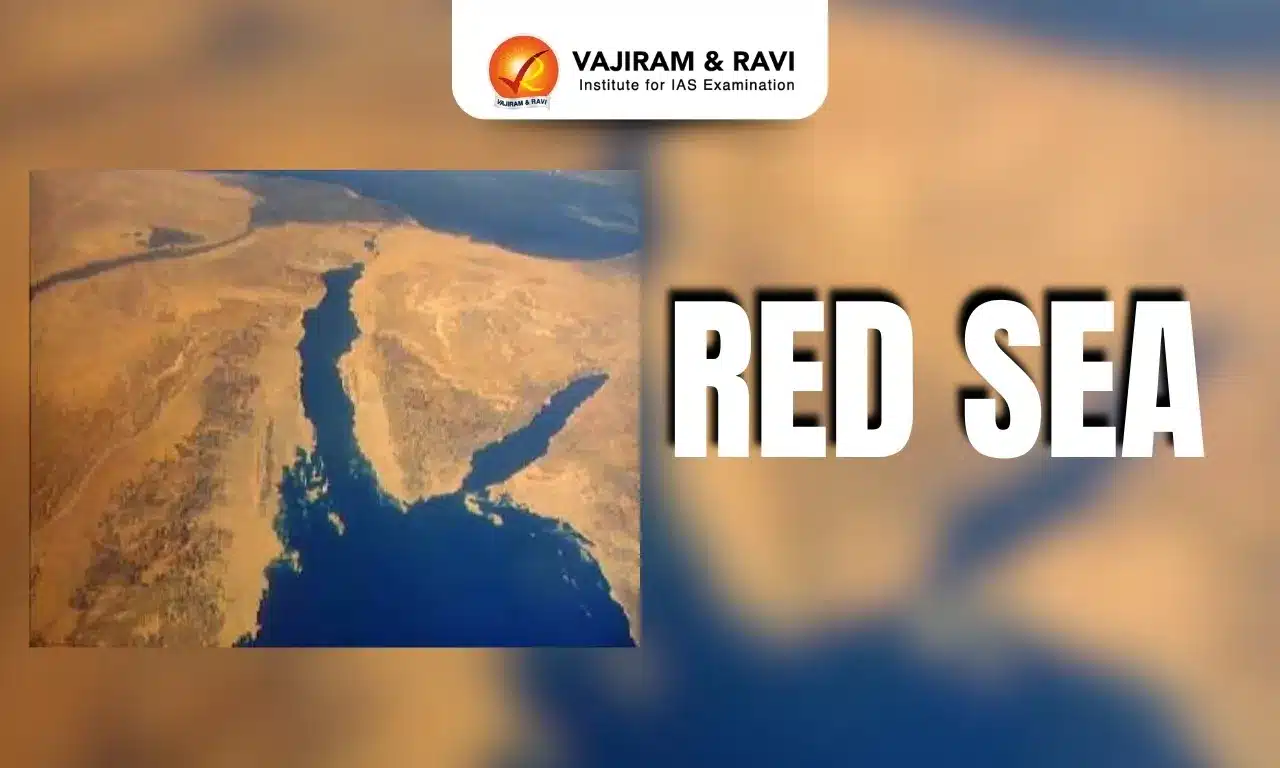
- It is a semi-enclosed inlet of the Indian Ocean between Africa and Asia.
- It is connected to the Arabian Sea and the Indian Ocean to the south through the Gulf of Aden and the narrow strait of Bab el Mandeb.
- The northern portion of the Red Sea is bifurcated by the Sinai Peninsula into the Gulf of Aqaba and the Gulf of Suez, where it is connected to the Mediterranean Sea via the famous Suez Canal.
- It is known for its hot and salty waters and is a crucial maritime route between Europe and Asia.
- The Red Sea's unique color changes are due to algae blooms. Geologically, it lies in a fault depression between the Arabian and North African tectonic plates.
- Bordering Countries: Egypt, Saudi Arabia, Yemen, Sudan, Eritrea and Djibouti.
- Five major types of mineral resources are found in the Red Sea region: petroleum deposits, evaporite deposits, sulfur, phosphates, and the heavy-metal deposits.
- Islands: Tiran Island, which is located near the mouth of the Gulf of Aqaba, and Shadwan Island, which is located at the entrance of the Gulf of Suez.
Source: DD News
Red Sea FAQs
Q1: What is the primary reason for the Red Sea's distinct coloration?
Ans: It contains a cyanobacteria called Trichodesmium erythraeum, which turns the normally blue-green water a reddish-brown.
Q2: Which major shipping canal connects the Red Sea to the Mediterranean Sea?
Ans: Suez Canal
