
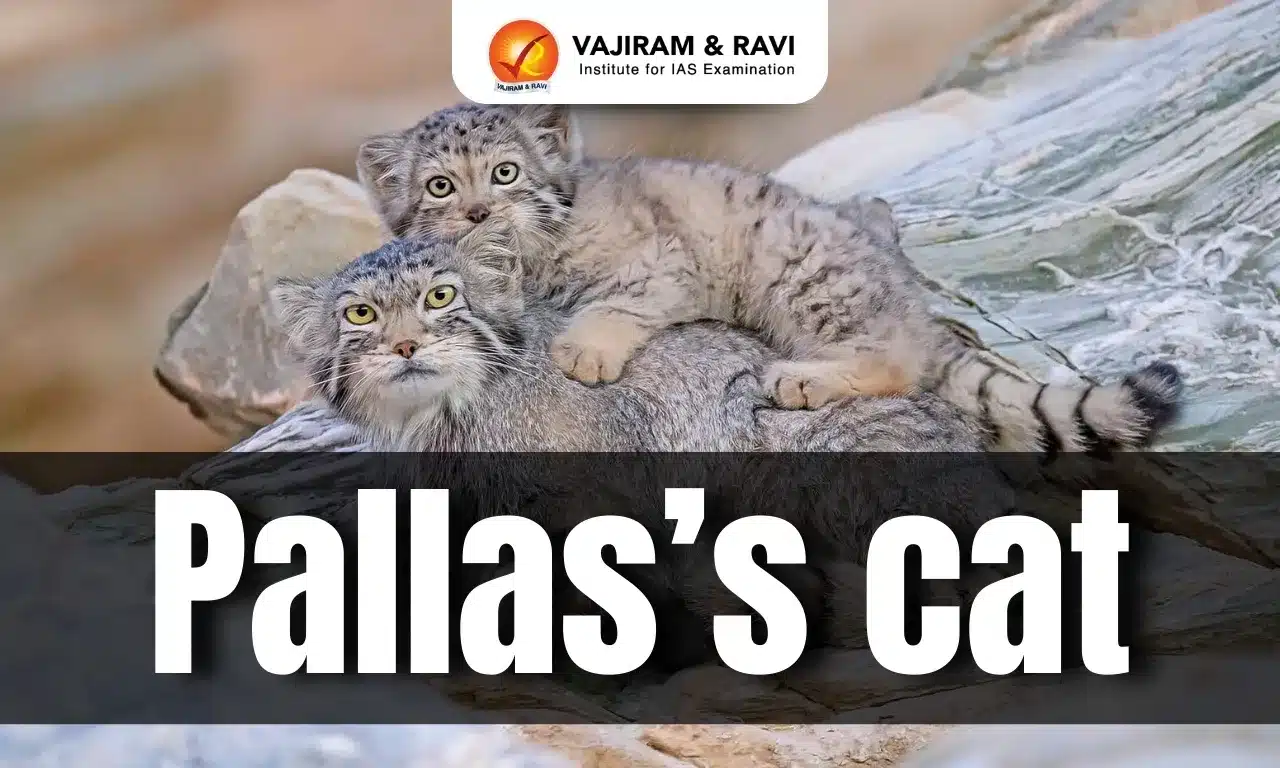
Pallas’s Cat Latest News
A wildlife survey conducted in Arunachal Pradesh has brought out first-ever photographic evidence of the elusive Pallas’s cat in the state.
About Pallas’s Cat
- The Pallas’s cat (Otocolobus manul) is a small wild cat well camouflaged and adapted to the cold continental climate in its native range.
- It was named Pallas’s cat after Peter Simon Pallas, who first described it in 1776 based on specimens collected near Lake Baikal, Russia.
Distribution of Pallas’s Cat
- They are primarily found in Central Asia, with their range extending to western Iran, Mongolia, China, Russia (on the border of Mongolia and China), Kazakhstan, and Kyrgyzstan.
- Habitat: It inhabits rocky montane grasslands and shrublands, where the snow cover is below 15-20 cm and preys foremost on lagomorphs and rodents.
Features of Pallas’s Cat
- It is a soft-furred animal about the size of a house cat and is pale silvery gray or light brown in colour.
- The Pallas’s cat is distinguished by a broad head with high-set eyes and low-set ears.
- The end of its tail is ringed and tipped with black, and some individuals have vague, dark markings on the body.
- The fur of the underparts is about twice as long as that of the upper parts and possibly represents an adaptation to the cat’s habitual lying and crouching on cold ground.
Conservation Status of Pallas’s Cat
- IUCN Red List: Least Concern
- CITES: Appendix II
Source: TOI
Pallas’s Cat FAQs
Q1: Where is IUCN headquarters?
Ans: Gland, Switzerland.
Q2: What is the meaning of montane grasslands?
Ans: Montane (mountain) grasslands and shrublands occur at high altitudes, where temperatures are cooler than in lowland grasslands.
