
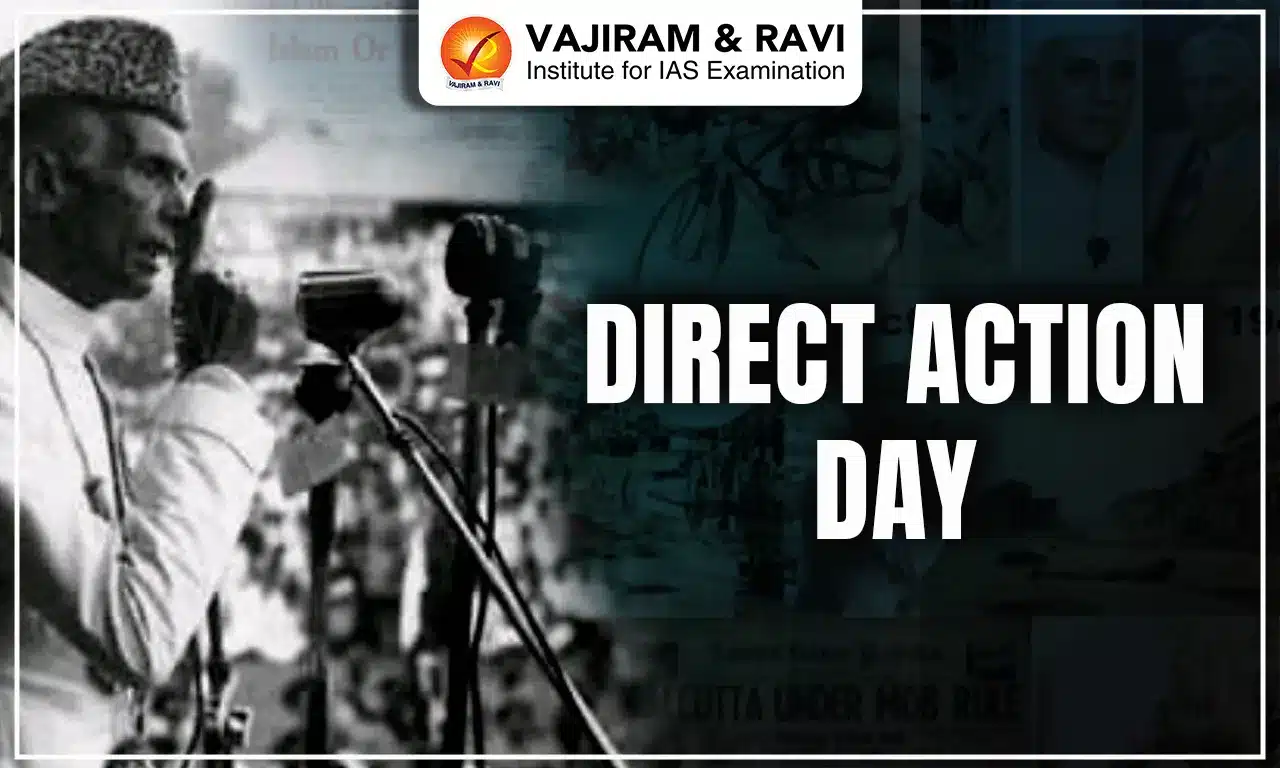
Direct Action Day is observed on 16 August every year as in 1946 on this day the most violent communal riots took place in Indian History. These riots were triggered by the Muslim League’s demand for a separate homeland of Pakistan and exposing the rift in between the Hindu-Muslim during the times of British India. Clement Attlee’s Declaration on 20 February 1947 put down a timeline for Britain’s withdrawal and admitted the likelihood of partition, hastening the decolonisation process. In this article, we are going to cover Direct Action Day, Attlee’s declaration and its implications.
Direct Action Day
- The 1940s witnessed a period of sharp communal polarisation and political instability making it the most unsettled period in Indian History. 16 August 1946, known as the Direct Action Day was the day that saw massive communal violence and created the path of partition. The Direct Action Plan was announced by Muhammad Ali Jinnah, the leader of Muslim League. The aim was to push the demand of Pakistan and challenge Congress leadership.
- The league urged its members to opt for general strike in order to highlight its complete rejection of a united India and its insistence on a separate nation. The call led to the initiation of riots across Bengal, especially in Calcutta, where the Muslim League Ministry governed the province. The violence had the following impacts:
- Death of more than 5,000 people and injuries to thousands.
- Destruction of homes, shops and neighbourhoods.
- Forced displacement of communities and deeper communal chasm.
- The bloodshed spread beyond Calcutta to Bombay, Noakhali, Tipperah, Bihar, and the United Provinces.
- The magnitude of the riots revealed the inability of the British administration to maintain control and emphasised the urgent need for a decisive political settlement.
Muslim League’s Participation and Tensions
In order to control the riots and the disastrous situation, Viceroy Lord Wavell took measures for a transitional government. He invited Jawaharlal Nehru, the President of Congress to form an Interim government that took charge on 2nd September 1946. Initially, the Muslim League rejected the participation, but later agreed to join on 26 October 1946, after talks with the Viceroy. However, the tension only got worse after the discussions.
- The League frequently neglected the decisions and boycotted informal cabinet discussions.
- The Muslim League and the Congress ministers often clashed, as the League utilised its position to advance its Pakistan demand.
- Congress pressed the British to either compel the League to cooperate or dissolve the Interim Government entirely.
- Thus, instead of acting as a bridge, the Interim Government became a battleground of rivalry, reflecting the sharp and growing divide between Congress and the League.
Attlee’s Declaration and the Countdown to Independence
Due to the worsening crisis, the British Prime Minister Clement Attlee delivered an important statement on 29 February 1947, setting a roadmap for British withdrawal and India’s future.
Important Points of Attlee’s Declaration
- Timeline for Transfer of Power: The Britishers fixed 30 June 1948 as the deadline to hand over authority to Indian leadership.
- Acknowledgement of Partition: Attlee admitted that if no central arrangement was workable, power would be transferred to provincial governments, thus accepting partition as an option.
- Change of Viceroy: Lord Louis Mountbatten was appointed as the new Viceroy, tasked with executing the withdrawal and ensuring a smooth transition.
Direct Action Day Implications and Attlee’s Declaration
The Direct Action Day that took place in 1946 was a watershed in India’s struggle for freedom, exposing the intensity of communal strife and making a political solution unavoidable. The instability of the Interim Government and Attlee’s declaration also led to the initiation of setting the final stage of independence. These moves managed to secure freedom for India but also led to painful and violent partition of the subcontinent. The Direct Action Day had the following implications:
- Widened Communal Divide: Direct Action Day riots and the League’s obstruction in the Interim Government increased mistrust between communities.
- Momentum for Pakistan: These events made the partition seem unavoidable, strengthening the Muslim League’s case.
- Speeding Up Decolonisation: Attlee’s declaration signaled the definitive end of British rule, with an explicit timeline and acceptance of partition.
- As the last Viceroy, Mountbatten presided over the transfer of power and the partition of India. His tenure concluded with the passage of the Indian Independence Act of 1947, which legally created India and Pakistan as independent states.
| Also Check Other Posts | |
| British Policies in India from 1765 to 1857 | Economic Policies of British in India |
| Drain of Wealth Theory | Land Revenue System in British India |
Direct Action Day FAQs
Q1: What is the main purpose of Direct Action Day?
Ans: The main purpose of Direct Action Day was to press the Muslim League’s demand for Pakistan through mass protests and strikes.
Q2: Which viceroy celebrated Direct Action Day?
Ans: Direct Action Day occurred during the tenure of Viceroy Lord Wavell.
Q3: Who announced Direct Action Day and when?
Ans: Muhammad Ali Jinnah and the Muslim League announced Direct Action Day on 16 August 1946.
Q4: When was the first Interim Government established in India?
Ans: The first Interim Government of India was established on 2 September 1946 under Jawaharlal Nehru’s leadership.
Q5: What was Attlee’s Declaration?
Ans: Attlee’s Declaration, announced on 20 February 1947, set 30 June 1948 as the deadline for British withdrawal and acknowledged the possibility of partition.
