
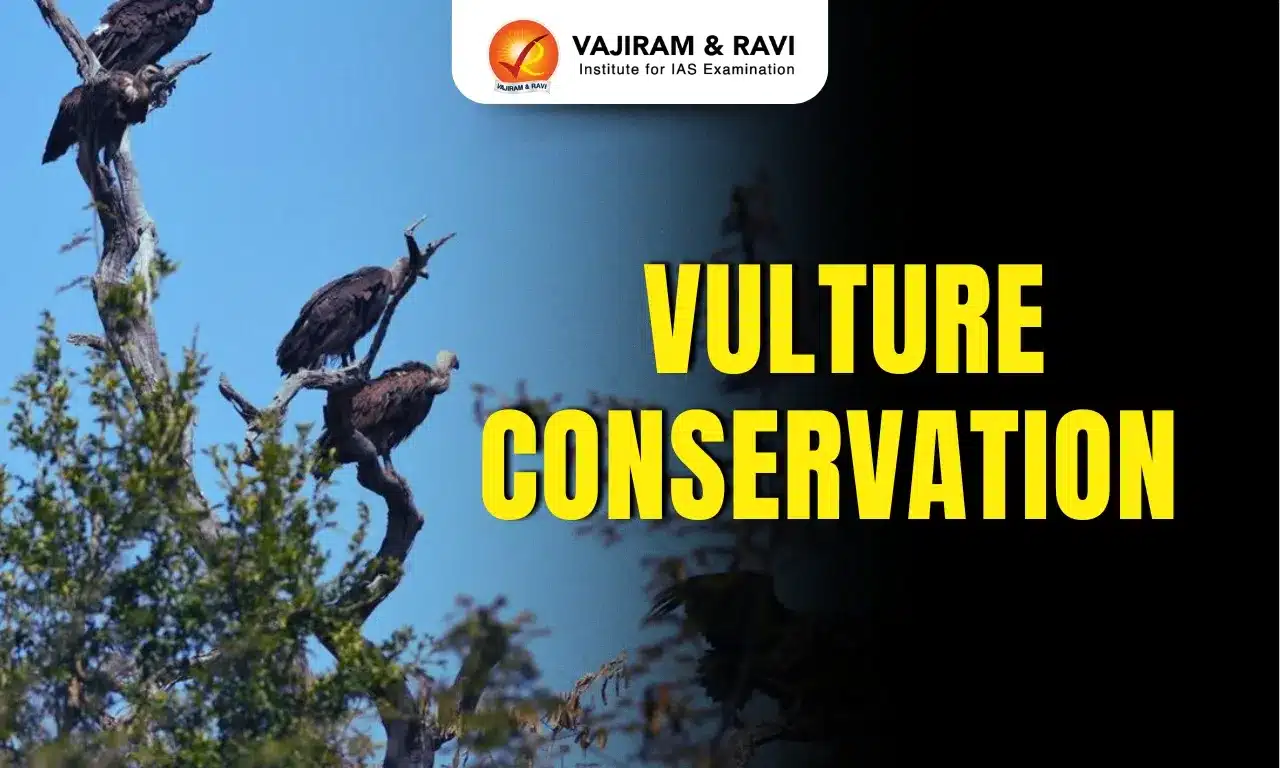
Vulture Conservation Latest News
- Vultures, often overlooked in discussions on pandemic preparedness, play a vital role in South Asia’s public health by acting as nature’s most efficient waste managers, preventing disease spread.
Vultures and Their Role in Pandemic Prevention
- As India’s National Action Plan for Vulture Conservation (2016–25) ends, the next phase highlights vultures as vital for pandemic preparedness.
- By swiftly consuming carcasses, they reduce risks of zoonotic spillover and act as the first line of defence in disease surveillance and carcass management.
- However, their role in public health has rarely been formalised.
- Communities living alongside vultures remain underutilised partners.
- Conservation financing has not yet recognised vultures as cost-effective pandemic prevention tools, despite the relatively low investments required compared to the enormous costs of outbreak responses.
India’s Vanishing Vultures and Public Health Risks
- For centuries, vultures acted as nature’s cleanup crew, preventing the spread of deadly pathogens such as anthrax, botulinum, and rabies.
- In the 1980s, carcass dumps swarmed with hundreds of vultures.
- India once had over 40 million vultures, but since the 1990s, numbers have plummeted by more than 95%, mainly due to the veterinary drug diclofenac.
- This decline is not just ecological — it poses a growing public health challenge by tying biodiversity loss to future pandemic risks.
Central Asian Flyway and Regional Linkages
- India’s vultures are part of the Central Asian Flyway (CAF), a vast migratory corridor connecting breeding grounds in Central Asia with wintering areas across South Asia.
- Spanning more than 30 countries, the CAF is used by millions of migratory birds, including raptors like vultures.
- As these birds move, they link ecosystems and disease risks across borders.
- Poorly managed landfills, carcass dumps, or stopover sites can quickly become hotspots for pathogen spillover.
- Thus, the CAF represents not just a biodiversity corridor but also a public health corridor, making regional cooperation crucial.
Conservation Challenges
- Despite this importance, conservation efforts remain fragmented and underfunded.
- Vulture protection is rarely integrated into One Health strategies, which link human, animal, and environmental health.
- Infrastructure threats like electrocution from power lines and continued poisoning from toxic veterinary drugs remain largely unaddressed.
- Without stronger investment and policy alignment, regional ambitions to safeguard vultures — and in turn, human health — face major roadblocks.
Protecting India’s Vultures Through a Post-2025 Strategy
- India’s post-2025 vulture strategy could focus on five key pillars:
- nationwide satellite telemetry to track habitats and hotspots;
- a Decision Support System integrating wildlife, livestock, and health data;
- stronger cross-sector coordination under the One Health framework;
- transboundary collaboration through the Central Asian Flyway with global health commitments; and
- community stewardship that empowers women, youth, and local groups in surveillance and awareness.
- Together, these measures would conserve vultures as keystone species, strengthen public health systems, reduce pandemic risks, and align with WHO’s regional roadmap for health security.
- This approach shifts conservation from recovery to resilience, making India a leader in biodiversity-linked health security.
India’s Opportunities in Linking Vulture Conservation with Health Security
- India has a unique chance to show how biodiversity conservation can also serve as pandemic prevention.
- By integrating surveillance across human, animal, and environmental health, and cutting detection-to-response time, systemic resilience can be built at modest cost compared to outbreak losses.
- With its significant share of Central Asian Flyway vulture species like Himalayan griffon, cinereous, and Eurasian griffon, India can scale telemetry, use Decision Support Systems, and embed vulture protection in One Health strategies.
- This model could inspire regional and global adoption, reminding us that safeguarding vultures not only protects ecosystems but also strengthens public health security.
Vulture Conservation FAQs
Q1: How do vultures help prevent pandemics?
Ans: By consuming carcasses quickly, vultures block pathogens from spreading, reducing risks of zoonotic spillover and supporting disease surveillance at carcass sites.
Q2: Why has India’s vulture population declined?
Ans: Since the 1990s, vulture numbers have fallen over 95%, mainly due to the veterinary drug diclofenac, creating ecological and public health challenges.
Q3: What is the Central Asian Flyway (CAF)?
Ans: A migratory corridor spanning 30+ countries, linking ecosystems and disease risks. Vultures moving along CAF make it a biodiversity and health corridor.
Q4: What are the main conservation challenges?
Ans: Conservation is underfunded and fragmented, with infrastructure risks like power line electrocution and poisoning from veterinary drugs remaining unaddressed.
Q5: What should India’s post-2025 vulture strategy focus on?
Ans: It should include satellite telemetry, Decision Support Systems, One Health integration, regional collaboration, and community stewardship for long-term resilience.
