
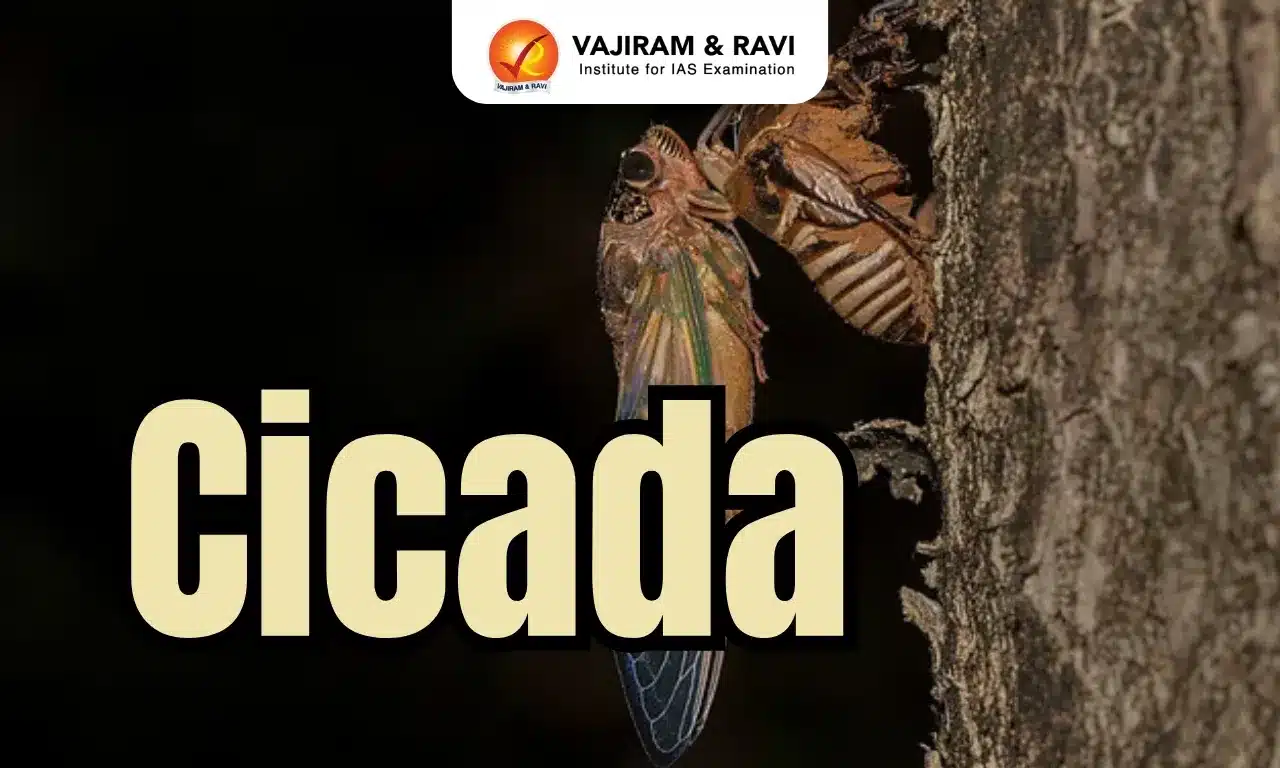
Cicadas Latest News
Scientists with the Botanical Survey of India (MoEF&CC), Southern Regional Centre, Coimbatore, said that resurgence of cicadas in Silent Valley is a telling sign of ecological upheaval.
About Cicadas
- Cicadas are hemipteran insects known for their loud, complex and species-specific acoustic signals or songs.
- A cicada will have the best chance of survival if it can emerge from the ground when its predators are lying dormant.
- Cicadas are insects that spend most of their lives underground and emerge from the soil mainly to mate.
- Habitat: Most cicadas are canopy dwellers and are found in natural forests with large trees.
- Types: Scientists divide the over 3,000 cicada species into two groups: annual and periodical.
- Annual cicadas: They emerge from the ground at different times each summer.
- They’re usually dark with greenish markings.
- These insects avoid predators by camouflaging themselves in the trees and flying from hungry birds and moles.
- Periodical cicadas: Only seven species of cicadas are in the periodical cicadas.
- These bugs all emerge from the ground at the same time(Summer).
- These groups appear after a dormant period of either 13 or 17 years.
- Ecological Significance: They prune mature trees, aerate the soil, and once they die, their bodies serve as an important source of nitrogen for growing trees.
Source: DTE
Cicadas FAQs
Q1: What is a cicada?
Ans: Cicadas are large, plant-feeding insects known for their loud, shrill noise and discarded shells (called exoskeletons) that cling to trees and other vegetation.
Q2: What are the insect pests of hemipterans?
Ans: Most notable of the phytophagous hemipterans are aphids, plant bugs, stink bugs, psyllids and whiteflies.
