
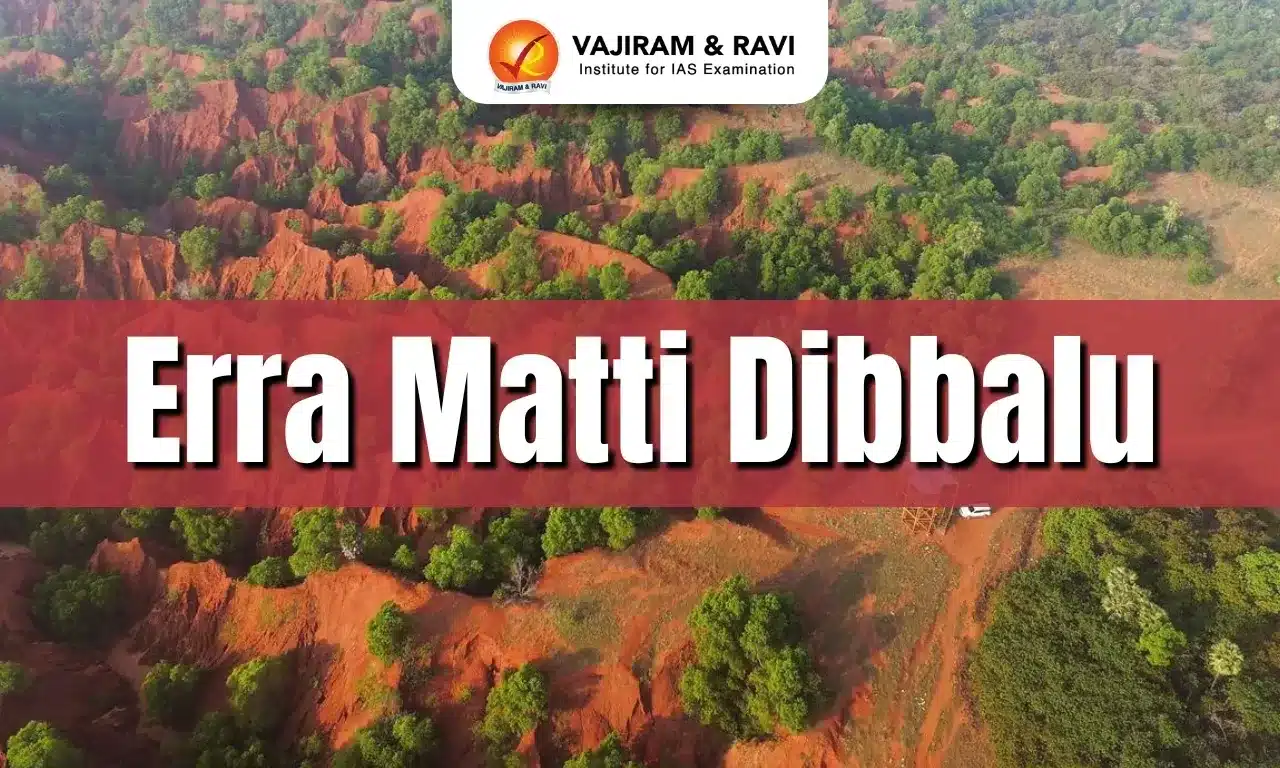
Erra Matti Dibbalu Latest News
Recently, Andhra Pradesh’s Erra Matti Dibbalu (Red Sand Dunes) have been included in the UNESCO Tentative List of World Heritage Sites.
About Erra Matti Dibbalu
- Erra Matti Dibbalu, also known as the Red Sand Dunes is located along the coast near Visakhapatnam in Andhra Pradesh.
- It was first documented by British geologist William King in 1886, these formations are regarded as rare coastal geomorphological features.
Key Features of Erra Matti Dibbalu
- It is composed of sand, silt, and clay, with their distinct reddish hue resulting from natural oxidation over thousands of years.
- The uniqueness of this site is that the red sediments are a part of the continuation of the evolution of the earth and represent the late quaternary geologic age.
- They exhibit badland topography with different geomorphic landforms and features, including gullies, sand dunes, buried channels, beach ridges, paired terraces, the valley in the valley, wave-cut terrace, knick point and waterfalls.
- It is a lively scientific evolution site, which depicts the real-time effects of climate change.
- The site also has archaeological significance, as studies of artefacts indicate an Upper Palaeolithic horizon and on cross dating assigned to Late Pleistocene epoch, which is 20,000 BC.
- The site contains dendritic drainage patterns and sediment layers that record fluctuations in sea level and climatic changes over the late Quaternary period.
- Other similar sites: Only two other similar sites exist in the world, one in Sri Lanka and another in Tamil Nadu (Teri Sands).
- The Geological Survey of India (GSI) declared Erra Matti Dibbalu a National Geo-heritage Monument in 2016.
- Issues: Experts note that the site faces threats from tourism and filming activities.
Source: NIE
Erra Matti Dibbalu FAQs
Q1: How many national geological monuments are there in India?
Ans: 34
Q2: Which is India's first geo heritage site?
Ans: Ramgarh Crater
