
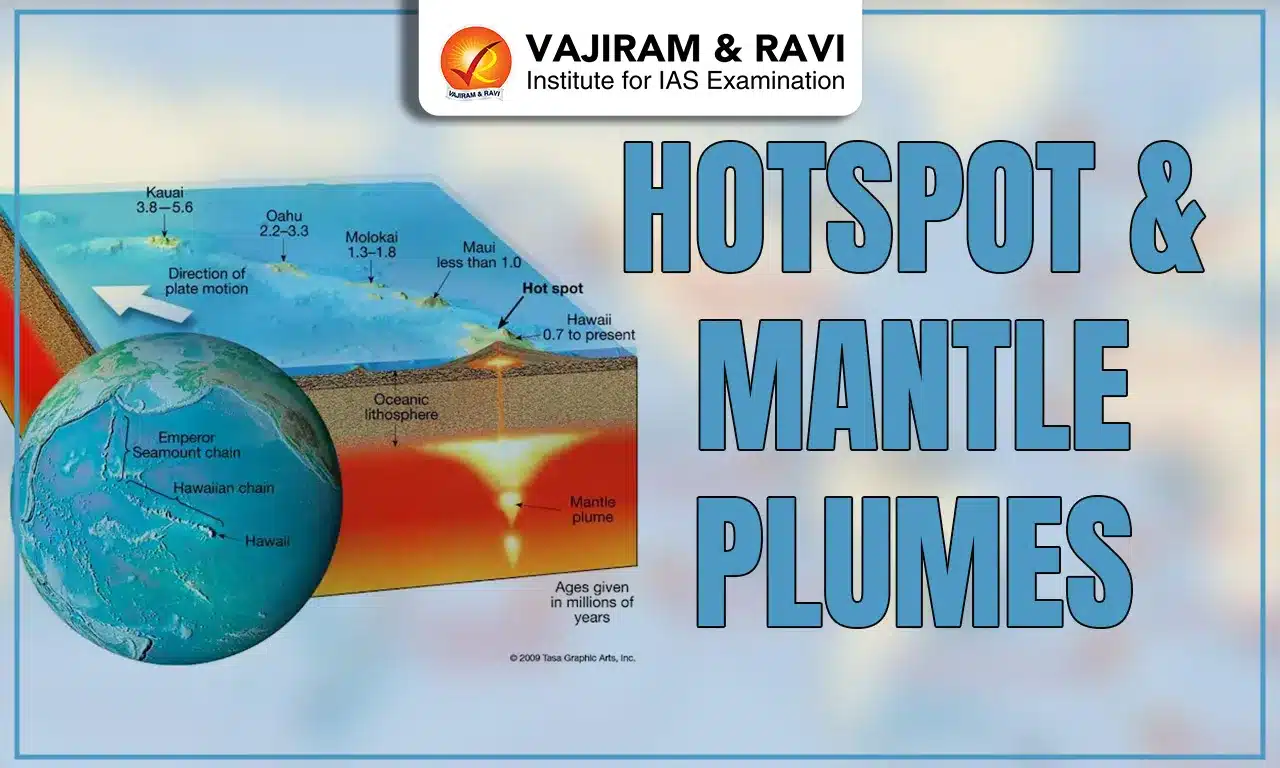
Hotspots and Mantle Plumes are geological wonders that lie beneath the Earth’s surface and constantly shape and reshape the planet. Unlike ordinary volcanic activity that occurs along plate boundaries, hotspots are special heat courses known as mantle plumes. These plumes originate from deep within the Earth’s interior and rise upward, it influences the surface by creating volcanoes, volcanic islands and geothermal activity. In this article, we are going to cover Hotspots and Mantle Plumes, its origins, global distributions and impact on Earth’s tectonics.
Hotspots
Hotspots are geothermal anomalies that serve as long-live and stationary sources of heat below the Earth’s crust. Unlike the other volcanic regions tied directly to tectonic plate boundaries, hotspots remain persistent and stationary for many years, giving rise to specific volcanic features. A hotspot is an area where the magma is hotter than the surrounding regions, leading to localised melting, thinning of the crust and volcanic eruptions on the Earth’s surface. Since its not related to subduction zones or rift boundaries, hotspots present a unique style of volcanism driven by internal mantle processes.
Hotspots Relation to Plate Movements
As tectonic plates move slowly across these fixed heat sources, chains of volcanoes are created, recording the direction and speed of plate movement over geological time. The Hawaiian Islands, one of the most studied examples, were formed as the Pacific Plate moved over the Hawaiian hotspot, producing a series of volcanic islands that decrease in age toward the southeast.
Hotspot Formation Theories: Mantle Plumes and Plate Weakness
Two important scientific hypotheses explain the origin and persistence of hotspots. These theories are:
1. The Mantle Plume Theory
- The Mantle Plume Theory proposes that hotspots are generated by deep seated mantle plumes, columns of abnormally hot, buoyant molten rock that rise from the lower mantle and the core-mantle boundary.
- As tectonic plates drift over these fixed plumes, magma ascends and penetrates the crust, creating volcanic activity.
- The plume may also weaken or thin the overlying plate, making it more susceptible to eruptions.
- Over time, this interaction creates linear chains of volcanic islands or seamounts, such as the Emperor-Hawaiian seamount chain in the Pacific Ocean.
- An important part of this theory is that while tectonic plates move, the plume remains fixed, serving as a “geological marker” for plate motion.
2. The Plate Weakness Theory (Foulger’s Hypothesis)
- The Plate Weakness Theory was proposed by geologist Gillian Foulger in 2003, this alternative theory challenges the plume concept.
- It says that hotspots may not necessarily arise from fixed mantle plumes but instead from structural weaknesses or “scars” within tectonic plates.
- These weak zones, formed by earlier tectonic events such as collisions or rifting, allow magma to rise more easily when they pass over areas with melted subducted material.
- According to this view, hotspots are the surface expression of shallow processes within tectonic plates rather than deep mantle upwellings.
- This theory emphasizes that hotspots could form in diverse geological settings without requiring a plume rising from great depths.
Both theories remain debated, and modern seismological studies continue to test whether hotspots indeed originate from deep mantle plumes or shallow lithospheric weaknesses.
Hotspots Associated Landforms
Hotspots have been created by some of the world’s most important geological features. These landforms include:
Volcanic Islands
Chains of volcanic islands form as tectonic plates move above stationary hotspots. The islands typically evolve from active shield volcanoes to extinct eroded landforms over millions of years. Examples include: Hawaiian Islands in the Pacific Ocean, Galápagos Islands near Ecuador and Canary Islands near northwest Africa
Seamounts
Seamounts are submerged volcanic mountains formed by hotspot volcanism. Even when submerged, they often continue erupting, building high underwater volcanic chains.
Large Igneous Provinces (LIPs)
Some hotspots give rise to massive outpourings of lava, covering vast areas with basaltic rock. These are called LIPs, and they have played a role in past mass extinctions. Examples include:
- Deccan Traps in India
- Columbia River Basalt Group in the United States
Rift Zones
Rift zones are generated due to hotspot activity where the crust is stretched and fractured. The areas are characterised by fissures, lava flows and sometimes even the initiation of new ocean basins. Examples include African Rift.
Geothermal Features
Hotspots are associated with geothermal activity such as geysers, fumaroles, and hot springs. For example the Yellowstone National Park in the United States is world-famous for its geothermal activity, linked to the Yellowstone hotspot.
Hotspots Distribution Across the World
Hotspots are distributed around the globe, each contributing uniquely to Earth’s geology:
- Hawaiian Hotspot: Responsible for the Hawaiian Islands and Emperor seamount chain, showing the Pacific Plate’s motion.
- Icelandic Hotspot: Located on the Mid-Atlantic Ridge, it produces volcanism and geothermal activity, with features like rift valleys, shield volcanoes, and geysers.
- Galápagos Hotspot: Created the Galápagos Islands, home to diverse ecosystems and young volcanic landscapes.
- Reunion Hotspot: Located in the Indian Ocean, it produced Réunion Island and the submerged Mascarene Plateau.
- Tahiti Hotspot: Formed the Society Islands, including Tahiti, famous for their volcanic origins and scenic beauty.
- Canary Islands Hotspot: Generated the Canary Islands off Africa’s northwest coast, with Tenerife as the largest island.
- Easter Island Hotspot: Produced Easter Island (Rapa Nui), renowned for its iconic Moai statues but geologically significant as a volcanic island.
Mantle Plumes
Mantle Plumes are columns of hot, buoyant rock that rise vertically from deep within the mantle, near the core mantle boundary. They play an important role in driving hotspot volcanism.
Mantle Plume Formation
Mantle Plumes are formed using the following sources:
- Heat Source: Generated by residual planetary heat and radioactive decay.
- Buoyant Material: Hot, less-dense material rises compared to its cooler surroundings.
- Partial Melting: Rising material undergoes decompression, leading to partial melting and magma formation.
- Plume Column: A cylindrical column of hot rock ascends toward the lithosphere.
- Surface Expression: When the plume head interacts with the lithosphere, massive volcanic eruptions and hotspot features are created.
Mantle Plumes Importance in Plate Tectonics
Mantle Plumes are important in plate tectonics due to following:
- Formation of Volcanic Hotspots: Plumes produce volcanic chains like Hawaii.
- Rift Formation: Their heat weakens continents, initiating rifting and ocean basin formation.
- Flood Basalts: Responsible for massive basalt outpourings such as the Deccan and Siberian Traps.
- Mountain Building: Plumes exert upward pressure, uplifting the lithosphere into ranges.
- Material and Energy Exchange: They act as conduits between Earth’s deep interior and surface processes.
- Volcanic Chains: Produce linear, time-progressive volcanic trails that track plate motion.
Hotspot & Mantle Plumes FAQs
Q1: What are hotspot and mantle plumes?
Ans: Hotspots are volcanic regions fed by deep mantle plumes—columns of hot rock rising from Earth’s mantle.
Q2: What is a mantle plume?
Ans: A mantle plume is an upwelling of abnormally hot rock within the Earth’s mantle that fuels surface volcanism.
Q3: What is a hot spot in the Earth's mantle?
Ans: A hot spot is a stationary volcanic center formed above a mantle plume, away from tectonic plate boundaries.
Q4: What is a Rift zone?
Ans: A rift zone is a region where the Earth’s lithosphere is being pulled apart, leading to volcanic activity and crustal thinning.
Q5: What are seamounts?
Ans: Seamounts are underwater volcanic mountains formed by eruptions that rise from the ocean floor but do not reach the surface.
