
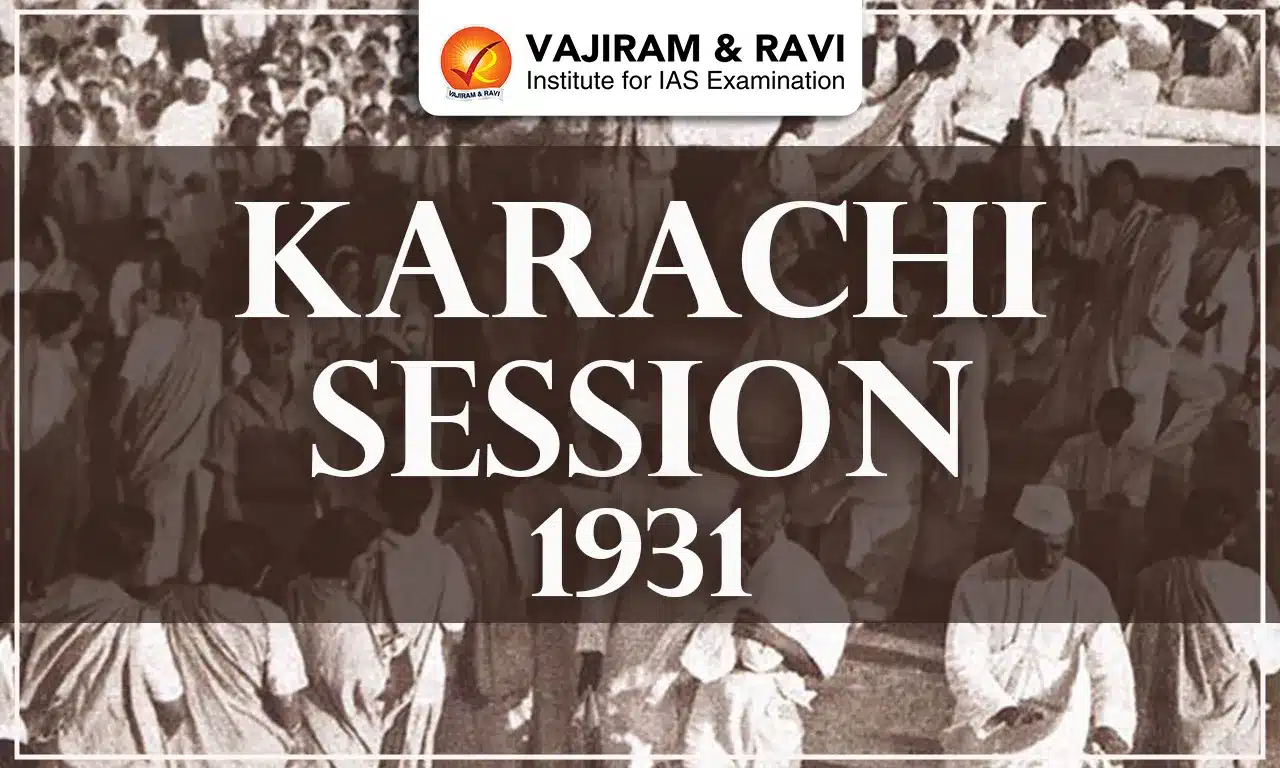
The Karachi Session held by the Indian National Congress was conducted in Karachi, which was a part of British India at that time. The session was conducted from 26th to 31st March 1931. The session helped in defining the political strategies and shaping the course of the Indian Freedom Movement. In this article, we are going to cover about the Karachi Session 1931, its developments and resolution.
Karachi Session 1931
The Karachi Session of the Indian National Congress took place in between 26-31 March 1931 and was presided over by Sardar Vallabhbhai Patel. The session took place after the Gandhi-Irwin Pact and the execution of Bhagat Singh, Rajguru, and Sukhdev and was marked by grief, protects and deep political debates. The Karachi session also strongly condemned communalism, stressing national unity against colonial rule, and authorized the resumption of the Civil Disobedience Movement if British promises were not fulfilled. Overall, the Karachi Session was a turning point as it broadened the struggle from merely seeking independence to envisioning a free India based on political freedom, social justice, and economic equality, and its resolutions remained the guiding framework for Congress policies in the years ahead.
Karachi Session 1931 Landmark Developments
The Karachi Session holds an important place in Indian History due to the important developments that took place during the session. These developments included:
- Gandhi-Irwin Pact: In March 1931, the Congress assembled at Karachi in a special session to formally ratify the Gandhi-irwin Pact.
- Execution of Revolutionaries: Just six days before the Karachi Session, Bhagat Singh, Rajguru and Sukhdev were hanged, casting a shadow over the proceedings.
- Black Flag Demonstrations: Mahatma Gandhi was met with black flag protests by the Punjab Naujawan Bharat Sabha, denouncing his inability to secure clemency for the revolutionaries.
Karachi Session 1931 Resolutions
The Indian Congress passed two important resolutions at the Karachi Session 1931. One was the Fundamental Rights and the other on a National Economic Programme. The Karachi Session 1931 Resolutions included:
- Resolution on Fundamental Rights: It promised free press, free speech, right to form associations, universal franchise, equality before law irrespective of caste, creed or gender, free and compulsory primary education, and safeguards for the language, culture, and script of minorities and linguistic groups.
- Reaffirmation of Poorna Swaraj: The Congress restated its goal of complete independence and demanded immediate transfer of power, pledging nationwide struggle to secure Poorna Swaraj.
- Revival of Civil Disobedience: The session backed Gandhi’s call to resume the Civil Disobedience Movement, suspended earlier under the Gandhi-Irwin Pact, highlighting nonviolent resistance and mass participation.
- National Economic Programme: It called for reduced rent and land revenue, exemption for uneconomic holdings, debt relief, curbs on usury, improved working conditions including a living wage and shorter working hours, safeguards for women workers, rights of peasants and labourers to unionize, and state control of major industries, mines, and transport — all aligned with the Poorna Swaraj vision.
- Denunciation of Communalism: The Congress firmly rejected communal politics, stressing unity among Indians across religious lines against British imperialism.
Poona Resolution
The Indian Congress passed the historic Poorna Swaraj Resolution at Lahore Session, 1930.
- The goal of the resolution was complete independence.
- The resolution marked a decisive shift away from constitutional concessions to complete freedom from British Rule.
- The goal was to unify Indians across communities in the struggle for independence.
- It propagated peaceful civil disobedience as the main method of resistance.
- The resolution stated that from January 26, 1930 the authority of the British Government in India would be deemed illegitimate.
Karachi Session 1931 FAQs
Q1: What was the Karachi session of 1931?
Ans: The Karachi Session of 1931 was a meeting of the Indian National Congress held from 26–31 March 1931 that endorsed the Gandhi-Irwin Pact and passed resolutions on Fundamental Rights and the National Economic Programme.
Q2: Who was the president of the Karachi session?
Ans: The Karachi Session of 1931 was presided over by Sardar Vallabhbhai Patel.
Q3: What were the three demands of the Karachi session?
Ans: The Karachi Session demanded Poorna Swaraj (complete independence), guarantee of Fundamental Rights, and a National Economic Programme ensuring social and economic justice.
Q4: When was the Gandhi-Irwin Pact?
Ans: The Gandhi-Irwin Pact was signed on 5 March 1931.
Q5: When was the Poorna Swaraj declared?
Ans: The Poorna Swaraj (Complete Independence) was declared at the Lahore Session of Congress on 31 December 1929, and celebrated as Independence Day on 26 January 1930.
