
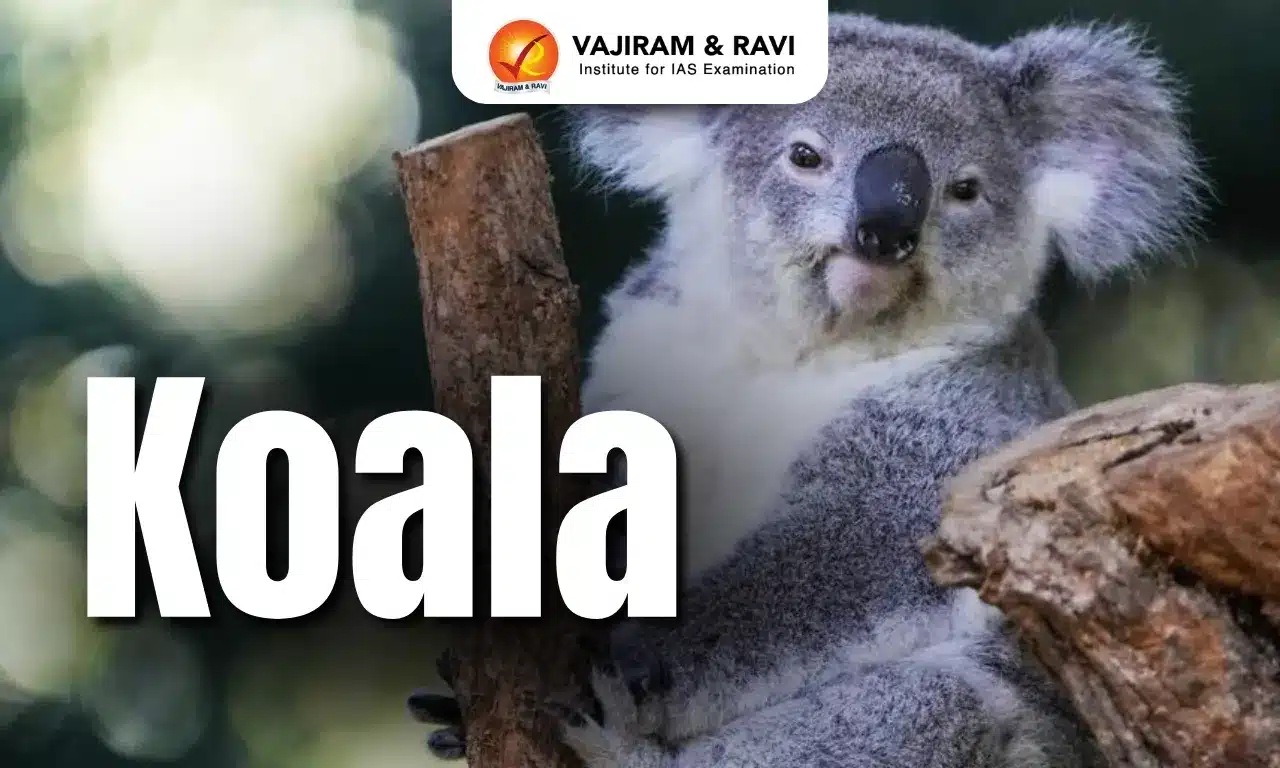
Koala Latest News
Recently, Australia approved the world's first vaccine to save koalas from Chlamydia.
About Koala
- Koala bear (Phascolarctos cinereus) is an arboreal herbivorous marsupial native to Australia.
- It is the only extant representative of the family Phascolarctidae and its closest living relatives are the wombats.
- Koalas are asocial animals, congregating only during the breeding season.
- They spend most of their time eating and sleeping in eucalyptus trees, and their paws have two opposing thumbs to help them grasp and climb up tree trunks.
- Distribution: Koalas are distributed across eastern and southeastern Australia, including northeastern, central, and southeastern Queensland, eastern New South Wales, Victoria as well as southeastern parts of South Australia.
- Habitat: They can be found in habitats ranging from relatively open forests to woodlands, and in climates ranging from tropical to cool temperate.
- Food: Koalas are herbivorous (folivorous) animals, feeding primarily upon the leaves of the eucalyptus tree.
- Conservation status: IUCN: Vulnerable
- Threats: These species are facing compounded threats from disease, habitat loss, climate change and road collisions.
Chlamydia in Koalas
- Koalas suffer from both bacterium species Chlamydia pneumonia and Chlamydia pecorum.
- The disease occurs in koalas multiple ways, including through mating, infected discharges and at birth.
- It can cause eye infections, blindness, urinary tract problems, and even infertility.
- Infected koalas often become weak, dehydrated, and more vulnerable to predators and bushfires.
- In some areas of Australia, up to 70% of wild koalas carry the disease.
- Chlamydia spreads quickly in koalas because they live in overlapping territories and groom each other.
Source: TH
Koala FAQ's
Q1: What is the IUCN status of the koala bear?
Ans: Vulnerable
Q2: What are three animals that are marsupials?
Ans: Kangaroos, wallabies, wombats

