
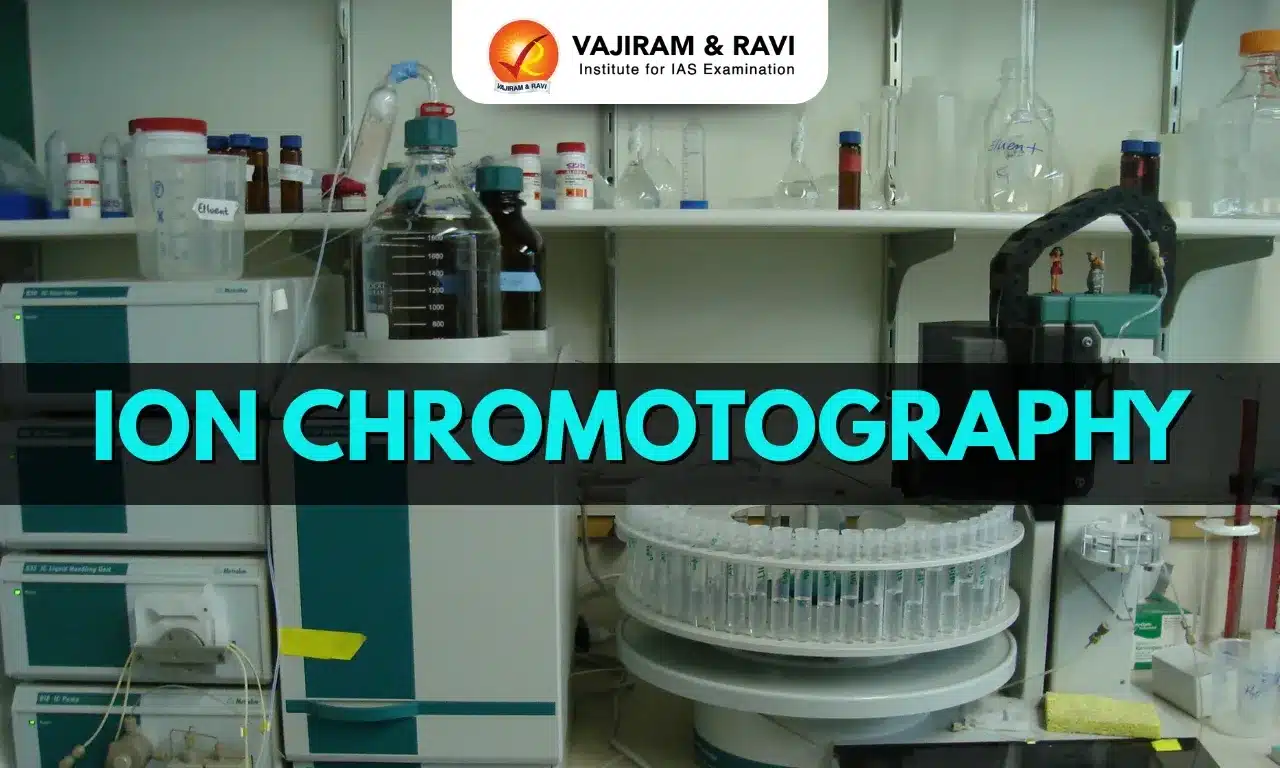
Ion Chromatography Latest News
Scientists recently devised a way to perform ion chromatography in the field.
About Ion Chromatography
- Ion chromatography (IC), or ion exchange chromatography, is a powerful analytical technique used to separate and quantify ions in a sample.
- It separates charged molecules based on their affinity to the ion-exchange resin.
- Ion chromatography techniques of various types enable scientists to target specific ions or classes of ions, providing precise and sensitive analysis.
- It is of two types: cation exchange and anion exchange.
- Ion chromatographs are able to measure concentrations of major anions, such as fluoride, chloride, nitrate, nitrite, and sulfate, as well as major cations, such as lithium, sodium, ammonium, potassium, calcium, and magnesium, in the parts-per-billion (ppb) range.
- Concentrations of organic acids can also be measured through ion chromatography.
How Does Ion Chromatography Work?
- Ion chromatography, a form of liquid chromatography, measures concentrations of ionic species by separating them based on their interaction with a resin.
- Ionic species separate differently depending on species type and size.
- Sample solutions pass through a pressurized chromatographic column where ions are absorbed by column constituents.
- As an ion extraction liquid, known as eluent, runs through the column, the absorbed ions begin separating from the column.
- The retention time of different species determines the ionic concentrations in the sample.
Ion Chromatography Applications
- Drinking water analysis for pollution and other constituents.
- Determination of water chemistries in aquatic ecosystems.
- Determination of sugar and salt content in foods.
- Isolation of select proteins.
Source: TH
Ion Chromatography FAQs
Q1: What does ion chromatography (IC) measure?
Ans: Ion chromatography (IC) measures the concentration of ions (both anions and cations) in a sample.
Q2: On what principle does ion chromatography separate ions?
Ans: Ion chromatography separates ions on the principle of ion-exchange, where charged molecules are separated based on their affinity to the ion-exchange resin in the chromatographic column.
Q3: Which major anions can be detected using ion chromatography?
Ans: Fluoride, chloride, nitrate, nitrite, and sulfate.
Q4: Which major cations can be detected using ion chromatography?
Ans: Lithium, sodium, ammonium, potassium, calcium, and magnesium.
Q5: Can ion chromatography be used to measure organic acids?
Ans: Concentrations of organic acids can also be measured through ion chromatography.
