
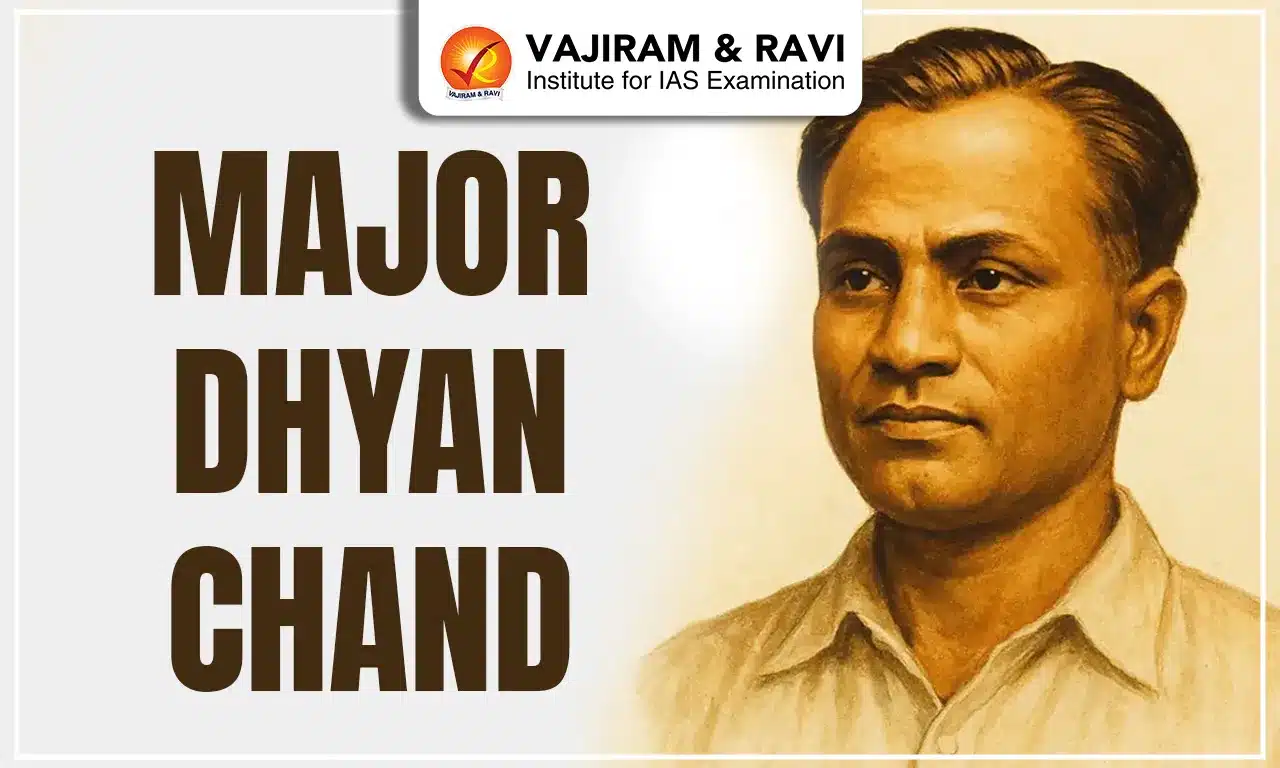
Major Dhyan Chand Singh Bais was an exceptional sportsman who was also remembered as the “Wizard of Hockey”. He was a team member of the Indian Hockey team and is remembered for his skill, discipline and sporting brilliance that defined Indian Hockey. He was born on 29 August 1905 in Allahabad, during the time of British India and his journey reflects his passion, discipline and perseverance. His contribution to Indian Hockey secured India’s dominance on the Olympic stage, making him a global icon. In this article, we are going to cover about Major Dhyan Chand, his early life, achievements and awards.
Major Dhyan Chand Biography
Major Dhyan Chand was not just a player but a phenomenon who revolutionised hockey, bringing India global prestige. With unmatched vision, discipline, and brilliance, he remains an eternal symbol of excellence and sportsmanship, inspiring generations to dream beyond boundaries. Here are some key Facts about Major Dhyan Chand:
| Attribute | Details |
|
Full Name |
Major Dhyan Chand Singh Bais |
|
Birth |
29 August 1905, Allahabad (British India) |
|
Family Background |
Son of Sameshwar Dutt Singh Bais (Army man) & Shyama Singh (Bais Rajput) |
|
Nickname |
“Chand” (Moon) – for practising hockey under moonlight |
|
Army Career |
Joined the British Indian Army in 1922 as a sepoy |
|
Position in Hockey |
Centre Forward |
|
International Debut |
1926 – Indian Army tour of New Zealand |
|
Olympic Achievements |
Gold – 1928 (Amsterdam), 1932 (Los Angeles), 1936 (Berlin) |
|
Notable Feat |
14 goals in 1928 Olympics; 570 goals in career (unofficial count) |
|
Retirement |
1949 |
|
Death |
3 December 1979, New Delhi |
|
Honors |
Padma Bhushan (1956), Dhyan Chand Award (2002), National Stadium & Sports Day named after him |
Major Dhyan Chand Early Life
Born into a Rajput family, Dhyan Chand’s childhood was marked by frequent relocations due to his father’s postings in the British Indian Army. These movements nurtured adaptability and resilience in him. Initially more interested in wrestling, it was only after his family’s settlement in Jhansi that his natural genius for hockey surfaced, playing with makeshift equipment before destiny guided him to the army.
Major Dhyan Chand Entry into Army and Hockey
Major Dhyan Chand joined the British Indian Army at the age of 17 in 1922 as a sepoy. His discipline and exposure to structured training helped him improve his skills. He often practised hockey alone after duty, earning the nickname “Chand.” By 1926, his extraordinary control and instinctive scoring earned him a spot on the Army tour to New Zealand, where his performance marked the beginning of an international career.
Major Dhyan Chand’s Career Highlights
- 1928 Amsterdam Olympics: India’s first Olympic hockey gold; scored 14 goals.
- 1932 Los Angeles Olympics: Formed a legendary duo with brother Roop Singh; India beat USA 24-1.
- 1936 Berlin Olympics: India defeated Germany 8-1 in the final before Adolf Hitler; Dhyan Chand’s brilliance left the world in awe.
Major Dhyan Chands Awards and Honours
- Olympic Gold Medals Won: 1928, 1932, 1936.
- Titles Abroad: Nicknamed “Wizard of Hockey”; Vienna erected a statue depicting him with four sticks to symbolise his magic. Hitler even offered him a post in the German Army, which he declined.
- National Recognition: Padma Bhushan (1956). Posthumously, the Dhyan Chand Award (2002) and the naming of National Sports Day and National Stadium in his honour immortalised his contributions.
Major Dhyan Chand’s Legacy
Retiring in 1949 with 570 career goals, Dhyan Chand’s name became synonymous with hockey excellence. Admired for both his skill and humility, he set a standard of sportsmanship that remains unmatched. His autobiography Goal (1952) offers a window into his life and times. Today, his legacy endures through National Sports Day (29 August), awards in his name, and the inspiration he continues to provide athletes across generations.
Major Dhyan Chand FAQs
Q1: What is the biography of Dhyan Chand?
Ans: The biography of Dhyan Chand highlights his journey from a sepoy in the British Indian Army to becoming the “Wizard of Hockey,” winning three Olympic gold medals for India.
Q2: Which is the autobiography of Major Dhyan Chand?
Ans: His autobiography is titled Goal, published in 1952.
Q3: Why is Dhyan Chand known as Major?
Ans: He was promoted to the rank of Major in the Indian Army for his exceptional achievements in hockey.
Q4: How many Olympic gold medals were earned by Major Dhyan Chand?
Ans: He won three Olympic gold medals – 1928 (Amsterdam), 1932 (Los Angeles), and 1936 (Berlin).
Q5: Who was the first Indian to win an individual Olympic gold medal?
Ans: Abhinav Bindra became the first Indian to win an individual Olympic gold in Shooting (10m Air Rifle) at Beijing 2008.
