
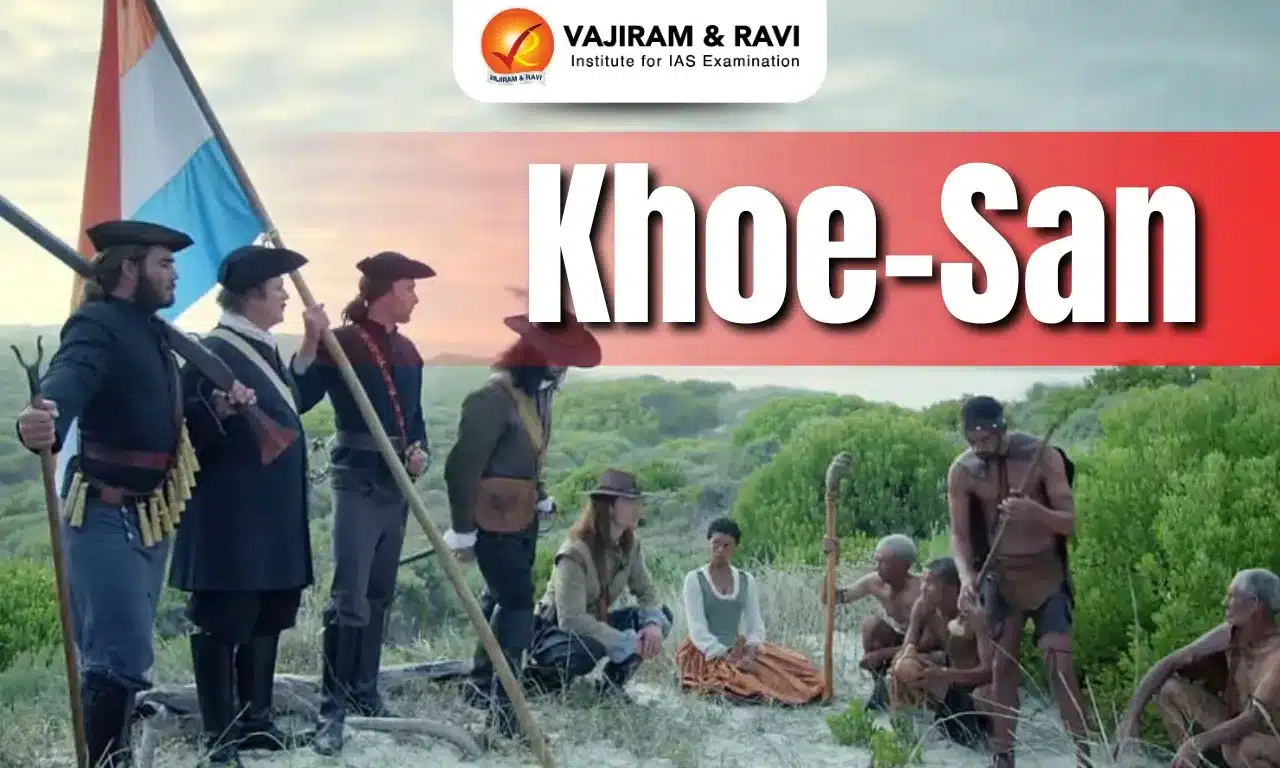
Khoe-San Latest News
Recently, a new genetic study published in the Cell Press journal reveals that European colonisation strongly altered the genetic ancestry of the indigenous Khoe-San peoples of southern Africa.
About Khoe-San
- Khoe-San is a collective term for the indigenous peoples of southern Africa, encompassing:
- San (Bushmen): Hunter-gatherers.
- Khoekhoe (Khoi): Cattle, goat, and sheep pastoralists.
- They represent one of the earliest divergent human lineages, with exceptionally high genetic diversity.
- The research highlights sex-biased migration, where European male settlers displaced Khoe-San men, while Khoe-San women contributed significantly to present-day genetic lineages.
- The study also shows the impact of the slave trade, where enslaved women from South Asia, Southeast Asia, Eastern Africa, and Madagascar were brought to the Cape by the Dutch East India Company (VOC).
Historical Interactions
- ~2,000 years ago: Eastern African pastoralists and Bantu-speaking agro-pastoralists arrived, influencing and displacing many Khoe-San groups.
- Last 1,500 years: Bantu-speaking groups largely replaced or assimilated Khoe-San populations in eastern South Africa.
- 1652 onwards: Dutch East India Company (VOC) established Cape Town; European settlers arrived in waves over 250 years.
- Slave Trade (1652–1808): VOC enslaved ~63,000 people from Africa and Asia, mostly women, reshaping genetic ancestry.
- Indigenous Khoe-San were also recruited as labourers.
Source: DTE
Khoe-San FAQs
Q1: Who are the Khoe-San?
Ans: The Khoe-San are indigenous peoples of southern Africa, comprising San (hunter-gatherers) and Khoekhoe (pastoralists), known for their high genetic diversity and status as one of the earliest human lineages.
Q2: Why are Khoe-San significant in human history?
Ans: They represent the earliest divergence among human populations, making them crucial for understanding human origins, genetic diversity, and early migration patterns.
