Ethambutol Hydrochloride

Ethambutol Hydrochloride

Ethambutol Hydrochloride Latest News

India recently launched an anti-dumping investigation on imports of tuberculosis drug Ethambutol Hydrochloride from China and Thailand.

About Ethambutol Hydrochloride

  • It is an antibacterial prescription medicine used for the treatment of tuberculosis (TB).
  • It is a synthetic, water soluble, heat stable compound. 
  • It is specifically effective against actively growing microorganisms of the genus Mycobacterium including M. tuberculosis. 
  • It is used to combat both pulmonary and extrapulmonary tuberculosis. 
  • Mechanism:
    • Ethambutol (HCl) specifically targets the synthesis of the cell wall in M. tuberculosis. 
    • By interfering with the polymerization of arabinogalactan, a key component of the mycobacterial cell wall, Ethambutol disrupts the structural integrity of the bacteria, leading to its demise.
    • Its unique mode of action is fundamental in combination therapies, where it is often used in conjunction with other anti-tubercular drugs to prevent resistance and enhance efficacy.
  • Resistance to ethambutol emerges rapidly when the drug is used alone. Therefore ethambutol is always given in combination with other antituberculosis drugs.

Source: TH

Ethambutol Hydrochloride FAQs

Q1: What is ethambutol hydrochloride used for?

Ans: It is an antibacterial prescription medicine used for the treatment of tuberculosis (TB).

Q2: What is the most common side effect of ethambutol?

Ans: Common side effects include vision changes, joint pain, nausea, and vomiting.

Q3: Why is Ethambutol Hydrochloride always given in combination with other antituberculosis drugs?

Ans: To prevent rapid emergence of resistance.

Chhatrapati Shivaji Maharaj Jayanti 2025, History, Facts

Chhatrapati Shivaji Maharaj Jayanti

Chhatrapati Shivaji Maharaj Jayanti 2025 is observed on February 19, 2025 which is celebrated each year to celebrate the birth anniversary of Chhatrapati Shivaji, the visionary founder of the Maratha Empire. Renowned for his exceptional military strategies and administrative prowess, Shivaji Maharaj played a crucial role in resisting Mughal domination and establishing a strong, independent kingdom. 

He was entitled as "Chhatrapati" in 1674, demonstrating his sovereignty over the Maratha realm. His leadership, Fearlessness and progressive governance continue to inspire generations. The celebration of Shivaji Jayanti is especially significant in Maharashtra, where grand events, and cultural programs are organized to honor his legacy. This year marks the 395th birth anniversary of the legendary Maratha ruler.

Chhatrapati Shivaji Maharaj Jayanti 2025 History

Chhatrapati Shivaji Maharaj was born as Shivaji Bhosale (1630-1680 CE) who was a visionary warrior king and the founder of the Maratha Empire. He was recognised for his military expertise, administrative reforms, and commitment to Swarajya (self-rule). His efforts to free India from foreign rule and his emphasis on good governance have established his legacy as a national hero. 

The celebration of Chhatrapati Shivaji Maharaj Jayanti began in 1870 after the discovery of his tomb at Raigad Fort. It was later popularized by freedom fighter Bal Gangadhar Tilak, who sought to highlight Shivaji Maharaj’s contributions during India’s struggle for independence. Today, Shivaji Jayanti is marked by grand processions, including the Shiv Jayanti Yatra in Maharashtra, where admirers pay tribute by chanting slogans like "Jai Bhavani" and "Jai Shivaji," celebrating his influence on Indian history and culture.

Chhatrapati Shivaji Maharaj Jayanti 2025 Significance

Chhatrapati Shivaji Maharaj Jayanti is observed twice a year, once according to the Hindu calendar on the 3rd day of Phalgun and once as per the Gregorian calendar on February 19. Shivaji Maharaj is remembered for his military prowess, administrative reforms, and his commitment to preserving Hindu political traditions and court conventions. 

Unlike many rulers of his time, he promoted the use of Marathi and Sanskrit in his court instead of Persian. His strategic approach enabled him to win multiple battles against the Mughals and establish the Maratha Empire. In 1674, he was officially crowned as the 'Chhatrapati' or emperor.

Chhatrapati Shivaji Maharaj Facts

  1. Shivaji Maharaj was raised by his mother, Jijabai, who shaped his values and instilled in him a strong sense of courage and righteousness.
  2. He had an interest in religious teachings and often considered hindu saints suggestions in his governance and policies.
  3. Contrary to popular belief, his name was not derived from Lord Shiva but from a regional goddess, Shivai. 
  4. He was known for his exceptional military strategies, he earned the title of 'Mountain Rat' due to his expertise in guerrilla warfare tactics, which helped him successfully counter larger enemy forces. 
  5. During his resignation, Shivaji engaged in both alliances and conflicts with the Mughal rulers, skillfully tackling the complex political landscape of his time.

List of Battles Fought by Chhatrapati Shivaji Maharaj

Chhatrapati Shivaji Maharaj, the founder of the Maratha Empire in western India, was born on February 19, 1630, at Shivneri Fort in present-day Maharashtra. Shivaji Maharaj is best known for his strategic military and innovative warfare techniques. Below is a detailed List of Battles Fought by Chhatrapati Shivaji Maharaj:

Battles Fought by Chhatrapati Shivaji Maharaj

Name of Battle

Date Fought

Description

Who Won

Battle of Pratapgad

November 10, 1659

Fought between Maratha king Chhatrapati Shivaji Maharaj and Adilshahi general Afzal Khan near Pratapgad Fort, Maharashtra.

Marathas

Battle of Kolhapur

December 28, 1659

Fought near Kolhapur, Maharashtra, between Chhatrapati Shivaji and Adilshahi forces.

Marathas

Battle of Pavan Khind

July 13, 1660

Fought at a mountain pass near Vishalgad Fort, Maharashtra, between Maratha Sardar Baji Prabhu Deshpande and Adilshahi general Siddi Masud.

Marathas (Tactical victory)

Battle of Chakan

1660

Fought between the Maratha Empire and the Mughal Empire.

Mughals

Battle of Umberkhind

February 2, 1661

Fought between Chhatrapati Shivaji’s forces and Mughal general Kartalab Khan.

Marathas

Sacking of Surat

January 5, 1664

Chhatrapati Shivaji Maharaj raided Surat against Mughal captain Inayat Khan.

Marathas

Battle of Purandar

1665

Fought between the Mughal Empire and the Maratha Empire.

Mughals

Battle of Sinhagad

February 4, 1670

Fought on Sinhagad Fort between Tanaji Malusare (Marathas) and Udaybhan Rathod (Mughals).

Marathas

Battle of Kalyan

1682-1683

Bahadur Khan of the Mughal Empire defeated the Marathas and took over Kalyan.

Mughals

Battle of Bhupalgarh

1679

Fought between the Mughal and Maratha empires.

Mughals

Battle of Sangamner

1679

The last battle fought by Chhatrapati Shivaji against the Mughal Empire.

Mughals

List of Chhatrapati Shivaji Maharaj Forts

Each fort linked to Chhatrapati Shivaji Maharaj reflects his strategic brilliance and serves as a symbol of Maratha strength and resilience. Below mentioned table includes the List of Chhatrapati Shivaji Maharaj Forts:

List of Chhatrapati Shivaji Maharaj Forts

S.no

Name

Location

1

Raigad Fort

Raigad, Maharashtra

2

Shivneri Fort

Kusur, Junnar, Maharashtra

3

Rajgad Fort

Balekilla Rd, Pune, Maharashtra

4

Sindhudurg Fort

Malvan, Maharashtra

5

Pratapgad Fort

Maan Rd, Hinjawadi, Pune, Maharashtra

6

Torna Fort

Rajgad – Torna Trek Path, Charhat Wadi, Maharashtra

7

Lohagad Fort

Lohagad Fort, Lonavala, Pune District, Maharashtra, India

8

Sinhagad Fort

Sinhagad Ghat Rd, Thoptewadi, Maharashtra

9

Vishalgad Fort

Vishalgad Rd, Vishalgad, Maharashtra

10

Purandar Fort

Purandar Rd, Gherapurandhar, Maharashtra

11

Jaigad Fort

Coastal Road, Jaigad, Maharashtra

12

Vijaydurg Fort

Maharashtra State Highway 4, Fort, Vijaydurg, Maharashtra

Chhatrapati Shivaji Maharaj Jayanti 2025 FAQs

Q1: Which Shiv Jayanti 2025?

Ans: In 2025, Chhatrapati Shivaji Maharaj Jayanti will be observed on February 19, which falls on a Wednesday.

Q2: Is 19 February 2025 a holiday?

Ans: On February 19, 2025, a settlement holiday will be observed in honor of Chhatrapati Shivaji Maharaj.

Q3: What are the two dates of Shiv Jayanti?

Ans: Chhatrapati Shivaji Maharaj Jayanti is celebrated on 19th Feb 24 as per Gregorian Calendar and on Falgun Krishna Tritiya as per the Vikram Samvat or Shalivahan Calendar.

Q4: Is Shivaji Jayanti a holiday in India?

Ans: No, It is just a public holiday in Maharashtra and most offices, schools, and colleges remain closed on this day.

Q5: How many years of Shiv Jayanti 2024?

Ans: This year marks the 394th birth anniversary of the Maratha King.

New Ramsar Sites

New Ramsar Sites

New Ramsar Sites Latest News

Recently, two wetlands from Bihar — Gokul Jalashaya in Buxar and Udaipur Jheel in West Champaran — have received the Ramsar tag.

About Gokul Jalashaya

  • Location: It is located in Buxar, Bihar
  • It is an oxbow lake located on the southern edge of the Ganga (Ganges) River.
  • The flood pulses of the Ganges influence land use and land cover in the wetland, exposing marshes and agricultural areas during the dry months and increasing inundation after monsoons.
  • It acts as a buffer for nearby villages during flooding events,.
  • Fauna: In total, over 50 bird species are found in the site and its surroundings; in the pre-monsoon season, exposed marshland and shrubs provide food and breeding habitats.
  • Local communities rely on the wetland for fishing, farming and irrigation.

About Udaipur Jheel

  • It is located in West Champaran, Bihar.
  • It is also an oxbow lake, bordered to the north and west by the dense forest of Udaipur Wildlife Sanctuary.
  • Flora: Over 280 plant species are found in the wetland, including Alysicarpus roxburghianus, a perennial herb endemic to India.
  • The wetland is an important wintering ground for around 35 migratory bird species, including the vulnerable common pochard (Aythya ferina).
  • Threats: The wetland faces threats from illegal fishing and intensive agriculture, particularly the use of chemical fertilizers and pesticides.

Source: HT

New Ramsar Sites FAQs

Q1: What is the largest Ramsar Site in India?

Ans: Sundarbans Wetland.

Q2: Which state has the highest number of Ramsar Sites in India?

Ans: Tamil Nadu

Corporate Average Fuel Efficiency (CAFE) Norms

Corporate Average Fuel Efficiency (CAFE) Norms

Corporate Average Fuel Efficiency (CAFE) Norms Latest News

India has proposed to significantly revamp its key vehicle emissions rules, called the Corporate average fuel efficiency (CAFE) norms, and has introduced a draft of the third iteration of the key standards. 

About Corporate Average Fuel Efficiency (CAFE) Norms

  • Corporate Average Fuel Efficiency (CAFE) norms are government-mandated standards that require auto manufacturers to meet a fleet-wide average fuel economy target.
  • These are introduced by the Bureau of Energy Efficiency (BEE) in 2017, aim to regulate fuel consumption and CO₂ emissions from passenger vehicles under 3,500 kg. 
  • In India, CAFE norms were introduced in two phases, with the first stage effective from 2017-18 and the second from 2022-23. 
  • These norms apply to vehicles powered by petrol, diesel, LPG, CNG, hybrids, and electric power.
  • Objective: CAFE norms were designed to: Reduce oil imports, Cut air pollution, Promote cleaner vehicles like EVs, CNG cars, and hybrids.

Key Facts about Bureau of Energy Efficiency

  • It was established in 2002 under the provisions of the Energy Conservation Act, 2001.
  • Objective: The primary objective of BEE is to reduce energy intensity in the Indian economy.
  • Function and Duties
    • It coordinates with designated consumers, designated agencies and other organizations; recognizes, identifies and utilizes the existing resources and infrastructure, in performing the functions assigned to it under the Energy Conservation Act.

Source: IE

Corporate Average Fuel Efficiency (CAFE) Norms FAQs

Q1: What is the CO2 emission target under CAFE norms for FY 2022-23?

Ans: Less than 113 gm/km.

Q2: What does CAFE norms stand for?

Ans: Corporate Average Fuel Economy/Efficiency. CAFE norms aim to lower fuel consumption and CO2 emissions from vehicles

Jal Sanchay Jan Bhagidari Initiative

Jal Sanchay Jan Bhagidari Initiative

Jal Sanchay Jan Bhagidari Initiative Latest News

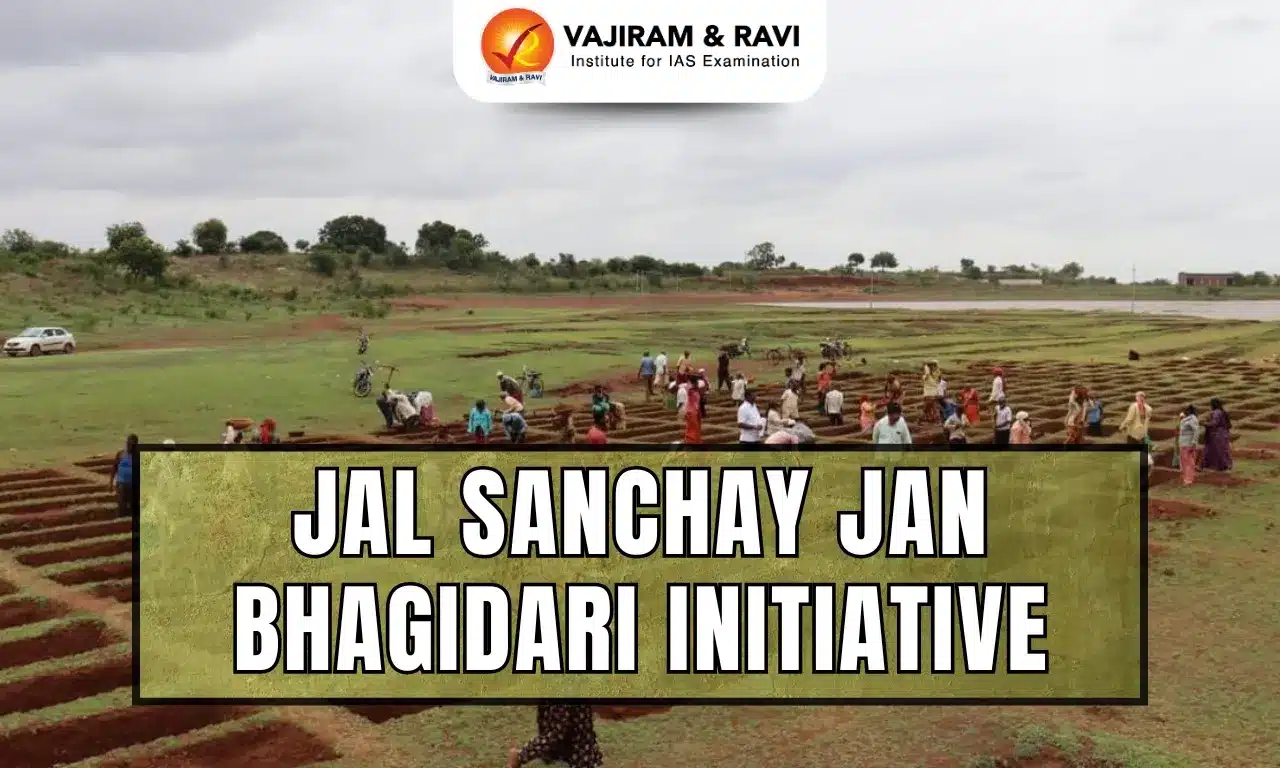
Bidar district of Karnataka has emerged as a winner of the Centre’s Jal Sanchay Jan Bhagidari Award given to top performing districts under the campaign, Jal Shakti Abhiyan: Catch the Rain.

About Jal Sanchay Jan Bhagidari Initiative

  • It was launched in 2024.
  • Aim: The initiative aims to enhance water recharge through rainwater harvesting/aquifer recharge/borewell recharge/ recharge shafts etc.
  • Objective: To ensure that every drop of water is conserved through collective efforts, following a whole-of-society and whole-of-government approach.
  • It is designed to foster active participation from all stakeholders, including government agencies, local communities, industries, NGOs and resident welfare associations.
  • The initiative will ensure
    • Boost in Groundwater Levels: Capture and store rainwater and surface runoff to stabilize and increase groundwater levels,
    • Promotion of Water Conservation Foster a culture of water conservation by engaging communities in local water resource management.
    • Enhancement of Climate Resilience Mitigate the impacts of climate change by developing storage solutions for heavy rainfall and providing a buffer against droughts.
    • Improvement of Water Quality: Utilizing artificial recharge methods to naturally filter water as it percolates through soil layers, reducing salinity and contamination.
  • Nodal Ministry: Ministry of Jal Shakti

Source: TH

Jal Sanchay Jan Bhagidari Initiative FAQs

Q1: When was Jal Shakti Abhiyan launched?

Ans: 2019

Q2: What is the primary objective of Jal Shakti Abhiyan?

Ans: To promote efficient use and conservation of water resources.

Battle of Purandar, Overview, History, Series of Events, Aftermath

Battle of Purandar

The Maratha Empire was unbeatable under Shivaji Maharaj during the mid 17th century in the Deccan region. Shivaji had launched several successful raids against Mughal territories, including the famous attack on Shaista Khan's camp in Pune (1663) and the Sack of Surat (1664), where he looted the Mughal port city. In response to this invasion, Aurangzeb decided to take action against Shivaji. Instead of direct confrontation, he hired Raja Jai Singh I of Amber, to lead Mughal troops against Marathas. Jai Singh was given a force of approximately 40,000 soldiers, including Rajputs, Mughal cavalry, artillery, and support troops.

Battle of Purandar

The Maratha War, Battle of Purandar was between the Mughal Empire and the Maratha forces in 1665. Mughal Emperor Aurangzeb assigned Jai Singh to lead a military campaign against Chhatrapati Shivaji. Jai Singh was supported by several Mughal commanders, including Dilir Khan, Rai Singh, Sujan Singh, and Daud Khan. Under Jai Singh’s leadership, the Mughal forces successfully seized control of the Purandar Fort. The battle concluded by the signing of the Treaty of Purandar between Shivaji and Jai Singh. However, there seems to be a historical mix-up in the last part, as the Treaty of Purandar (1776) was later signed between the Peshwa of the Marathas and the British East India Company in Calcutta.

Battle of Purandar History

The Battle of Purandar was fought in 1665 between the Maratha Empire, led by Chhatrapati Shivaji Maharaj, and the Mughal Empire, under Raja Jai Singh I of Amber. The battle was part of the larger conflict between the Mughals and the Marathas over control of the Deccan region. 

During the mid-17th century, the Maratha Empire emerged as a major force in the Deccan under Shivaji Maharaj. Shivaji had successfully expanded his territories, capturing several forts and challenging the supremacy of the Adil Shahi Sultanate of Bijapur and the Mughal Empire. Some of the notable battles fought between Maratha and Mughal, before the Battle of Purandar are discussed below:

  1. 1659: Shivaji defeated Afzal Khan, a general of Bijapur, and expanded his control over the Deccan.
  2. 1663: Shivaji conducted a daring raid on Shaista Khan's camp in Pune, dealing a humiliating blow to the Mughals.
  3. 1664: Shivaji launched the Sack of Surat, looting one of the richest Mughal trading cities.

Battle of Purandar Overview

Below in the table we have discussed the Battle of Purandar Overview:

Battle of Purandar Overview

Events

Battle of Purandar

Date

31 March 1665 – 12 June 1665

Location

Purandar, Maharashtra, India

Forces Involved

Maratha Empire led by Chhatrapati Shivaji and Mughal Forces led by Jai Singh.

Result

Victory of Mughal Empire

Battle of Purandar Series of Events

  • In 1665, an army of 14,000 soldiers, armed with gunpowder and weapons, set out to invade Shivaji’s Swarajya. 
  • Instead of attacking Shivaji head-on, Mirza Jaisingh and Diler Khan chose a different strategy. They focused on capturing smaller forts first, where the defenses were weaker, with only 500 to 1,000 soldiers guarding them.
  • As they moved forward, their strength kept growing. By the time they reached Purandar, their army had nearly doubled to 30,000, reinforced by troops from the territories they had already conquered.
  • On the way, they stopped at a village called Saswad. Diler Khan decided to camp there for the night before pushing forward with his cannons and men. 
  • However, the Marathas saw an opportunity. Under the cover of darkness, a small group launched a sudden attack, striking the Mughals with full force. 
  • After causing chaos in their ranks, they swiftly withdrew, leaving the enemy unsettled

Siege of Vajragarh Fort

The late-night attack had a clear objective, to weaken the Mughal army’s military strength, and it proved highly successful. Despite their inventory of ammunition and cannons, the Mughals struggled to breach the walls of Purandar Fort. Even after days of attempts, they failed to break through its defenses.

Realizing direct assault wasn’t working, Diler Khan shifted his strategy. He began capturing smaller forts around Purandar, each manned by just 300 to 400 soldiers. One such fort was Vajragarh, located near Purandar. Historians believe that controlling Vajragarh made it easier to target Purandar.

Murarbaji Deshpande, the fort’s killedaar (commander), was renowned for his exceptional bravery. As the cannon fire weakened the fort’s walls, he knew he had to act. One evening, he led a small group of warriors on a daring mission into the Mughal camp. They first sabotaged the enemy’s artillery, then launched a surprise attack, killing around 200–300 Mughal soldiers before retreating to the fort.

The following morning, when the Mughals attempted to fire their cannons, many of them exploded due to the damage inflicted by Murarbaji’s men. However, the Mughal weapons were soon reinforced under the command of Niccolao Manucci, who managed to breach Purandar’s walls. Despite the defenses, Murarbaji and his men refused to surrender.

Siege by Murarbaji Deshpande

Diler Khan attempted to win him over after getting iImpressed by Murarbaji’s exceptional bravery . He offered a treaty, a high-ranking position in the Mughal army, a generous salary, and even a jagir (land grant).

However, Murarbaji was deeply committed to the cause of Hindavi Swarajya and rejected the offer outright. The very idea of serving the enemy enraged him. In a fearless act of defence, he charged straight into the heart of the Mughal forces, cutting down enemy soldiers one after another.

According to historical accounts, Murarbaji alone killed nearly 100 Mughal soldiers. Unable to contain his fury, Diler Khan broke the traditional code of battle. As Murarbaji engaged in combat with multiple warriors, Diler Khan shot an arrow at him from a distance, killing the Maratha warrior in the middle of the battle.

Battle of Purandar Aftermath

During the Battle of Purandar, Chhatrapati Shivaji realized that sustaining the Maratha troops against the massive Mughal forces led by Mirza Raja Jai Singh was becoming increasingly difficult. Following the Mughal victory in June 1665 and the fall of Purandar Fort, Shivaji made a strategic decision. Instead of prolonging the conflict, he chose to negotiate with Jai Singh and propose new terms for peace.

Before proceeding, Shivaji ensured his safety by securing a formal guarantee that he would be allowed to meet Jai Singh and return unharmed, regardless of the outcome. This agreement, which marked a significant turning point, came to be known as the Treaty of Purandar.

Treaty of Purandar 1665

The Treaty of Purandar was signed between Chhatrapati Shivaji Maharaj and Rajput ruler Jai Singh I, who was leading the Mughal forces on behalf of Emperor Aurangzeb. As per the Treaty of Purandar 1665 was surrendered to the Mughals, along with several other key territories. The terms of the agreement included the following:

  1. Shivaji gave 23 out of his 35 forts to the Mughals, which had a combined annual revenue of 40 lakh huns (a currency of that time).
  2. He was allowed to retain control over the remaining 12 forts, provided he remained loyal to the Mughal Empire.
  3. On the advice of Jai Singh, Shivaji agreed to send his eight-year-old son, Shambhaji, to the Mughal court. In return, Shambhaji was granted a mansab (military rank) of 500 and an honorable position.
  4. Shivaji pledged to join the Mughal army when required and act in accordance with imperial commands.
  5. The Mughals approved Shivaji’s request to govern the Bijapur-controlled provinces of Konkan and Balaghat. These regions generated an annual revenue of 4 lakh huns and 5 lakh huns, respectively.
  6. Shivaji agreed to pay the Mughal emperor a total sum of 40 lakh huns in 13 installments, ensuring his continued control over these newly acquired provinces despite the ongoing Mughal expansion.
  7. This treaty marked a significant moment in Shivaji’s strategic diplomacy, allowing him to regroup and later challenge Mughal dominance more effectively.

Battle of Purandar FAQs

Q1: Who won the Battle of Purandar?

Ans: Mughal Empire won the Battle of Purandar.

Q2: Who died while defending Purandar?

Ans: Murarbaji Deshpande died while defending Purandar.

Q3: Which is the biggest battle of Shivaji Maharaj?

Ans: The Battle of Pratapgad was fought between Chhatrapati Shivaji Maharaj and Afzal Khan is the biggest battle of Shivaji Maharaj.

Q4: What was the purpose of the Battle of Purandar?

Ans: The agenda of the battle was to capture the fort of Purandar which had been the then abode of the Marathas in the southwestern part of India located near to Pune.

Q5: Did Jai Singh defeat Shivaji?

Ans: Jai Singh did not defeat Shivaji in the conventional sense of a decisive battlefield victory. Instead, he used a combination of military pressure and diplomacy to force Shivaji into signing the Treaty of Purandar in 1665.

Key Facts about Ecuador

Ecuador

Ecuador Latest News

Ecuador's Indigenous groups are fiercely opposing President Noboa's plan to expand oil drilling in the Amazon.

About Ecuador

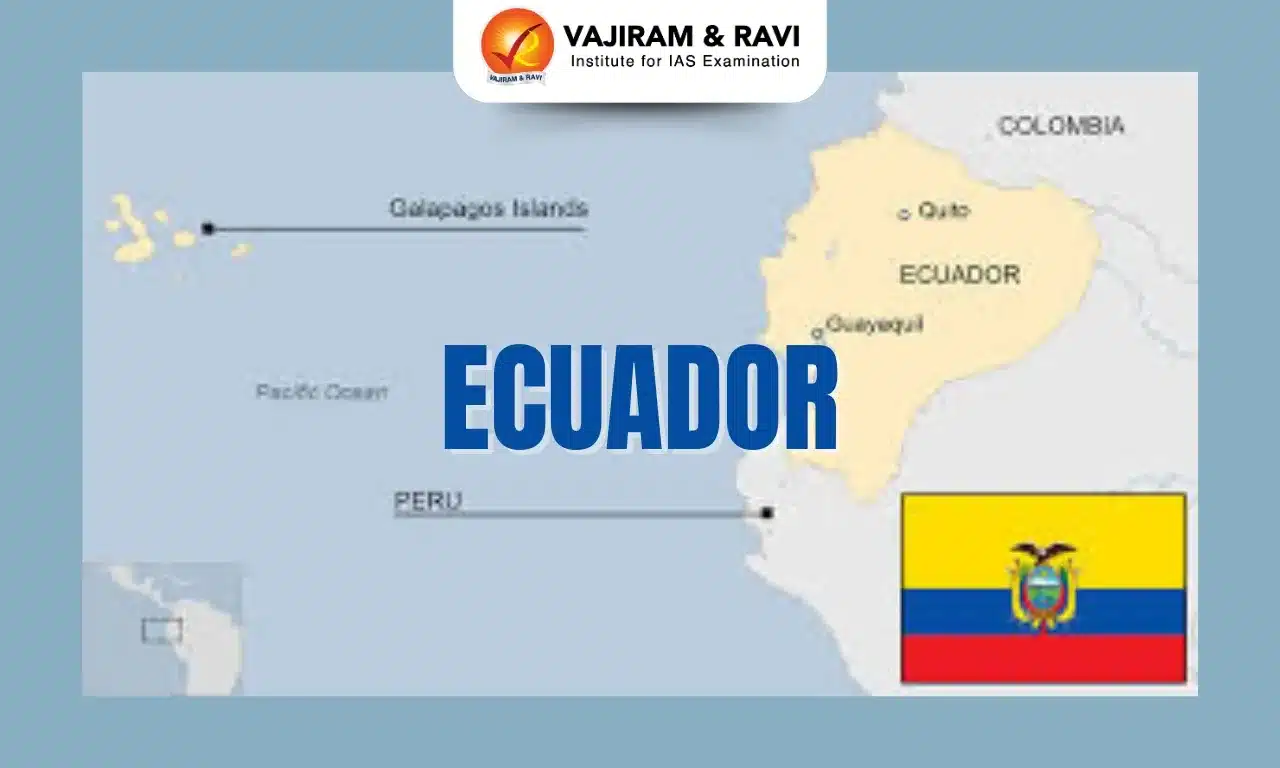
  • Location: It is a country located on the northwestern edge of South America.
  • History: Ecuador was part of the Inca Empire until the Spanish arrived and claimed the country as a Spanish colony. 
  • It is divided into four geographic regions: the coastal lowlands and mountain area; the Central Andes Mountains and its two major chains (Cordillera Occidental in the West) and the (Cordillera Oriental in the east).
  • Bordering countries: It is bordered by Colombia to the north, by Peru to the south and east.
  • Maritime boundaries: It shares borders with the Pacific Ocean to the west.
  • Ecuador also includes the Galapagos Islands. 
  • Highest Point: The highest point in Ecuador is Mount Chimborazo, at 20,560ft (6,268m).
  • Volcano: Cotopaxi is one of the world's highest active volcanoes located in the Andes Mountains.
  • Climate: Tropical along coast, becoming cooler inland at higher elevations; tropical in Amazonian jungle lowlands.
  • Natural resources: Petroleum, fish, timber, hydropower
  • Rivers:  Babahoyo, Chira, Coca, Curaray.
  • Capital City: Quito

Source: DTE

Ecuador FAQs

Q1: What is the highest active volcano in the world located in Ecuador?

Ans: Mt. Cotopaxi.

Q2: Where is Ecuador located?

Ans: Western coast of South America

Amrabad Tiger Reserve

Amrabad Tiger Reserve

Amrabad Tiger Reserve Latest News

A 54-kilometre-long elevated road bridge that will take traffic over the Nallamala forests of the Amrabad tiger reserve promises to be a one-of-a-kind initiative in the country that could become a model for protecting forests and wildlife in other parts of India.

About Amrabad Tiger Reserve

  • It is located in the Nallamala hills of the Eastern Ghats in Telangana state.
  • It covers a total area of 2,611.39 sq.km, with 2,166.37 sq.km designated as the core area. 
  • In terms of core area, it is the second-largest tiger reserve in India.
  • This expansive reserve was originally part of the larger Nagarjunasagar-Srisailam Tiger Reserve before the bifurcation of Andhra Pradesh and Telangana in 2014.
  • The reserve is renowned for its rugged terrain, deep valleys, and dense forests.
  • Within the reserve lies the historic Nagalapuram fort.
  • The Krishna River and its perennial streams originating within the reserve contribute to the water supply of major reservoirs such as the Srishailam Dam and Nagarjunsagar Dam.
  • The Chenchu tribe is one of the major tribal communities that live in the ATR.
  • Flora
    • Amrabad is characterized by dry deciduous forests, primarily made up of sal, teak, bamboo, and acacia trees. 
    • The forest is rich in medicinal plants and shrubs, which have long been used by local tribes for traditional remedies.
  • Fauna:
    • Apart from tigers, the reserve supports a range of other big cats, such as leopards and wild cats, along with herbivores like sambar deer, chital (spotted deer), nilgai (blue bull), wild boar, and the Indian bison (gaur). 
    • Over 303 bird species have been identified in this region. Some important groups include Eagles, Pigeons, Doves, Cuckoos, Woodpeckers, Drongos, etc.

Source: DC


Amrabad Tiger Reserve FAQs

Q1: Amrabad Tiger Reserve is located in which Indian state?

Ans: Telangana

Q2: Amrabad Tiger Reserve is situated in which hill range of the Eastern Ghats?

Ans: Nallamala Hills

Q3: Which historic fort is located within Amrabad Tiger Reserve?

Ans: Nagalapuram Fort

Q4: Which river flows through Amrabad Tiger Reserve?

Ans: Krishna River

Oju Hydel Project

Oju Hydel Project

Oju Hydel Project Latest News

An expert panel of the Union Environment Ministry recently recommended environmental clearance for the 2,220 MW Oju hydroelectric project proposed on the Subansiri River in Taksing near the China border.

About Oju Hydel Project

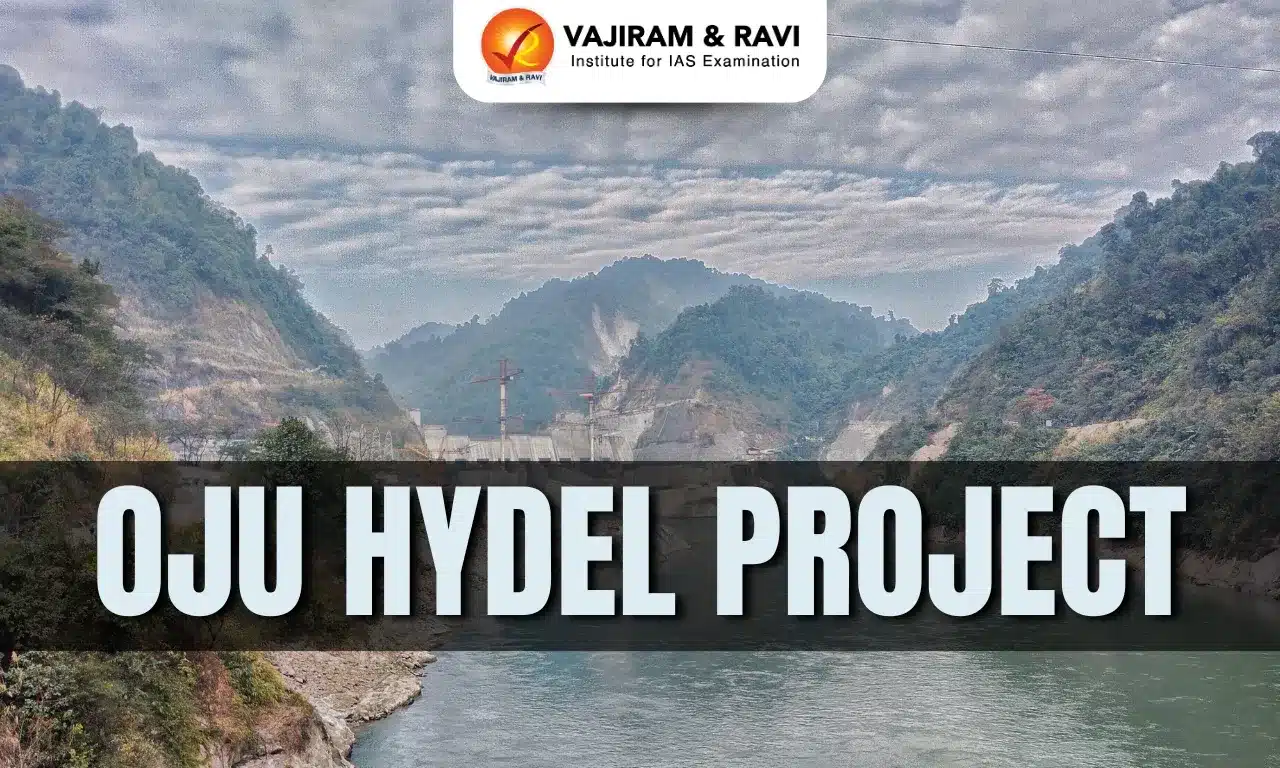
  • It is a hydroelectric project proposed on the Subansiri River (right-bank tributary of the Brahmaputra) in Taksing, Arunachal Pradesh, near the China border. 
  • The project, to be developed by Oju Subansiri Hydro Power Corporation Pvt. Ltd., envisages generating 2,220 megawatts of electricity through a run-of-the-river scheme with daily peaking capability. 
  • It involves a 100-metre-high concrete gravity dam, a 14.12 km headrace tunnel, and an underground powerhouse complex.
  • With an estimated cost of over Rs 24,942 crore, the dam is expected to produce 8,402 million units of electricity annually.
  • It is the largest in a series of dams proposed on the Subansiri River, often described as the lifeline of Assam.

Source: IE


Oju Hydel Project FAQs

Q1: The Oju Hydel Project is proposed on which river?

Ans: Subansiri River

Q2: The Oju Hydel Project is located in which state of India?

Ans: Arunachal Pradesh

Q3: What is the installed capacity of the proposed Oju Hydel Project?

Ans: 2,220 MW

Important Days in August 2023

Important Days in August 2023

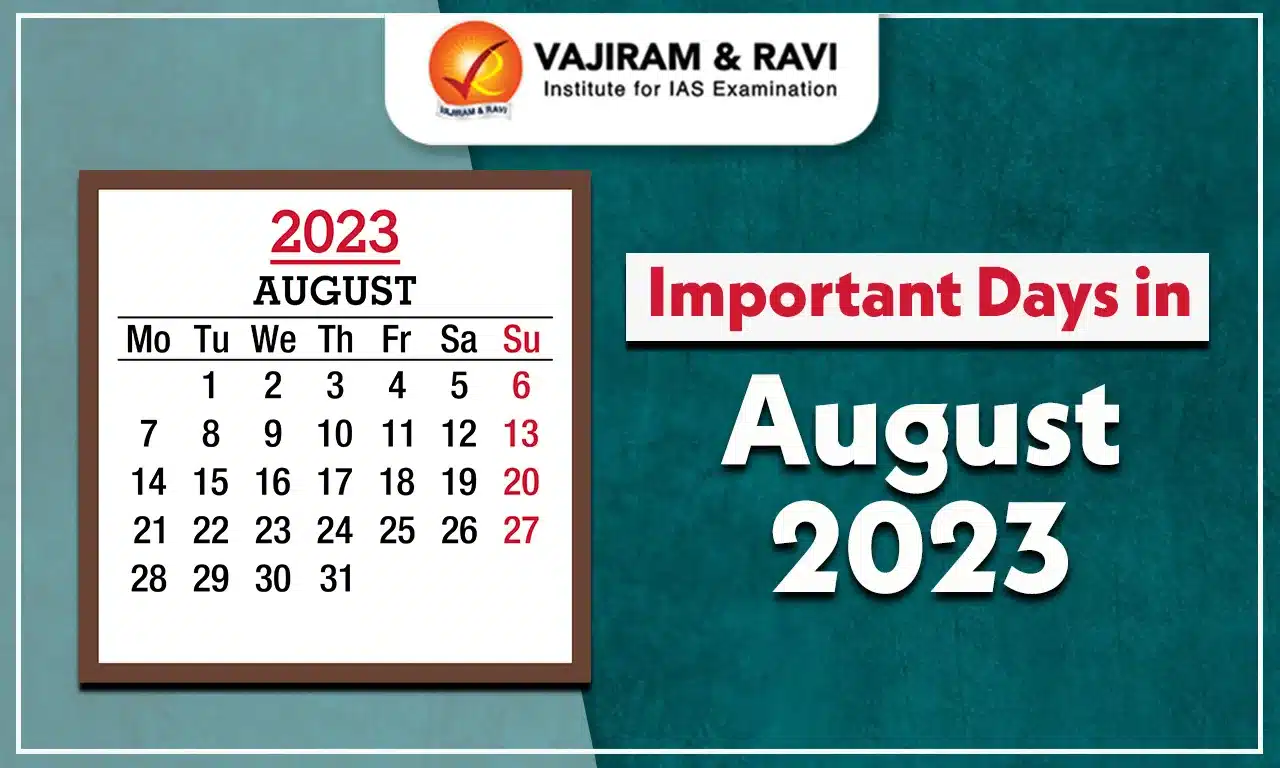
Important Days in August 2023: The month of August has historical resonance as well as contemporary significance and occupies a unique place in the calendar. It stands as a month where the past converges with the present. As UPSC aspirants gear up for their journey, comprehending the importance of these events in August 2023 is essential.

This compilation illuminates days that have shaped history and continue to mould the present, offering aspirants a holistic perspective that extends beyond textbooks and into the world's intricacies.

List of Important Days in August 2023

Some of the important days in August 2023 include National Handloom Day, Quit India Movement Day, World Wide Web Day, etc. From celebrating historical events to raising awareness about critical issues, August is a month that offers a diverse range of observances. Let's delve into some of the most noteworthy and impactful days that make August a month to remember by going through the list of important days in August 2023:

Important Dates

Important Days in August 2023

August 1

World Wide Web Day

August 1

National Mountain Climbing Day

August 2

Birth Anniversary of Pingali Venkayya

August 1 to August 7

World Breastfeeding Week

August 6

Hiroshima Day

August 7

National Handloom Day

August 8

Quit India Movement Day (launched by Gandhi)

August 9

Kakori Train Robbery Anniversary

August 9

Nagasaki Day

August 9

International Day of World’s Indigenous People

August 10

World Lion Day

August 10

World Biofuel Day

August 12

International Youth Day

August 12

World Elephant Day

August 13

World Organ Donation Day

August 14

Partition Horrors Remembrance Day

August 15

Independence Day in India

August 15

National Mourning Day (Bangladesh)

August 16

Parsi New Year

August 16

Bennington Battle Day

August 17

Indonesian Independence Day

August 17

Radcliff Line was declared between India and Pakistan

August 19

World Humanitarian Day

August 19

First Rupee Coin of East India Company was minted

August 20

World Mosquito Day

August 20

Sadbhavna Diwas

August 20

Indian Akshay Urja Day

August 21

Wildlife Protection Act, 1972 was passed

August 21

World Senior Citizen Day

August 23

International Day for the Remembrance of the Slave Trade and its Abolition

August 23

European Day of Remembrance for Victims of Stalinism and Nazism

August 23

National Space Day

August 24

Birth Anniversary of Bina Das

August 26

Women’s Equality Day

August 26

Birth Anniversary of Mother Teresa

August 29

National Sports Day

August 30

Small Industry Day

August 31

Malaysia National Day

August 31

Sanskrit Diwas

Details of Important Days in August 2023

Listed below are the Important Days in August 2023, crucial for candidates preparing for the UPSC Civil Services Examination. These days hold importance due to their historical, cultural, and global significance:

August 1 - World Wide Web Day

World Wide Web Day commemorates the date in 1990 when the physicist Tim Berners-Lee first introduced the concept of the World Wide Web, which revolutionized the way information is shared and accessed. This day celebrates the transformative impact of the Internet on global communication, commerce, and connectivity.

August 2 - Birth Anniversary of Pingali Venkayya

Pingali Venkayya (1876-1963) was a Telugu freedom fighter and social reformer. He is best known for designing the Indian flag. He was born in 1876 in Andhra Pradesh and was a member of the Arya Samaj, a Hindu reform movement. In 1921, he designed the first version of the Indian flag, which was a tricolour of red, yellow, and green with a white Ashoka Chakra in the center. The flag was adopted by the Indian National Congress in 1931 and became the official flag of India after independence in 1947.

August 7 - National Handloom Day

National Handloom Day celebrates the rich heritage and craftsmanship of handloom weavers in India. This day was chosen to honour the Swadeshi Movement, which aimed to promote indigenous industries and self-reliance.

August 6 - Hiroshima Day

Hiroshima Day marks the anniversary of the atomic bombing of Hiroshima, Japan, on August 6, 1945, during World War II. The event is a solemn reminder of the devastating consequences of nuclear warfare and serves as a call for peace and nuclear disarmament.

August 8 - Quit India Movement Day 

The day witnessed nationwide campaign of civil disobedience against British rule in India, the Quit India Movement was launched by Mahatma Gandhi on this day in 1942. The movement was met with widespread arrests and repression, but it ultimately helped to pave the way for India's Independence in 1947.

August 9 - Nagasaki Day

Similar to Hiroshima Day, Nagasaki Day remembers the victims of the atomic bombing of Nagasaki on August 9, 1945. This event also emphasises the need to eliminate nuclear weapons and promote peace.

August 9 - Kakori Train Robbery Anniversary

On 9 August 1925, the Kakori Train Robbery, a major turning point in the Freedom Struggle, was carried out by a group of Indian revolutionaries. The revolutionaries robbed a train carrying British government money in Kakori, Uttar Pradesh, in order to fund their activities. The robbery was a bold act of defiance against British rule, and it helped to inspire other revolutionaries.

August 10 - World Lion Day

World Lion Day is celebrated to raise awareness about the plight of lions and to promote conservation efforts. Lions are endangered animals, with only around 20,000 left in the wild. The day was first celebrated in 2013 by the World Wildlife Fund (WWF) and the Global Coalition for the Protection of African Lions.

August 10 - World Biofuel Day

The World Biofuel Day was first celebrated in 2008 by the International Bioenergy Association. It is celebrated to raise awareness about the benefits of biofuels, which are renewable fuels made from biomass. Biofuels can help to reduce our reliance on fossil fuels and combat climate change.

August 12 - World Elephant Day

World Elephant Day is dedicated to raising awareness about the conservation and well-being of elephants around the world. The day aims to highlight the threats elephants face from habitat loss, poaching, and illegal trade.

August 13 - World Organ Donation Day

World Organ Donation Day seeks to promote organ and tissue donation for transplantation. It emphasises the importance of altruism and saving lives through organ donation.

August 15 - Independence Day in India

Independence Day is a momentous occasion in India, celebrated with great pride and enthusiasm. It marks the day in 1947 when India gained freedom from British rule after decades of struggle and sacrifice. During this day, the Prime Minister raises the national flag at the Red Fort in Delhi and delivers an address to the nation.

The day signifies the culmination of the efforts of countless freedom fighters who fought for India's self-determination. It is a reminder of India's sovereignty and a tribute to those who gave their lives for the nation's independence.

August 15 - National Mourning Day (Bangladesh)

National Mourning Day is observed in Bangladesh to remember and honour Sheikh Mujibur Rahman, the country's founding leader, and his family members who were assassinated on August 15, 1975.

August 16 - Bennington Battle Day

Bennington Battle Day commemorates the Battle of Bennington during the American Revolutionary War. The battle was a pivotal moment in the struggle for independence and is celebrated in the United States.

August 17 - Radcliff Line was declared between India and Pakistan

The Radcliffe Line, declared on 17 August 1947, was a boundary demarcation line between India and Pakistan, which were two newly independent countries that emerged from the partition of British India. The line was drawn hastily and without much regard for the wishes of the people who lived in the region, and it led to widespread violence and displacement.

August 19 - First Rupee Coin of East India Company was minted

The East India Company minted its first rupee coin on 19 August 1760, at Calcutta (Kolkata). The coin was made of silver and bore the image of the company's founder, Robert Clive. The coin was a symbol of the company's growing power and influence in India.

August 20 - Sadbhavna Diwas

On August 20, the birth anniversary of India's sixth Prime Minister, Rajiv Gandhi, is observed as Sadbhavana Diwas or Harmony Day. Rajiv Gandhi held the distinction of being India's youngest Prime Minister. In English, the term "Sadbhavana" translates to "goodwill." The day aims to promote communal harmony, national integration, and peace among all communities.

Rajiv Gandhi's vision for a united and inclusive India is honoured through various events and initiatives that encourage dialogue, understanding, and cooperation among people from diverse backgrounds.

August 20 - World Mosquito Day

World Mosquito Day commemorates the discovery by Sir Ronald Ross in 1897 that female mosquitoes transmit malaria. The day raises awareness about the dangers of mosquito-borne diseases and efforts to control them.

August 20 - Indian Akshay Urja Day

Indian Akshay Urja Day, also known as Renewable Energy Day, highlights India's commitment to sustainable energy sources. It marks the anniversary of the establishment of the Ministry of New and Renewable Energy (MNRE) in 1992. The day underscores India's strides in harnessing renewable energy, such as solar, wind, and hydropower, to reduce dependence on fossil fuels and mitigate environmental concerns.

It serves as a reminder of India's goal to transition towards cleaner and more sustainable energy alternatives.

August 21 - World Senior Citizen Day

The World Senior Citizen Day is celebrated to honor and appreciate senior citizens. They have made significant contributions to society, and they deserve our respect and care. The day was first celebrated in India in 1999 by the Ministry of Social Justice and Empowerment.

August 23 - International Day for the Remembrance of the Slave Trade and its Abolition

This day acknowledges the transatlantic slave trade's historical impact and the importance of abolishing slavery. It serves as a reminder of the need to combat racism, discrimination, and prejudice.

August 23 - European Day of Remembrance for Victims of Nazism and Stalinism

This day honours the victims of totalitarian regimes led by Stalin and Hitler in Europe. It aims to promote understanding, remembrance, and lessons learned from these dark periods of history.

August 23 - National Space Day

Prime Minister designated August 23 as 'National Space Day', coinciding with Chandrayaan-3's successful soft landing on the Moon's south pole. During his visit to the ISRO command centre in Bengaluru, he lauded the contributions of women scientists and declared that the lunar site of Chandrayaan-3's landing would be named 'Shivshakti', fostering scientific inspiration. He revealed that the point where Chandrayaan-2 impacted the Moon would be termed the 'Tiranga' point. This recognition underscores India's strides in space exploration and encourages future generations in scientific pursuits.

August 24 - Birth Anniversary of Bina Das

Bina Das (1911-1994) was a Bengali revolutionary and social reformer. She was one of the first women to participate in the Quit India Movement. In 1930, she threw a shoe at the portrait of British King George V in protest against British rule. She was arrested and imprisoned for her actions. On 6 February 1932, she attempted to assassinate the Bengal Governor Stanley Jackson at University of Calcutta but failed. After independence, she continued to work for social justice and women's rights.

August 26 - Women’s Equality Day

Women’s Equality Day commemorates the passing of the 19th Amendment to the United States Constitution in 1920, granting women the right to vote. The day advocates for gender equality and the ongoing struggle for women's rights.

August 26 - Birth Anniversary of Mother Teresa

Mother Teresa (1910-1997) was a Catholic nun dedicated her life to helping the poor and sick. She founded the Missionaries of Charity, a religious order that cares for the destitute and dying. Mother Teresa was awarded the Nobel Peace Prize in 1979 for her work.

August 30 - National Small Industry Day

National Small Industry Day celebrates the vital role of small and medium-sized enterprises (SMEs) in economies worldwide. It recognises their contributions to employment, innovation, and economic growth.

August 31 - Sanskrit Diwas

Sanskrit Diwas honours the ancient Indian language, Sanskrit, which has significant religious, philosophical, and literary importance. The day promotes the preservation and propagation of the Sanskrit language and culture.

Enhance your knowledge by learning about Important Days in September 2023 as well.

FAQs on Important Days in August

Q1: What are the special days in August 2023?

Ans: World Breastfeeding Week, International Youth Day, World Elephant Day, Indian Independence Day, National Sports Day (India), etc., are some examples of special days that fall in the month of August.

Q2: What is special on 8 August 2023?

Ans: On August 8, there is "International Cat Day," which celebrates and raises awareness about the wonderful companionship and unique qualities of cats.

Q3: What day is August 23rd on 2023?

Ans: The Prime Minister declared 23rd August to be celebrated as National Space Day every year. This day holds significance as it aligns with the successful soft landing of Chandrayaan-3 on the Moon's south pole.


Syphilis

Syphilis

Syphilis Latest News

Sexually transmitted disease rates for U.S. adults fell last year, but syphilis in newborns continued to rise, according to new government data recently.

About Syphilis

  • It is a preventable and curable bacterial sexually transmitted infection (STI) that can cause serious health problems if you do not treat it. 
  • It is caused by the bacteria, Treponema pallidum.
  • After the infection happens, syphilis bacteria can stay in the body for many years without causing symptoms. But the infection can become active again.

Syphilis Transmission

  • People usually get syphilis from sexual contact with someone who has it.
  • People get it if any part of their body touches the sore or rash of someone with syphilis.
  • It can also pass from mother to baby during pregnancy, childbirth, and sometimes through breastfeeding.

Syphilis Symptoms

  • Syphilis develops in stages
  • The disease starts as a sore that’s often painless and typically appears on the genitals, rectum, or mouth.
  • Sometimes it causes swelling in nearby lymph nodes.
  • If you do not treat it, syphilis usually causes a non-itchy skin rash, often on your hands and feet.
  • Many people do not notice symptoms for years. Symptoms can go away and come back.
  • Without treatment, syphilis can damage the heart, brain, or other organs. It can become life-threatening.
  • Syphilis in pregnancy, when not treated, treated late, or treated with the incorrect antibiotic, results in 50−80% of cases with adverse birth outcomes.

Syphilis Treatment

  • It is easy to cure with antibiotics, especially during the early stages.
  • Penicillin is the most commonly used medication for syphilis.

Source: TH

Syphilis FAQs

Q1: What can cause syphilis?

Ans: Syphilis is a sexually transmitted infection (STI) caused by the bacteria, Treponema pallidum.

Q2: Is syphilis a curable disease?

Ans: It is a preventable and curable disease.

Q3: What is usually the first sign of syphilis infection?

Ans: A painless sore on the genitals, rectum, or mouth.

Insolvency and Bankruptcy Code (IBC) – SC Clears JSW Steel’s Acquisition of BPSL

Insolvency and Bankruptcy Code

Insolvency and Bankruptcy Code (IBC) Latest News

  • The Supreme Court of India has approved JSW Steel’s $2.3 billion (₹19,350 crore) acquisition of Bhushan Power and Steel (BPSL), reversing its earlier decision of liquidation
  • This judgment strengthens the Insolvency and Bankruptcy Code (IBC), 2016, by prioritising revival of distressed firms over liquidation.

Understanding Insolvency and Bankruptcy and the IBC

  • Insolvency vs Bankruptcy: While insolvency results from an inability to pay debts due to a lack of assets, bankruptcy occurs when an application is presented to an authority declaring insolvency and requesting to be declared bankrupt, which will last until discharge.
  • About the IBC 2016: 
    • It is the bankruptcy law of India which seeks to consolidate the existing framework by creating a single law for insolvency and bankruptcy. 
    • It is a one stop solution for resolving insolvencies which previously was a long process that did not offer an economically viable arrangement. 
    • It aims to protect the interests of small investors and make the process of doing business less cumbersome.
  • Insolvency and Bankruptcy Board of India (IBBI):
    • It is the regulator for overseeing insolvency proceedings and entities like Insolvency Professional Agencies (IPA), Insolvency Professionals (IP) and Information Utilities (IU) in India. 
    • It was established on 1 October 2016 and given statutory powers through the IBC 2016. 
    • It functions under the Ministry of Corporate Affairs and covers Individuals, Companies, Limited Liability Partnerships and Partnership firms. 

Process Followed under the IBC

  • Initiation of CIRP:
    • Corporate Debtor (CD): A company that has taken loans and defaults on repayment.
    • Who can Apply: Either the creditor or the debtor can initiate proceedings.
    • Relevant Section: Corporate Insolvency Resolution Process (CIRP) is governed by Section 6 of the IBC.
  • Threshold for default:
    • Earlier limit: ₹1 lakh default.
    • Revised limit: Raised to ₹1 crore during the pandemic to reduce undue stress on companies.
  • Adjudicating Authority (AA):
    • Designated authority: National Company Law Tribunal (NCLT) benches across India.
    • Role: Receives insolvency applications from creditors or debtors.
    • Timeline: Must admit or reject application within 14 days, with reasons for delay if not disposed within this period.
  • Commencement of CIRP:
    • Trigger point: CIRP begins once NCLT admits the application.
    • Resolution timeline: As per amendment, the process must be completed within 330 days (including litigation period).
  • Outcome of CIRP:
    • Resolution: Revival of the corporate debtor through restructuring or takeover by a Successful Resolution Applicant (SRA).
    • Liquidation: If no resolution plan is approved within the stipulated period.

Supreme Court’s Ruling

  • Revival of BPSL: JSW Steel has invested in modernisation, safeguarded thousands of jobs, and ensured that the company will continue to operate.
  • IBC objective fulfilled: The court emphasised that the essence of IBC is to convert loss-making firms into profitable entities.
  • On claims: Creditors’ demand for an additional ₹6,100 crore was dismissed. The Court stated that once the Committee of Creditors (CoC) approves a plan, reopening claims undermines the law.
  • CCDs as equity: Compulsorily Convertible Debentures (CCDs) issued by the Successful Resolution Applicant (SRA) must be treated as equity.

Background

  • The SC had earlier ordered liquidation, citing JSW Steel’s delay in implementing the plan and failure of CoC to exercise its commercial wisdom.
  • The court criticised the Resolution Professional (RP) and CoC for failing to protect creditors’ interests and supporting JSW despite violations.
  • The (May 2024) order unsettled investors and cast doubts on the effectiveness of IBC reforms.

Importance of BPSL to JSW Steel

  • BPSL contributes significantly to JSW’s revenue and profitability. FY25 performance - Profit of ₹300 crore (Q1), loss of ₹93 crore (Q2), profit of ₹11 crore (Q3).
  • BPSL increased capacity from 3.5 MTPA to 5 MTPA, operating advanced facilities across India.
  • Analysts estimate an 8–10% revenue and EBITDA decline in FY26 if BPSL is liquidated.

Liquidation Trends and Broader Implications of Judgment

  • Rising liquidations: FY24 witnessed 2,476 cases ending in liquidation with total claims of ₹11 lakh crore. Recovery rate remained only 6.33% of admitted claims (₹69,634 crore).
  • Example of Jet Airways: Earlier, Jet Airways faced liquidation due to a failed resolution plan (₹15,723 crore admitted claims).
  • Liquidation of BPSL: This would have been the largest in corporate history.
  • The judgment: This is expected to restore investor confidence in IBC and discourage frivolous delays.

Conclusion

  • The Supreme Court’s reversal aligns with the spirit of the IBC by prioritising corporate revival over liquidation. 
  • The ruling will likely strengthen creditors’ trust in resolution plans, reduce litigation uncertainties, and boost investor confidence in India’s insolvency ecosystem. 
  • Going ahead, stricter accountability for Resolution Professionals and CoCs is essential to prevent delays and safeguard creditors’ interests.

Source: IE

Insolvency and Bankruptcy Code FAQs

Q1: How does the recent Supreme Court ruling on JSW Steel’s acquisition of Bhushan Power and Steel reinforce the objectives of the IBC?

Ans: It upholds IBC’s core objective of reviving distressed assets into going concerns while protecting jobs and maximising asset value.

Q2: Why did the Supreme Court dismiss creditors’ additional demand in the BPSL case?

Ans: This would undermine the finality of resolution plans and violate IBC provisions.

Q3: What role does Bhushan Power and Steel play in JSW Steel’s revenue profile?

Ans: BPSL contributes significantly to JSW’s revenue and profits, with liquidation projected to cause an 8–10% decline in revenue in FY26.

Q4: What was the SC’s earlier criticism in the JSW–BPSL case?

Ans: The SC highlighted CoC’s failure to exercise commercial wisdom, protect creditors’ interests, and ensure compliance with IBC norms.

Q5: What do the liquidation trends under IBC indicate?

Ans: The data highlights systemic delays and weak enforcement in the resolution process.

India-US Nuclear Energy Talks Face Hurdles Over Liability Laws

India-US Nuclear Deal

India-US Nuclear Deal Latest News

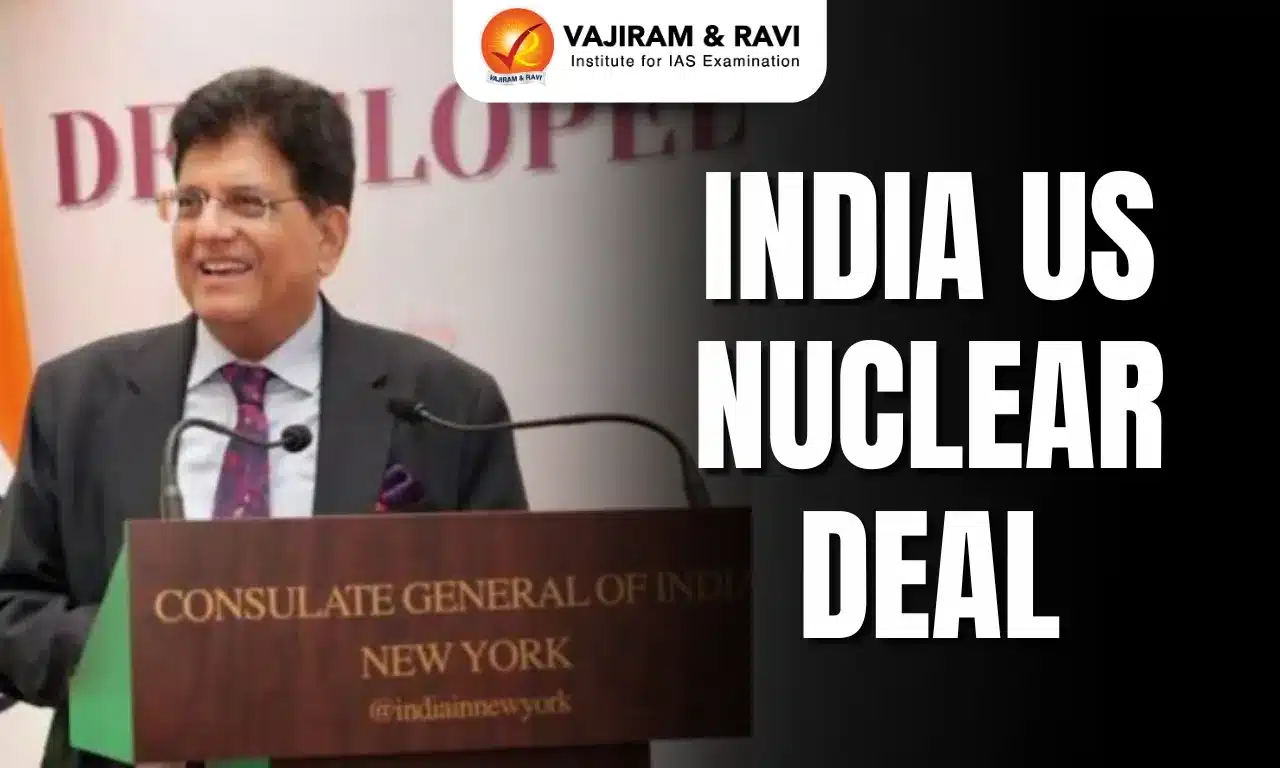
  • During renewed trade negotiations in New York, Commerce Minister Piyush Goyal highlighted India’s energy security vision, which will involve strong collaboration with the United States, especially in small modular reactor (SMR) technologies and broader nuclear energy cooperation.
  • However, progress faces hurdles due to unresolved legal issues, particularly India’s nuclear liability framework, which has long discouraged US firms from entering the Indian nuclear market. 
  • Addressing these liability concerns is essential but remains a complex challenge, making expansion in nuclear cooperation easier said than done.

US Regulatory Clearance Boosts Indo-US Nuclear Prospects

  • In March, the US Department of Energy (DoE) granted Holtec International regulatory clearance under the restrictive 10CFR810 rule, a long-standing hurdle in Indo-US nuclear cooperation.
  • The approval conditionally permits Holtec to transfer unclassified small modular reactor (SMR) technology to its subsidiary Holtec Asia, as well as Indian firms Tata Consulting Engineers and Larsen & Toubro.
  • Previously, 10CFR810 regulations barred US companies from manufacturing nuclear equipment or conducting nuclear design work in India, blocking New Delhi’s aim to co-produce SMRs for domestic needs. 
  • The clearance removes this roadblock, paving the way for collaboration.
  • Now, the onus shifts to India, which must pass pending legislative amendments — particularly to its liability law and the Atomic Energy Act — to unlock foreign investment.

Key Amendments to India’s Nuclear Liability Framework

  • India is working on a set of 11 amendments to its Civil Liability for Nuclear Damage Act, 2010 (CLNDA) to attract foreign investment and ease vendor concerns.

Section 17(b) – The Main Obstacle

  • Section 17 of CLNDA allows nuclear plant operators to seek compensation from suppliers after paying damages for an accident
  • Specifically, Section 17(b) gives operators a “right of recourse” if an incident results from defective or substandard equipment supplied.
    • Foreign vendors like Westinghouse Electric (US) and Framatome (France) argue this provision is stricter than global norms, exposing them to unlimited liability.
    • Since its enactment, no foreign company has invested in India’s nuclear projects, fearing financial risks.
    • Even domestic sub-suppliers like L&T and Walchandnagar Industries are wary, as the term “supplier” is too broad and could include small vendors.

Proposed Amendments

  • The government is considering:
    • Diluting Section 17(b) to bring it in line with international nuclear liability laws.
    • Clarifying the definition of “supplier” to exclude sub-suppliers from automatic liability.
    • Capping vendor liability, both in monetary terms (limited to contract value) and by time frame, so risks do not extend indefinitely.

Regulatory Safeguards

  • Officials note that the Atomic Energy Regulatory Board (AERB) already vets all projects and can ensure right of recourse is explicitly written into contracts. 
  • This safeguard could balance accountability while easing investor fears.

Opening India’s Nuclear Sector to Private Participation

  • India is preparing sweeping reforms to allow private and potentially foreign companies to participate in nuclear power generation — a sector long reserved for state-owned operators. 

Amendment to the Atomic Energy Act, 1962

  • The government plans to amend the Atomic Energy Act, 1962, which currently restricts nuclear plant operations to public sector entities like NPCIL and NTPC Ltd. 
  • The proposed reform would:
    • Enable private firms to enter nuclear power generation.
    • Allow for minority equity stakes by foreign companies in upcoming nuclear projects at a later stage.
    • Expand the sector’s capacity by leveraging private investment and technology.

Link to Indo-US Civil Nuclear Deal

  • Nearly two decades after the Indo-US civil nuclear agreement, these reforms are seen as crucial to unlocking its commercial potential. 
  • New Delhi also hopes to present this move as part of its broader trade and investment partnership with Washington, complementing ongoing India–US trade negotiations.

Aligning India’s Nuclear Laws with Global Norms

  • India is moving to amend its Civil Liability for Nuclear Damage Act (CLNDA) to align more closely with the 1997 Convention on Supplementary Compensation for Nuclear Damage (CSC)
  • These changes are aimed at easing investor concerns, clarifying ambiguities, and bringing India fully into the global nuclear liability regime.

Compliance with the CSC

  • India signed the CSC in 2010 and ratified it in 2016, despite not being a member of the Vienna (1963) or Paris (1960) Conventions
  • The proposed amendments to CLNDA will:
    • Harmonise India’s framework with CSC provisions and annexures.
    • Strengthen India’s standing as a CSC-compliant state party, ensuring compatibility with international liability norms.

Clarification of “Supplier”

  • A major issue has been ambiguity in the definition of “supplier” under Rule 24 of CLND Rules. The rules state a supplier may include:
    • A manufacturer providing systems, equipment, or structures.
    • A vendor responsible for design and quality assurance.
    • Providers of quality assurance or design services.
  • However, uncertainty remains on whether this applies only to reactor suppliers like Westinghouse or also to small vendors, such as an electrical package provider in a Rs 1 crore contract. 
  • The amendments seek to clearly define supplier responsibilities, easing fears of unlimited liability for smaller sub-vendors.

Conclusion

  • These amendments are an economic necessity to attract foreign and domestic investment into India’s nuclear sector. 
  • Still, the biggest challenge will be forging political consensus in Parliament to pass the reforms, which may now be delayed beyond the monsoon session.

Source: IE

India-US Nuclear Deal FAQs

Q1: What did Commerce Minister Piyush Goyal highlight in US talks?

Ans: He flagged India’s energy security vision, stressing collaboration with the US in nuclear energy and small modular reactor (SMR) technologies.

Q2: What regulatory clearance did the US grant recently?

Ans: The US DoE cleared Holtec International to share SMR technology with Indian firms, removing a key hurdle under restrictive 10CFR810 regulations.

Q3: Why is Section 17(b) of CLNDA controversial?

Ans: It gives operators a right of recourse against suppliers for defective equipment, deterring foreign vendors like Westinghouse from investing in India’s nuclear sector.

Q4: What reforms are planned under the Atomic Energy Act?

Ans: Amendments would allow private and possibly foreign companies to enter nuclear generation, breaking the state monopoly of NPCIL and NTPC Ltd.

Q5: Why are these amendments considered urgent?

Ans: They are seen as an economic necessity to attract foreign investment, align India with global nuclear norms, and unlock the potential of the Indo-US nuclear deal.

India Calls for Major UN Reforms to Address Global Crises

UN Reforms

UN Reforms Latest News

  • India’s External Affairs Minister S. Jaishankar addressed the 80th session of the UN General Assembly. 
  • During this speech, he emphasised that the UN must be reformed and member states — led by active Global South contributors like India — must strengthen cooperation, confront terrorism, and restore multilateral credibility to meet 21st-century challenges.

UN General Assembly

  • The UN General Assembly (UNGA) is the main deliberative, policymaking and representative organ of the United Nations.
  • All 193 UN member states are members (each with one vote). The Holy See and Palestine are permanent observers.
  • It provides a global forum for multilateral discussion of international issues — peace & security, development, human rights, international law, budgetary and administrative matters.

Working

  • It holds an annual Regular Session (High-Level Week in September) plus Special and Emergency Special Sessions when required.
  • Structure: Six Main Committees handle substantive work:
    • Disarmament & International Security
    • Economic & Financial
    • Social, Humanitarian & Cultural
    • Special Political & Decolonization
    • Administrative & Budgetary
    • Legal
  • President & Bureau: A President (elected for one year) chairs sessions and sets procedural priorities; elected from different regional groups on rotation.

Decision-Making & Voting

  • Important questions (admission of members, budget, peace & security recommendations) normally require a two-thirds majority.
  • Other questions require a simple majority.
  • Nature of GA decisions: Most resolutions and declarations are non-binding politically influential instruments; binding enforcement is typically the Security Council’s domain.

Key Powers & Functions

  • Approve the UN budget and apportion member contributions.
  • Elect non-permanent members of the Security Council, members of other UN bodies and the judges of the ICJ (in conjunction with the Security Council).
  • Recommend appointment of the Secretary-General to the Security Council.
  • Create subsidiary organs and specialised agencies; convene world conferences.

Key Achievements & Historical Impact

  • Universal Declaration of Human Rights (1948): Adopted by UNGA — foundational text in international human rights.
  • Decolonization: Adopted the 1960 Declaration on Granting Independence to Colonial Countries and Peoples and guided a major wave of decolonization through UN support and membership expansion.
  • Development agendas: Endorsed the Millennium Declaration (MDGs) and later the 2030 Agenda for Sustainable Development and the SDGs (2015) — global compacts for development.

The General Debate

  • The general debate is part of the General Assembly session and is held at the beginning of each regular session in September.
  • Purpose: Heads of state/government and ministers present national views and priorities and respond to global issues under a chosen theme.
  • Speaking order & practice: Traditionally Brazil speaks first, then the United States, followed by other states in order of request and protocol.
  • Theme of 80th session - Better Together: 80 years and more for peace, development and human rights.
  • Presidency of 80th session - Annalena Baerbock of Germany is the President of 80th UNGA being held in New York.

EAM Jaishankar at the UN — Key Points & Takeaways

  • EAM argued that the UN’s founding Charter calls for peace and human dignity, but the state of the world shows the organisation struggling to deliver.
  • He said that the global problems (conflict, climate, development, trade, terrorism) make a compelling case for more international cooperation — and urgent reform of multilateral institutions.

State of the world — Where the UN is Falling Short

  • Major conflicts: Cited Ukraine and the Middle East as evidence that the UN’s conflict-resolution role is under strain.
  • Development shortfalls: Slow progress on the Sustainable Development Goals; resources and delivery lag.
  • Climate credibility at risk: “If climate action itself is questioned, what hope is there for climate justice?” — concern over hollow commitments and creative accounting.
  • Economic friction: Rising tariff volatility, technology controls, supply-chain grip, and restricted labour mobility undermine open trade and require multilateral responses.

Terrorism — An Urgent, Shared Threat

  • Terrorism synthesises bigotry, violence, intolerance and fear and remains a priority.
  • India’s experience: living next to a state that is a centre for global terrorism underlines the urgency.
  • Required measures: choke terrorism financing, sanction prominent terrorists, and deepen international cooperation against sponsors and sympathisers.

UN Credibility & The Need for Reform

  • The UN is “in a state of crisis”: gridlock has reduced its ability to build common ground and weakened belief in multilateralism.
  • Security Council reform is essential — expand both permanent and non-permanent membership to reflect contemporary realities.

India and the Global South — Readiness to Lead

  • India stands ready to assume greater responsibilities, and the Global South must contribute more actively.
  • Cited India’s international role: development projects, crisis response, safe commerce, and security assistance.
  • Call for countries that can engage all sides (e.g., in Ukraine and the Middle East) to step up mediation and search for solutions.

Principles for Action — Cooperation, Empathy, Common Purpose

  • International cooperation must prevail; islands of prosperity cannot flourish in an ocean of turbulence.
  • A functioning world order requires common purpose and empathy — the UN should be the forum to enable that.
  • Reforming multilateralism is presented as the obvious, necessary path forward.

Source: TH | UN | UNGA

UN Reforms FAQs

Q1: Why is India calling for UN reforms?

Ans: India argues the UN is gridlocked, unable to address terrorism, climate action, and development effectively, and needs urgent reform to restore credibility.

Q2: What did Jaishankar highlight at the UNGA?

Ans: He emphasised terrorism, climate justice, economic frictions, and multilateral failures, urging collective action and reform of institutions like the UN Security Council.

Q3: How does India view its role in UN reforms?

Ans: India projects itself as a responsible Global South leader, ready to take greater responsibilities and strengthen cooperation for peace, development, and global security.

Q4: What reforms does India propose for the UN Security Council?

Ans: India advocates expanding both permanent and non-permanent membership to reflect contemporary realities and strengthen multilateral decision-making.

Q5: Why does terrorism remain central in India’s UN message?

Ans: India stressed its experience living next to a terrorism hub, calling for choking terror financing, sanctioning sponsors, and deeper global cooperation against extremism.

Cold Desert Biosphere Reserve – UNESCO Recognition

Cold Desert Biosphere Reserve

Biosphere Reserve Latest News

  • The Cold Desert Biosphere Reserve in Himachal Pradesh has been included in UNESCO’s World Network of Biosphere Reserves, making it India’s 13th site on the global list.

Introduction

  • In a significant recognition of India’s conservation efforts, UNESCO has designated the Cold Desert Biosphere Reserve in Himachal Pradesh as part of its prestigious World Network of Biosphere Reserves (WNBR). 
  • This inclusion marks a global acknowledgement of the ecological, cultural, and scientific importance of the fragile Trans-Himalayan ecosystem. 
  • With this addition, India now has 13 biosphere reserves listed under UNESCO, highlighting the country’s commitment to biodiversity protection and sustainable development.

About the Cold Desert Biosphere Reserve

  • The Cold Desert Biosphere Reserve spans 7,770 sq. km. across Himachal Pradesh’s Lahaul-Spiti district
  • Situated at altitudes ranging from 3,300 to 6,600 meters, the region represents one of the coldest and driest ecosystems in the world. 
  • It covers landscapes such as windswept plateaus, glacial valleys, alpine lakes, and high-altitude deserts.
  • The reserve integrates the Pin Valley National Park, Kibber Wildlife Sanctuary, Chandratal Wetland, and the Sarchu plains, making it a hub of biodiversity and cultural heritage. 
  • It is divided into three zones: core (2,665 sq. km), buffer (3,977 sq. km), and transition (1,128 sq. km), to balance conservation goals with sustainable community practices.

Biodiversity and Cultural Richness

  • The Cold Desert is home to a diverse range of flora and fauna. 
  • It harbours 732 vascular plant species, including 30 endemics and 47 medicinal herbs crucial to the traditional Sowa Rigpa (Amchi) healing system. 
  • Among its iconic fauna are the snow leopard, Himalayan ibex, blue sheep, Himalayan wolf, and several bird species like the golden eagle and Himalayan snowcock.
  • Around 12,000 residents inhabit scattered villages across the reserve. 
  • They continue to practice traditional pastoralism, yak and goat herding, and small-scale farming of barley and peas. 
  • The communities also maintain ancient Tibetan herbal medicine traditions, often guided by Buddhist monasteries and local councils that regulate the use of alpine resources.

Global and National Significance

  • The UNESCO designation underscores the urgent need to protect fragile Himalayan ecosystems, which face mounting challenges from climate change and unchecked tourism. 
  • It also elevates Himachal’s cold desert to global prominence, ensuring international cooperation in conservation, eco-tourism, and climate research.
  • The recognition came during the 37th session of UNESCO’s International Coordinating Council of the Man and the Biosphere (MAB) in Paris. 
  • Globally, UNESCO has added 26 new biosphere reserves across 21 countries this year, the highest number in two decades, expanding WNBR to 785 sites in 142 countries.

India’s Growing Biosphere Network

  • With the addition of the Cold Desert Biosphere Reserve, India’s tally of UNESCO-recognised biospheres has reached 13. 
  • This reflects the country’s broader strategy to align conservation with sustainable community development. 
  • India’s biospheres now include diverse ecosystems, from the Nilgiri and Sundarbans to the Great Nicobar and Pachmarhi.
  • Union Environment Ministry noted that this achievement follows the inclusion of two new Ramsar sites in India, bringing the country’s total wetlands of international importance to 93. 
  • The move reflects India’s consistent push to integrate ecological preservation with international frameworks.

Future Outlook

  • The UNESCO recognition is expected to encourage greater research collaborations, promote responsible tourism, and improve climate resilience strategies in high-altitude ecosystems. 
  • It also calls attention to India’s role in safeguarding fragile mountain landscapes that are both biodiversity hotspots and cultural treasures.
  • The designation strengthens the global narrative of balancing conservation with community livelihoods, offering India an opportunity to showcase its traditional knowledge systems, pastoral practices, and eco-cultural heritage.

Source : TH | IE

Biosphere Reserve FAQs

Q1: What is the Cold Desert Biosphere Reserve?

Ans: It is a 7,770 sq. km protected ecosystem in Himachal Pradesh’s Lahaul-Spiti district, now part of UNESCO’s World Network of Biosphere Reserves.

Q2: Why is the Cold Desert Reserve ecologically important?

Ans: It hosts rare species like the snow leopard, blue sheep, and Himalayan ibex, along with 732 plant species, including many medicinal herbs.

Q3: How many UNESCO biosphere reserves does India have now?

Ans: India now has 13 biosphere reserves listed under UNESCO’s World Network of Biosphere Reserves.

Q4: What cultural practices are linked to the reserve?

Ans: Local communities practice pastoralism, barley and pea farming, and Tibetan herbal medicine guided by Buddhist monastic traditions.

Q5: What global significance does the UNESCO listing bring?

Ans: It enhances international collaboration, eco-tourism opportunities, and climate resilience efforts in the fragile Himalayan ecosystem.

Enquire Now