
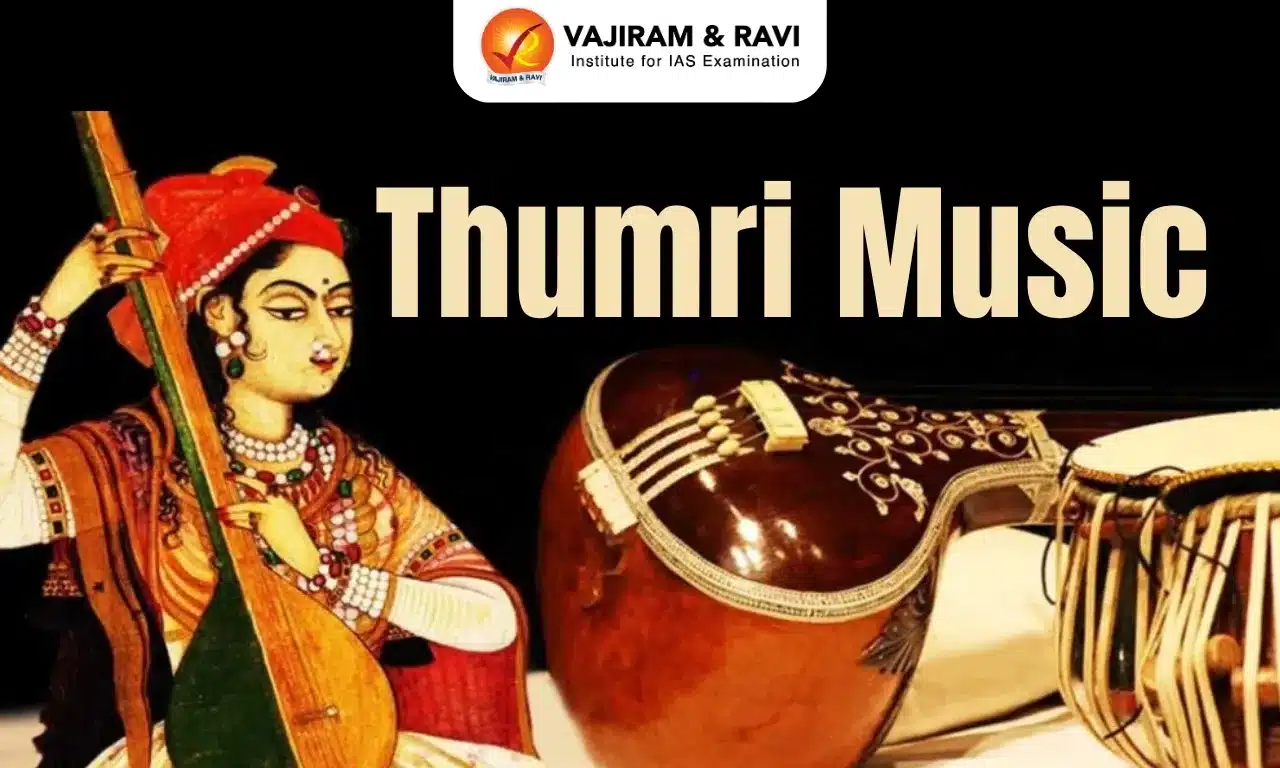
Thumri Music Latest News
Recently, Thumri lost a towering voice with the demise of Pandit Chhannulal Mishra (1936–2025), Padma Vibhushan awardee and one of the last great exponents of the Purab Ang of Banaras Gharana.
About Thumri Music
- Thumri is a semi-classical vocal form of Hindustani music, often called the “lyric of Indian classical music”.
- It originated in Eastern Uttar Pradesh (mainly Lucknow and Benares) during the 18th century CE, developed by Sadiq Ali Shah.
- Themes: Primarily about love, separation, and devotion, often centered on Radha-Krishna episodes.
- Language: Usually sung in Braj Bhasha, Awadhi, and Hindi dialects, with touches of Urdu and Sanskrit.
- Distinct Feature: Freedom in improvisation; emphasis on bhava (emotion) over strict adherence to raga grammar.
- Associated Dance Form: Closely linked with Kathak, enhancing its narrative expression.
- Influences: Draws from Hori, Kajri, Dadra, Jhoola, Chaiti, etc.
- Types of Thumri:
- Purbi Thumri (Eastern/Slow tempo): More emotional and lyrical, usually associated with Banaras Gharana.
- Punjabi Thumri (Fast tempo): Energetic, lively, linked with Patiala Gharana.
- Major Gharanas of Thumri:
- Banaras Gharana – Girija Devi, Rasoolan Bai, Siddheshwari Devi, Chhannulal Mishra.
- Lucknow Gharana – Courtly refinement under Nawabs, Begum Akhtar.
- Patiala Gharana – Vibrant style with rhythmic play.
Source: TH
Thumri Music FAQs
Q1: What is Thumri?
Ans: Thumri is a semi-classical vocal form of Hindustani music, emphasising lyrical expression and emotion over strict raga rules.
Q2: Where did Thumri originate?
Ans: It originated in Lucknow and Banaras (Eastern UP) in the 18th century CE.
Q3: What are the themes of Thumri?
Ans: Themes include love, separation, devotion, often portraying Radha-Krishna stories.
