
Cassini Spacecraft Latest News
A fresh look at data collected by NASA’s Cassini spacecraft has uncovered more evidence that Saturn’s moon Enceladus may be able to support life.
About Cassini Spacecraft
- It is a joint project of NASA, the European Space Agency and the Italian space agency (ASI).
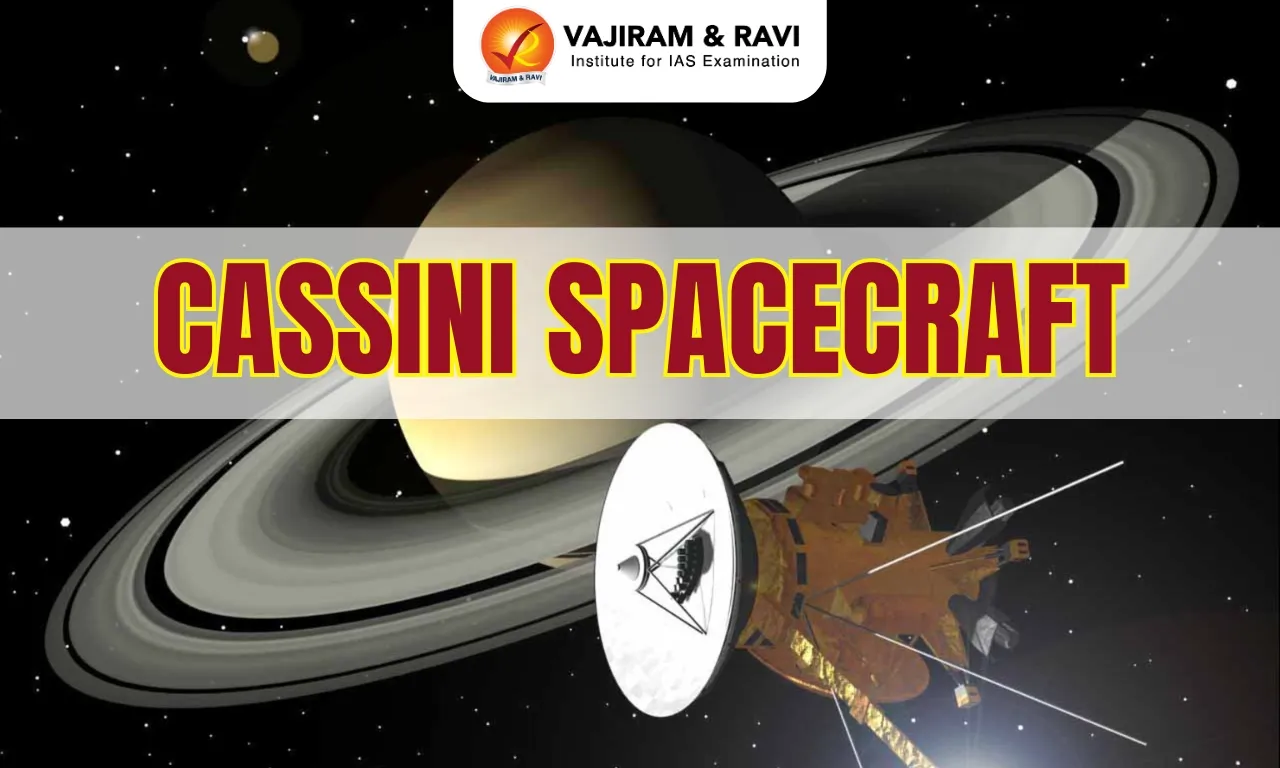
- Cassini was a sophisticated robotic spacecraft sent to study Saturn and its complex system of rings and moons in unprecedented detail.
- It was launched on October 15, 1997. It was one of the largest interplanetary spacecraft.
- The mission consisted of NASA’s Cassini orbiter, which was the first space probe to orbit Saturn, and the ESA’s Huygens probe, which landed on Titan, Saturn’s largest moon
Objectives of Cassini Spacecraft
- Saturn—Study cloud properties and atmospheric composition, winds and temperatures, internal structure and rotation, ionosphere, origin, and evolution
- Rings—Observe their structure and composition, dynamical processes, interrelation of rings and satellites, dust and micrometeoroid environment.
- Titan—Study abundances of atmospheric constituents, distribution of trace gases and aerosols, winds and temperatures, composition and state of the surface, and upper atmosphere
- Saturn’s Magnetosphere—Study its structure and electric currents; composition, sources, and sinks of particles within it; dynamics; interaction with the solar wind, satellites, and rings; Titan’s interaction with solar wind and magnetosphere
Components of Cassini Spacecraft
- The instruments on board Cassini included radar to map the cloud-covered surface of Titan and a magnetometer to study Saturn’s magnetic field.
- The disk-shaped Huygens probe was mounted on the side of Cassini and carried six instruments designed to study the atmosphere and surface of Titan.
Key Facts about Enceladus
- It is named after a giant in ancient Greek mythology,
- It is one of the innermost moons of the ringed gas giant Saturn.
- It has a diameter of 313 miles (504 km) and orbits Saturn at a distance of roughly 148,000 miles (238,000 km).
- Scientists believe Enceladus possesses the chemical ingredients needed for life and has hydrothermal vents releasing hot, mineral-rich water into its ocean, the same type of environment that may have spawned Earth’s first living organisms.
- Its ocean resides under a crust of ice about 12-19 miles (20-30 km) thick.
Source: DD News
Cassini Spacecraft FAQs
Q1: What was the primary mission of the Cassini spacecraft?
Ans: To study the geology and magnetic field of Saturn
Q2: What significant discovery was made by the Cassini spacecraft regarding Enceladus?
Ans: Geysers of water vapor and ice particles.
