
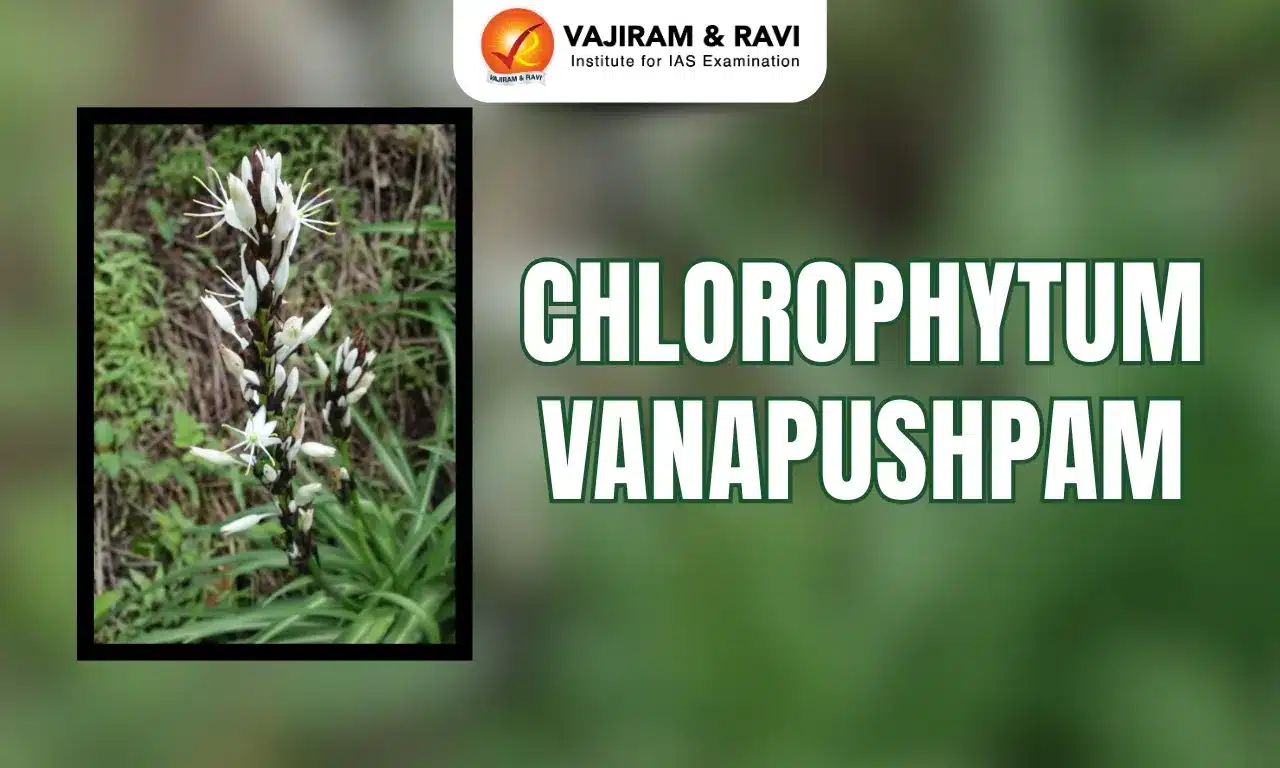
Chlorophytum Vanapushpam
Researchers during a field exploration in Idukki district’s Vagamon hills have identified a new species of the genus Chlorophytum and named the new species as Chlorophytum vanapushpam.
About Chlorophytum Vanapushpam
- It is a perennial herb belonging to the genus Chlorophytum (family Asparagaceae).
- It is a close relative of the safed musli.
- It has been found in the rocky hills of Vagamon and Neymakkad - parts of the Western Ghats regions of Idukki district - at elevations between 700 m and 2124 m.
- The species name vanapushpam is a composite of ‘Vanam’ and ‘Pushpam,’ the Malayalam for forest and flower respectively.
- Features of Chlorophytum vanapushpam:
- It has white flowers in small clusters and slender leaves and grows up to 90 cm in height.
- But unlike its more famous cousin Chlorophytum borivilianum, Chlorophytum vanapushpam lacks tubers.
- Its seeds are about 4 to 5 mm across. Flowering and fruiting occurs from September to December.
- The Western Ghats region is thought to be a centre of origin of the genus Chlorophytum.
- A total of 18 species have been identified here so far, with many of them exhibiting medicinal properties.
- One of these is the Chlorophytum borivilianum, more familiar to Indians as the ‘safed musli,’ a herb widely used in traditional medical preparations and also popular as a leaf vegetable.
Source: TH
Chlorophytum Vanapushpam FAQs
Q1: What are the primary uses of Safed Musli?
Ans: Safed Musli is used to enhance strength, stamina, and overall well-being
Q2: What is the meaning of perennial plant?
Ans: A plant that persists for several years, usually with new herbaceous growth from a part that survives from growing season to growing season.

